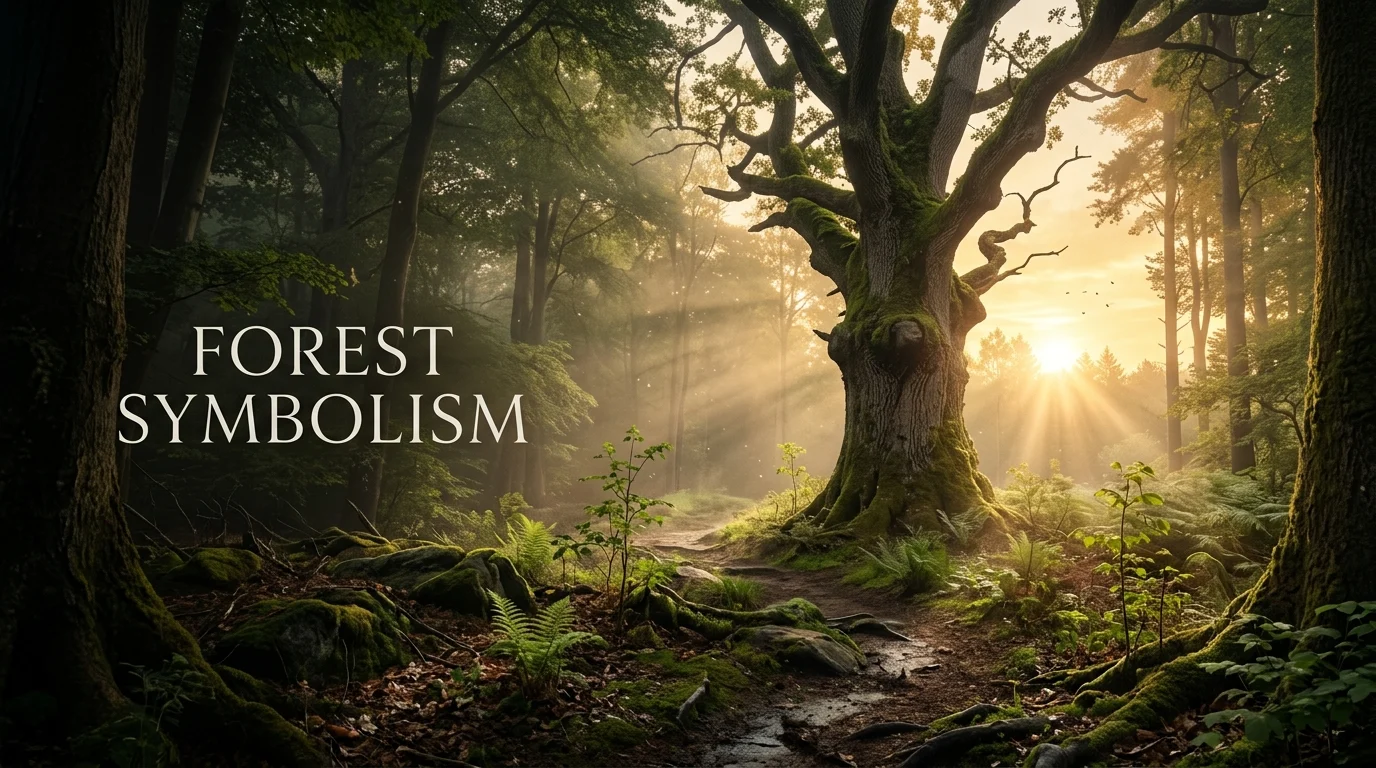
Forests have fascinated people for thousands of years. They can feel peaceful and protective, yet mysterious and unknown. Forest symbolism explores what forests represent in spiritual traditions, mythology, literature, dreams, art, and everyday life.
Across cultures, the forest is often connected with growth, mystery, transformation, protection, wisdom, renewal, solitude, and the journey into the unknown. Its meaning can change depending on whether the forest appears bright or dark, welcoming or frightening, familiar or unexplored.
Forest Symbolism Meaning (Clear Definition)
Forest symbolism is the use of forests as representations of deeper ideas such as growth, mystery, transformation, wisdom, protection, renewal, and the unknown.
A forest contains many layers. Trees rise toward the sky while their roots remain hidden underground. Paths disappear around corners, sunlight moves through branches, and seasons continually transform the landscape.
Because of this, forests naturally symbolize the complexity of life itself.
Common Forest Symbolism Meanings
| Symbolic Meaning | What the Forest Represents |
|---|---|
| Growth | Personal development and gradual progress |
| Mystery | Secrets, unanswered questions, and the unknown |
| Transformation | Change, healing, and entering a new stage of life |
| Wisdom | Ancient knowledge and lessons gained through experience |
| Protection | Shelter, safety, and a connection with nature |
| Renewal | Rebirth, regeneration, and new beginnings |
| Solitude | Self-reflection and time away from distractions |
| Journey | Life’s challenges, choices, and discoveries |
| Resilience | Strength through changing seasons and difficult conditions |
The forest can therefore represent both what we know and what remains hidden.
What Does Forest Symbolism Represent?
Forest symbolism can have many interpretations, but several themes appear repeatedly across cultures and creative traditions.
1. Growth and Personal Development
A forest is constantly growing. New trees emerge, old trees fall, and seedlings develop beneath the canopy.
This makes the forest a powerful symbol of personal growth. It reminds us that meaningful development often happens slowly and quietly.
2. Mystery and the Unknown
Dense forests hide what lies beyond the visible path. Historically, entering a forest could mean entering a place where familiar rules and landmarks disappeared.
For this reason, forests often represent mystery, uncertainty, hidden knowledge, and the unknown.
3. Transformation
Walking through a forest can symbolize entering one state of life and emerging from another.
This is particularly common in stories where a character enters the woods confused or vulnerable and leaves with greater knowledge, courage, or self-awareness.
4. Protection and Shelter
Forests can provide shade, food, materials, and shelter. Their dense vegetation can create a feeling of being surrounded and protected.
As a result, forests may symbolize security, sanctuary, refuge, and natural protection.
5. Wisdom and Ancient Knowledge
Some forests contain trees that have lived for centuries. Their age creates a strong association with memory and accumulated wisdom.
A forest can therefore symbolize knowledge that existed long before us and will continue after us.
6. Solitude and Self-Discovery
Being alone among trees creates an opportunity to slow down and listen to one’s thoughts.
Forest symbolism can consequently represent introspection, solitude, meditation, and self-discovery.
Spiritual Meaning of Forest Symbolism
Spiritually, the forest often represents a journey inward.
Its trees can symbolize the connection between earth and sky, with roots reaching downward and branches reaching upward. This creates a natural image of balance between the physical and spiritual worlds.
A forest may symbolize:
- Spiritual growth
- Inner wisdom
- Connection with nature
- Healing and renewal
- Protection from negative influences
- Introspection
- The search for meaning
- Spiritual transformation
- Connection between earthly and heavenly realms
A peaceful forest can represent harmony and spiritual restoration, while a dark forest may symbolize uncertainty, hidden fears, or a period of inner transformation.
The important point is that darkness does not always mean something negative. In symbolic traditions, darkness can represent the unknown stage that comes before understanding.
Biblical / Religious Meaning of Forest Symbolism
Forests and wooded landscapes appear throughout biblical and religious imagery, although the symbolism varies according to the specific passage or tradition.
In the Bible, trees, forests, wilderness, gardens, and mountains frequently provide settings for important spiritual events and metaphors. Trees can represent life, prosperity, righteousness, knowledge, or judgment depending on context.
The broader religious symbolism of a forest can therefore include:
- Creation: the richness and diversity of God’s natural world.
- Life: trees and vegetation represent growth and vitality.
- Wilderness: secluded natural places can become settings for testing, reflection, and spiritual encounters.
- Shelter: wooded landscapes can evoke refuge and protection.
- Renewal: seasonal growth can symbolize restoration and new life.
It is important not to assign one universal biblical meaning to every forest image. In religious interpretation, context matters.
Forest Symbolism in History and Culture
Forests have held powerful meanings throughout human history.
For ancient communities, forests were not simply beautiful landscapes. They were sources of food, medicine, fuel, timber, and shelter. At the same time, their vastness and unpredictability made them places of mystery.
Many traditional cultures associated forests with sacred spaces, spirits, ancestors, or supernatural beings. Sacred groves in different parts of the world were protected because communities regarded particular natural areas as spiritually significant.
European folklore also frequently placed magical beings, heroes, witches, and mysterious creatures in forests. The woods became a symbolic boundary between ordinary human society and the supernatural world.
In Japanese cultural traditions, forests have also been associated with sacred natural spaces and spiritual presence. More broadly, many cultures have developed traditions that treat old trees and natural landscapes with reverence.
These traditions reveal a recurring idea: the forest represents a world larger than the individual human being.
Forest Symbolism in Literature and Art
Few natural settings have been used as extensively in literature as the forest.
Writers often use forests to create an atmosphere of mystery or to place characters outside the safety of ordinary society.
In fairy tales, the forest may be a dangerous place where characters encounter challenges and discover their courage. In adventure stories, it can represent exploration. In psychological stories, it may reflect a character’s hidden fears or inner world.
Common Literary Meanings of Forests
- The unknown: characters cannot see what lies ahead.
- Transformation: entering the forest begins a life-changing experience.
- Temptation: the forest may contain something attractive but dangerous.
- Escape: characters leave society to find freedom or safety.
- Self-discovery: isolation forces characters to confront themselves.
- Danger: darkness and unfamiliar paths create suspense.
- Renewal: emerging from the forest can symbolize a fresh beginning.
Artists similarly use forests to contrast light and darkness, civilization and nature, order and mystery.
A sunlit forest may create feelings of hope and peace, while a shadowy forest can communicate uncertainty, fear, or hidden possibilities.
Dream Meaning of Forest Symbolism
Dreaming about a forest can have several possible interpretations. The meaning depends heavily on the dream’s emotional atmosphere and personal circumstances.
Walking Through a Forest
Walking through a forest may symbolize a personal journey, especially when you are facing decisions or changes in waking life.
A Dark or Frightening Forest
A dark forest may represent uncertainty, anxiety, hidden fears, or a situation you do not fully understand.
A Beautiful Green Forest
A lush, peaceful forest can symbolize growth, healing, abundance, hope, and emotional renewal.
Getting Lost in a Forest
Being lost may reflect confusion or uncertainty about a decision, relationship, career direction, or personal goal.
Finding a Path Through the Forest
Discovering a path can symbolize clarity, guidance, or finding a way forward after a difficult period.
A Forest Fire
A forest fire may symbolize intense change, destruction, emotional release, or the ending of one stage before another begins. Its meaning depends on whether the dream felt frightening, cleansing, or transformative.
Dream symbolism is personal rather than universal. The strongest clue is often how you felt during the dream.
Modern Meaning of Forest Symbolism
Today, forests have taken on additional symbolic meanings connected with environmental awareness, mental restoration, sustainability, and our relationship with nature.
In modern life, the forest can represent an escape from constant digital stimulation and busy urban environments.
Spending time among trees is often associated with calmness, reflection, and reconnecting with the natural world. This has strengthened the forest’s symbolism as a place of restoration and mental renewal.
Forests also symbolize environmental responsibility. Deforestation, conservation, biodiversity, and climate concerns have transformed the forest into a powerful symbol of the planet’s health.
In modern storytelling and visual culture, forests continue to represent:
- Freedom from routine
- Environmental protection
- Healing
- Adventure
- Mindfulness
- Resilience
- Simplicity
- Reconnection with nature
- Personal transformation
- Hope for future generations
The forest is no longer viewed only as an unknown wilderness. It can also represent something humanity has a responsibility to protect.
Forest Symbolism and Different Types of Forests
The type of forest can influence its symbolic meaning.
Ancient forest: Wisdom, history, endurance, ancestral memory, and timelessness.
Tropical rainforest: Abundance, biodiversity, mystery, vitality, and the richness of life.
Pine forest: Endurance, longevity, resilience, and strength through difficult conditions.
Autumn forest: Change, maturity, acceptance, beauty in impermanence, and letting go.
Winter forest: Stillness, solitude, patience, dormancy, and inner reflection.
Spring forest: Renewal, hope, rebirth, growth, and fresh opportunities.
This seasonal symbolism makes forests especially powerful representations of the cycles of life.
Why Is the Forest Such a Powerful Symbol?
The forest combines several experiences that humans naturally find meaningful.
It contains both visible and hidden worlds. It can provide safety while also creating uncertainty. It can feel peaceful yet powerful, familiar yet mysterious.
Most importantly, a forest is never completely still. Trees grow, leaves fall, animals move, streams flow, and seasons change.
That makes the forest a natural metaphor for life:
We enter uncertain paths, experience change, learn along the way, and eventually discover something about ourselves.
Frequently Asked Questions About Forest Symbolism
What is the main meaning of forest symbolism?
The main meanings of forest symbolism include growth, mystery, transformation, wisdom, protection, renewal, and the unknown. Its exact meaning depends on the cultural, spiritual, literary, or personal context.
What does a forest symbolize spiritually?
Spiritually, a forest can symbolize inner growth, connection with nature, healing, wisdom, solitude, and transformation. It may represent a journey toward deeper self-understanding.
What does a forest symbolize in dreams?
A forest in a dream can represent a personal journey, uncertainty, hidden emotions, growth, or self-discovery. A peaceful forest may suggest renewal, while being lost in a dark forest may reflect confusion or fear.
What does a dark forest symbolize?
A dark forest commonly represents the unknown, hidden fears, uncertainty, mystery, or a difficult period of transformation. It can also symbolize the opportunity to discover something previously hidden.
What does a green forest symbolize?
A green forest often symbolizes life, growth, healing, abundance, renewal, hope, and vitality. Its lush appearance can suggest emotional or spiritual flourishing.
Conclusion
Forest symbolism captures one of life’s most enduring truths: growth often happens in places we cannot fully see.
A forest can symbolize mystery when the path disappears, wisdom through its ancient trees, protection beneath its canopy, and transformation as we move from one season to another. if encountered in dreams, religion, literature, art, or real life, the forest invites us to slow down, explore the unknown, and trust that every journey can reveal something meaningful.

I am Simon Michael, an author passionate about exploring symbols, their meanings, and cultural significance. I enjoy making symbolism simple, engaging, and meaningful for curious readers everywhere.