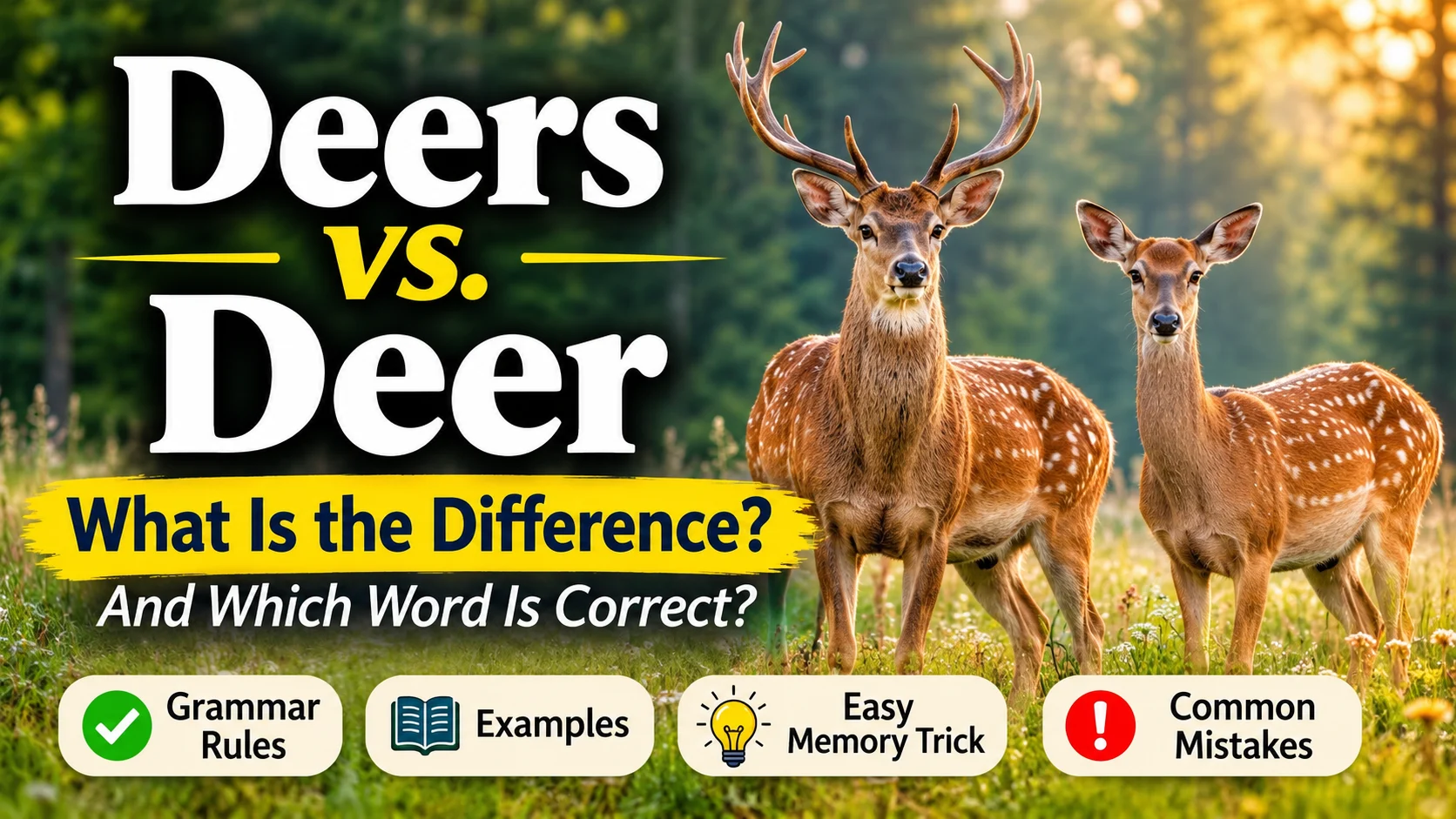
If you have ever wondered if to write deers or deer, you are not alone. These two forms look similar, but only one is generally correct when talking about more than one animal. The correct plural of deer is deer, not deers. For example, you should say, “I saw three deer in the forest,” rather than “I saw three deers in the forest.”
The confusion happens because most English nouns form their plurals by adding -s or -es. Words such as dogs, horses, and birds follow this familiar pattern. However, deer is an irregular noun that keeps the same spelling in both singular and plural forms. Understanding this simple grammar rule will help you use deer correctly in everyday conversations, school assignments, and professional writing.
Quick Answer: Deers vs. Deer
Deer is the correct singular and plural form of the noun. You can use it when talking about one animal or several animals. Deers is generally incorrect in standard English when referring to multiple animals. For example, “one deer” and “five deer” are both grammatically correct.
Why Do People Confuse Deers and Deer?
People often confuse deers vs. deer because English has a common pluralization rule: add -s or -es to a singular noun.
For example:
- One cat → Two cats
- One dog → Three dogs
- One horse → Four horses
- One bird → Five birds
Following this pattern, someone might naturally assume that the plural of deer should be deers.
However, English contains several irregular nouns that do not change their spelling when they become plural. Deer belongs to this group.
Another reason for the confusion is that learners sometimes encounter unusual uses of deers in specialized contexts. However, for ordinary writing and conversation, deer is the standard plural form.
What Does Deer Mean?
Deer is a noun that refers to a hoofed mammal belonging to the family Cervidae. Deer are commonly found in forests, grasslands, mountains, and other natural environments.
They are generally recognized by their long legs, slender bodies, and, in many species, antlers.
The word deer can describe one animal or multiple animals.
Deer as a Singular Noun
When referring to one animal, use deer with singular verbs and appropriate singular expressions.
Examples:
- A deer is standing near the trees.
- I saw one deer beside the road.
- The deer looks healthy.
- A deer was eating grass in the field.
- That deer has beautiful antlers.
In these examples, deer refers to one animal.
Deer as a Plural Noun
When referring to two or more animals, the spelling remains exactly the same.
Examples:
- Three deer are crossing the road.
- I saw several deer in the forest.
- The deer were eating leaves.
- Many deer live in this area.
- Five deer gathered near the river.
Notice that the noun does not change, even though the number of animals increases.
What Does Deers Mean?
Deers is a nonstandard plural form that people sometimes create by adding -s to deer.
In everyday American English, it is generally considered incorrect when referring to multiple individual deer.
For example:
- Incorrect: I saw four deers in the forest.
- Correct: I saw four deer in the forest.
There are limited specialized or historical contexts in which deers may appear, particularly when distinguishing different kinds or species of deer. However, this usage is uncommon and unnecessary for ordinary communication.
For students, ESL learners, and general readers, the safest rule is simple: use deer for both singular and plural.
Deers vs. Deer: Key Differences
The main difference between these two forms is grammatical correctness and standard usage.
| Feature | Deer | Deers |
|---|---|---|
| Word type | Noun | Nonstandard plural form in ordinary usage |
| Singular use | Correct | Incorrect |
| Plural use | Correct | Generally incorrect |
| Standard spelling | Yes | No, for ordinary plural use |
| American English | Standard | Nonstandard |
| Example | Two deer are running. | Two deers are running. |
| Best choice | Always for ordinary use | Avoid in everyday writing |
The important point is that deer is an irregular noun with an unchanged plural form.
Is Deer Singular or Plural?
One of the most interesting things about the word deer is that it can be either singular or plural.
Its meaning depends on the surrounding sentence.
When Deer Is Singular
Use singular verbs such as is, was, and has when referring to one deer.
Examples:
- The deer is sleeping.
- A deer was standing outside.
- This deer has a white tail.
When Deer Is Plural
Use plural verbs such as are, were, and have when referring to multiple deer.
Examples:
- The deer are running.
- Several deer were near the lake.
- These deer have large antlers.
The noun stays unchanged, but the verb helps readers understand if you mean one animal or several.
Grammatical Forms of Deer
Understanding the grammatical forms of deer makes it easier to use the word correctly.
| Grammatical Form | Correct Usage | Example |
|---|---|---|
| Singular | Deer | A deer is eating. |
| Plural | Deer | Four deer are eating. |
| Indefinite article | A deer | I saw a deer. |
| Demonstrative singular | This deer | This deer is young. |
| Demonstrative plural | These deer | These deer are young. |
| Possessive singular | Deer’s | The deer’s legs are strong. |
| Possessive plural | Deers’ | The deers’ habitats were studied. |
The last example is grammatically possible when deers is deliberately used as a specialized plural, but it is rarely needed. In normal writing, use deer’s for the possessive of both singular and plural deer, with the meaning determined by context.
For example:
- The deer’s habitat is protected. (One deer)
- The deer’s habitats are protected. (Multiple deer)
When Should You Use Deer?
Use deer whenever you refer to one or more animals.
Here are some common situations.
1. Talking About One Animal
Use deer with a singular article or expression.
Example: A deer is drinking water from the stream.
2. Talking About Multiple Animals
Keep the spelling unchanged when describing a group.
Example: Six deer are grazing in the meadow.
3. Describing Wildlife
Use deer when discussing animals in nature, forests, or wildlife habitats.
Example: Deer are common in many parts of North America.
4. Writing Scientific or Educational Content
Use deer when discussing the animal family, behavior, diet, or habitat.
Example: Deer are herbivores that feed on plants.
When Should You Use Deers?
For everyday American English, you should generally avoid deers.
Use deer instead when describing multiple animals.
Although deers occasionally appears in specialized discussions about different species or varieties, it is not the normal plural form expected in schoolwork, general writing, or conversation.
For example:
- Avoid: The park has many deers.
- Write: The park has many deer.
15 Practical Examples of Deer vs. Deers
The following examples demonstrate how to use the correct form in everyday English.
| Incorrect or Correct | Sentence |
|---|---|
| Correct | I saw two deer near my house. |
| Incorrect | We watched three deers eating grass. |
| Correct | A deer crossed the highway. |
| Correct | Several deer live in this forest. |
| Incorrect | There are many deers in the park. |
| Correct | The deer is standing under a tree. |
| Correct | Those deer are moving toward the river. |
| Incorrect | Five deers were hiding behind the bushes. |
| Correct | A young deer followed its mother. |
| Correct | The deer were resting in the shade. |
| Correct | We spotted a deer during our hike. |
| Correct | Many deer come out at sunrise. |
| Incorrect | Two deers ran across the field. |
| Correct | The deer have found fresh grass. |
| Correct | One deer was drinking from the pond. |
These examples show why using deer consistently is the easiest way to avoid grammatical mistakes.
Common Mistakes When Using Deer and Deers
Even experienced English speakers sometimes make mistakes with irregular plurals.
Here are some common errors and their corrections.
Mistake 1: Adding -S to Deer
Incorrect: There are four deers in the garden.
Correct: There are four deer in the garden.
Explanation: Deer already has an unchanged plural form.
Mistake 2: Using a Singular Verb With Multiple Deer
Incorrect: The deer is running across the field. (When referring to several animals.)
Correct: The deer are running across the field.
Explanation: Use a plural verb when the noun refers to multiple animals.
Mistake 3: Using a Plural Verb for One Deer
Incorrect: A deer are standing near the road.
Correct: A deer is standing near the road.
Explanation: The article a indicates one animal, so the verb must be singular.
Mistake 4: Assuming All Animal Plurals Follow the Same Rule
Incorrect: The plural of deer must be deers because the plural of dog is dogs.
Correct: The plural of deer is deer.
Explanation: English includes regular and irregular plural nouns.
Mistake 5: Confusing Deer With Other Wildlife Words
Incorrect: I saw three mooses and four deers.
Correct: I saw three moose and four deer.
Explanation: Both moose and deer have unchanged standard plural forms.
Easy Memory Trick: How to Remember Deer vs. Deers
Here is a simple trick to remember the correct spelling:
One deer, two deer, ten deer. The word never changes!
Think of deer as a special noun that does not need an additional -s to become plural.
Remember these examples:
- 1 deer
- 2 deer
- 5 deer
- 10 deer
- 100 deer
If you remember this simple pattern, you will rarely make a mistake with the word.
American vs. British English: Is There a Difference?
There is no meaningful difference between American and British English when it comes to the standard plural form of deer.
Both varieties use deer for one animal and multiple animals.
Examples:
- American English: We saw three deer in the park.
- British English: We saw three deer in the park.
Although vocabulary, pronunciation, and some spelling conventions differ between American and British English, this plural rule remains the same.
Similar and Related Words
Learning other irregular nouns can help you understand why deer does not follow the usual pluralization pattern.
Here are some related examples:
| Singular | Plural | Example |
|---|---|---|
| Deer | Deer | Two deer are grazing. |
| Sheep | Sheep | Five sheep are eating. |
| Moose | Moose | Three moose crossed the road. |
| Fish | Fish | Several fish are swimming. |
| Species | Species | Different species live here. |
| Aircraft | Aircraft | Two aircraft landed. |
| Child | Children | Three children are playing. |
| Mouse | Mice | Two mice entered the house. |
| Goose | Geese | Several geese are swimming. |
| Ox | Oxen | The oxen pulled the cart. |
These examples demonstrate that English nouns follow different pluralization patterns.
Frequently Asked Questions About Deers vs. Deer
1. Is Deers a Correct English Word?
Deers is generally considered incorrect when used as the ordinary plural of deer. The correct plural is deer. Although specialized contexts occasionally use deers to distinguish types or species, everyday English requires the unchanged form.
2. What Is the Plural of Deer?
The plural of deer is deer. You do not add -s or -es to the word. For example, one deer, two deer, and ten deer are all grammatically correct expressions.
3. Can I Say Two Deers?
No, not in standard everyday English. The correct expression is two deer. The word remains unchanged if you are describing one animal or several animals.
4. Is Deer Both Singular and Plural?
Yes. Deer is an unchanged noun that can be singular or plural. You can say, “The deer is sleeping” for one animal and “The deer are sleeping” for multiple animals.
5. Why Does Deer Not Become Deers?
Deer is an irregular noun with an unchanged plural form. Unlike regular nouns that add -s or -es, this word keeps the same spelling when referring to multiple animals.
6. What Is the Difference Between Deer and Deer’s?
Deer is the noun used for one or multiple animals. Deer’s is the possessive form, showing ownership or association. For example, “The deer’s legs are strong” describes the legs belonging to a deer.
7. Is Deer Singular or Plural in American English?
In American English, deer can be both singular and plural. Its meaning depends on the sentence, number expressions, and verb agreement. The word itself never changes in ordinary usage.
Remember This: Deers vs. Deer
Keep these simple rules in mind:
- Deer is the correct singular form.
- Deer is also the correct plural form.
- Deers is generally incorrect in everyday English.
- Use is and was for one deer.
- Use are and were for multiple deer.
- Never add -s when forming the ordinary plural of deer.
Conclusion
When comparing deers vs. deer, the correct choice for everyday English is deer. It is an irregular noun that uses the same spelling for both singular and plural meanings. if you are talking about one animal in your backyard or a large group in a forest, the word remains unchanged. Remember to use singular or plural verbs according to the number of animals you are describing.
Understanding this simple grammar rule can improve your English writing, speaking, and vocabulary. Instead of saying three deers, say three deer. Once you remember the pattern, you can confidently use the word in conversations, academic assignments, and everyday communication without making this common pluralization mistake.

I am Luna Grace, an author passionate about exploring the meanings, history, and symbolism behind everyday signs. I enjoy sharing thoughtful insights that help readers understand symbols and their deeper significance.


