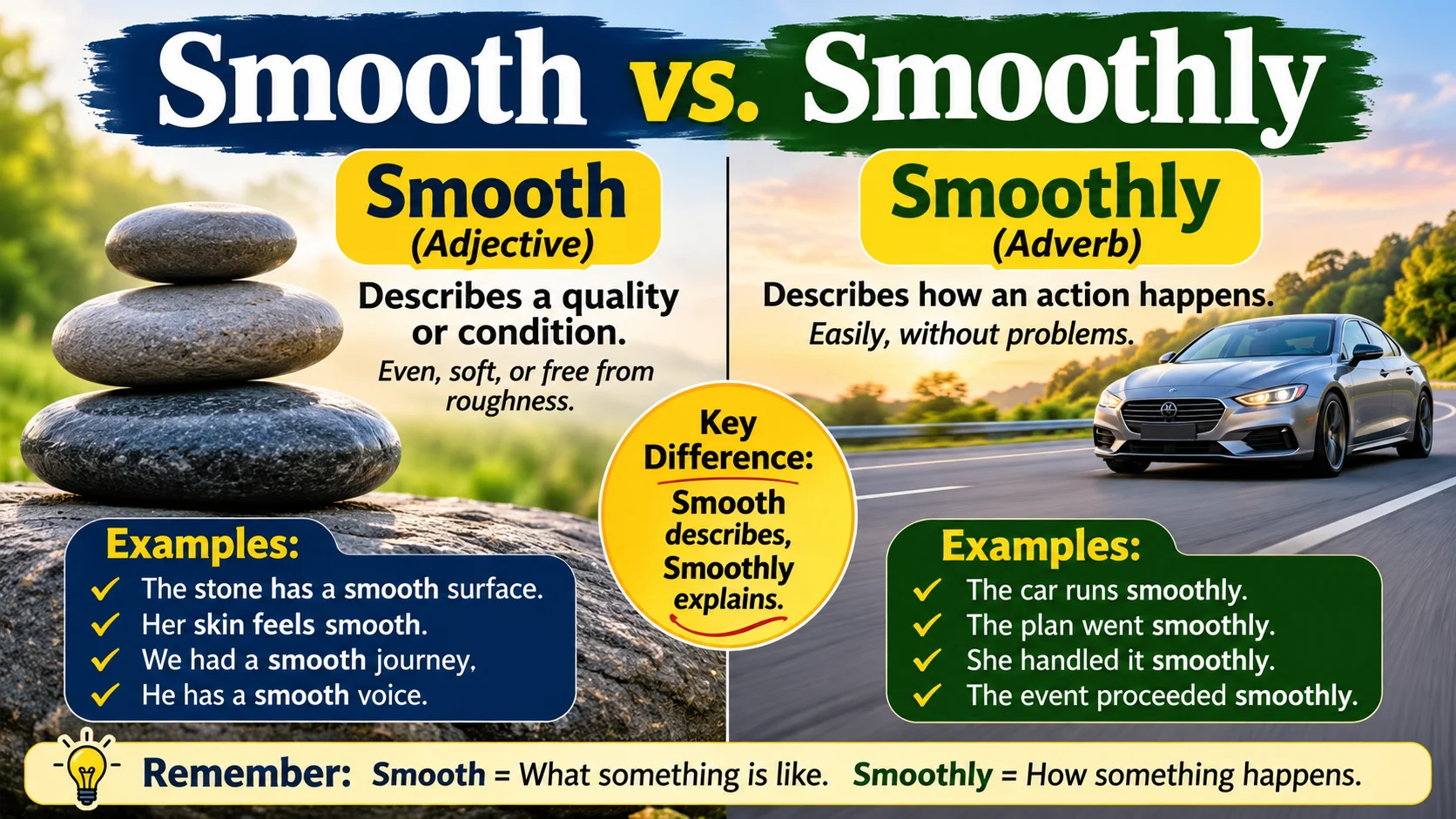
Understanding the difference between smooth vs. smoothly can make your English clearer and more natural. Although these two words look and sound similar, they serve different grammatical purposes. The main difference is that smooth is usually an adjective that describes a person, object, surface, or action, while smoothly is an adverb that explains how something happens or how someone performs an action.
Both words are common in American English and appear in everyday conversations, academic writing, professional communication, and descriptions. Knowing when to use each one will help you avoid grammar mistakes and express your ideas more accurately. if you are an English learner, student, or native speaker looking to improve your writing, understanding their meanings and sentence patterns is useful.
Quick Answer: Smooth vs. Smoothly
Smooth is an adjective that describes something even, soft, polished, effortless, or free from problems. Smoothly is an adverb that describes how an action happens, meaning easily, effortlessly, or without interruption. For example, say “The surface is smooth” but “The machine runs smoothly.”
What Does Smooth Mean?
Smooth is an adjective that describes something without roughness, bumps, interruptions, or difficulties. It can refer to physical surfaces, sounds, movements, experiences, and situations.
In everyday English, smooth can also describe something that happens easily or feels comfortable.
For example:
- The wooden table has a smooth surface.
- Her skin feels smooth and soft.
- We had a smooth journey home.
- He has a smooth speaking voice.
- The meeting was smooth and productive.
In these sentences, smooth describes a noun or provides information about a subject.
Smooth as an Adjective
The most common grammatical use of smooth is as an adjective.
An adjective describes a noun or pronoun by explaining its qualities or characteristics.
Examples:
- This fabric feels smooth.
- She has smooth hair.
- The road is smooth.
- He gave a smooth performance.
- The conversation was surprisingly smooth.
In each example, smooth describes a quality or condition.
Different Meanings of Smooth
The word smooth has several meanings depending on the context.
- Even or flat: A surface without bumps or rough areas.
- Soft or pleasant: Something that feels comfortable to touch.
- Easy or effortless: An activity or experience without difficulties.
- Calm or controlled: A person who behaves confidently and naturally.
- Pleasant or gentle: A sound, voice, or movement without harshness.
What Does Smoothly Mean?
Smoothly is an adverb that describes how an action happens. It means easily, efficiently, continuously, or without unexpected problems.
It is commonly used with action verbs to explain the manner in which something is performed.
For example:
- The project went smoothly.
- The car runs smoothly.
- She handled the situation smoothly.
- Everything worked smoothly during the event.
- The presentation proceeded smoothly.
In these sentences, smoothly explains how an action or process happens.
Smoothly as an Adverb
An adverb modifies a verb, adjective, or another adverb. Smoothly is specifically a manner adverb that explains how someone does something or how something occurs.
Examples:
- The engine runs smoothly.
- He moved smoothly across the stage.
- The conversation flowed smoothly.
- The team worked smoothly together.
- The software installed smoothly.
Here, smoothly provides additional information about the actions or processes.
Different Meanings of Smoothly
Depending on the sentence, smoothly can communicate several related ideas:
- Without difficulty: Something happens without problems.
- Without interruption: An activity continues naturally.
- Effortlessly: Someone performs an action with little visible effort.
- Evenly: A movement or process happens in a consistent way.
- Efficiently: Something works successfully without unnecessary delays.
Smooth vs. Smoothly: Key Differences
The most important difference between smooth and smoothly is their part of speech and grammatical function.
| Feature | Smooth | Smoothly |
|---|---|---|
| Part of speech | Adjective | Adverb |
| Main purpose | Describes a quality | Describes how an action happens |
| Meaning | Even, soft, easy, or free from problems | Easily, evenly, or without problems |
| Common use | Before nouns or after linking verbs | With action verbs |
| Word ending | No -ly ending | Ends in -ly |
| Example | The road is smooth. | The car drives smoothly. |
Why Do People Confuse Smooth and Smoothly?
People often confuse these words because they share the same basic meaning and spelling pattern.
Both can communicate the idea of something happening without difficulty or roughness. However, their grammatical functions are different.
For example:
- Correct: The presentation was smooth.
- Correct: The presentation went smoothly.
The first sentence describes the presentation. The second explains how it went.
Another reason for confusion is that English speakers sometimes use adjectives after linking verbs such as feel, look, seem, and be. These words describe the subject rather than an action.
When to Use Smooth
Use smooth when you want to describe a noun, person, object, surface, experience, or condition.
It is especially useful when talking about physical qualities or describing something as easy and comfortable.
1. When Describing Physical Surfaces
Use smooth to describe something without roughness or bumps.
Examples:
- The stone has a smooth surface.
- This glass feels smooth.
- The baby’s skin is smooth.
- The polished floor looks smooth.
2. When Describing Experiences
Smooth can describe an experience that is easy or free from difficulties.
Examples:
- We had a smooth flight.
- The hiring process was smooth.
- Their wedding ceremony was smooth and organized.
- The transition to the new system was smooth.
3. When Describing Sounds and Movements
Smooth can also describe pleasant sounds, gentle movements, or controlled performances.
Examples:
- She has a smooth singing voice.
- The dancer made a smooth movement.
- His writing has a smooth style.
- The athlete delivered a smooth performance.
When to Use Smoothly
Use smoothly when you want to explain how an action happens or how someone performs an activity.
It usually modifies an action verb.
1. When Describing Actions
Use smoothly to explain that someone performs an action easily or naturally.
Examples:
- She smoothly opened the conversation.
- He smoothly completed the task.
- The dancer moved smoothly across the floor.
- The speaker transitioned smoothly between topics.
2. When Describing Processes
Smoothly is useful when explaining how a process or system operates.
Examples:
- The software runs smoothly.
- The machine operates smoothly.
- The event went smoothly.
- The business transition happened smoothly.
3. When Describing Communication
Use smoothly when talking about conversations, presentations, or communication that happens naturally.
Examples:
- The discussion flowed smoothly.
- She spoke smoothly during the interview.
- The meeting progressed smoothly.
- He smoothly explained the complicated idea.
Smooth vs. Smoothly: 15 Practical Example Sentences
The following examples show how these words work in everyday American English.
5 Examples Using Smooth
- The road is smooth and comfortable to drive on.
- She bought a beautiful dress made from smooth silk.
- His voice is deep, calm, and smooth.
- We enjoyed a smooth journey through the countryside.
- The new employee made a smooth transition into the team.
5 Examples Using Smoothly
- The car engine runs smoothly after the repair.
- The presentation went smoothly from beginning to end.
- She handled the difficult conversation smoothly.
- The computer operates smoothly without freezing.
- The dancers moved smoothly across the stage.
5 Additional Examples Comparing Both Words
- The table has a smooth surface, so the papers slide smoothly across it.
- Her smooth voice makes the song sound beautiful, and she sings smoothly.
- The road is smooth, allowing vehicles to travel smoothly.
- We had a smooth flight, and the plane landed smoothly.
- The company introduced a smooth process that allows employees to work more smoothly.
Common Mistakes When Using Smooth and Smoothly
Even experienced English speakers sometimes confuse adjectives and adverbs. Here are some common mistakes and their corrections.
| Incorrect Sentence | Correct Sentence | Explanation |
|---|---|---|
| The car runs smooth. | The car runs smoothly. | An adverb modifies the verb runs. |
| She sings smoothly voice. | She has a smooth singing voice. | Smooth describes the noun voice. |
| The machine works smooth. | The machine works smoothly. | Smoothly describes how it works. |
| He has a smoothly face. | He has a smooth face. | An adjective describes face. |
| The meeting went smooth. | The meeting went smoothly. | Smoothly describes how the meeting went. |
| This fabric feels smoothly. | This fabric feels smooth. | Feel is a linking verb here. |
Mistake 1: Using Smooth Instead of Smoothly
Incorrect: The car drives smooth.
Correct: The car drives smoothly.
Why? Drives is an action verb in this sentence. Smoothly explains how the car drives.
Mistake 2: Using Smoothly Instead of Smooth
Incorrect: Her skin feels smoothly.
Correct: Her skin feels smooth.
Why? Feel acts as a linking verb here. Smooth describes the condition of the skin.
Mistake 3: Adding -ly to Every Description
Incorrect: He has a smoothly personality.
Correct: He has a smooth personality.
Why? Personality is a noun, so it needs an adjective.
An Easy Memory Trick to Remember Smooth vs. Smoothly
A simple way to remember the difference is to focus on what the word describes.
- Smooth = What something is like.
- Smoothly = How something happens.
Think of these two questions:
- What is the road like? It is smooth.
- How does the car drive? It drives smoothly.
Another helpful trick is to remember that many adverbs of manner end in -ly. Smoothly follows this common pattern.
Whenever you are unsure, ask yourself if you are describing a thing or explaining an action.
If you are describing a thing, smooth is usually the right choice. If you are explaining how an action happens, smoothly is usually correct.
American vs. British English: Is There a Difference?
There is no meaningful difference between smooth and smoothly in American and British English.
Both varieties use smooth as an adjective and smoothly as an adverb. Their meanings, spelling, and grammatical functions remain the same.
For example:
- American English: The system is running smoothly.
- British English: The system is running smoothly.
Both sentences are grammatically correct.
The distinction is grammatical rather than regional.
Similar and Related Words
Understanding related vocabulary can help you use smooth and smoothly more confidently.
Words Similar to Smooth
These adjectives describe qualities similar to smooth:
- Even: Having a flat or consistent surface.
- Soft: Pleasant to touch.
- Polished: Made smooth and shiny.
- Gentle: Calm or mild in nature.
- Sleek: Smooth, attractive, and streamlined.
- Effortless: Requiring little effort.
Words Similar to Smoothly
These adverbs describe actions that happen easily or naturally:
- Easily: Without difficulty.
- Effortlessly: Without requiring much effort.
- Seamlessly: Without noticeable interruptions.
- Naturally: In a normal or comfortable way.
- Efficiently: With little wasted time or effort.
- Consistently: In a steady and reliable manner.
Remember that these words are related but are not always interchangeable. Choose the word that best communicates your intended meaning.
Frequently Asked Questions (FAQs)
1. Is smooth an adjective or an adverb?
Smooth is primarily an adjective. It describes nouns and pronouns by explaining their qualities, conditions, or characteristics. For example, in “The surface is smooth,” the word smooth describes the surface.
2. Is smoothly an adjective or an adverb?
Smoothly is an adverb. It explains how an action happens or how someone performs an activity. For example, in “She speaks smoothly,” the word smoothly describes how she speaks.
3. Can I use smooth and smoothly in the same sentence?
Yes, you can use both words in one sentence because they have different grammatical functions. For example, “The smooth road allowed the car to travel smoothly.” Smooth describes the road, while smoothly explains how the car travels.
4. Is it correct to say “everything went smooth”?
In standard written English, “Everything went smoothly” is the preferred grammatical form. Smoothly modifies the verb went and explains how things happened. Although you may hear “went smooth” in casual speech, smoothly is the better choice in formal writing.
5. Why does smooth become smoothly?
Smooth becomes smoothly when the suffix “-ly” is added to form an adverb. This changes its grammatical function from describing a noun to explaining how an action happens. The spelling changes by adding -ly directly to smooth.
6. Is “feel smooth” or “feel smoothly” correct?
“Feel smooth” is correct when feel acts as a linking verb describing someone’s physical condition or a surface. For example, “The fabric feels smooth.” In this sentence, smooth describes the fabric rather than the action of feeling.
7. What is the opposite of smooth and smoothly?
The opposite of smooth can be rough, uneven, or bumpy, depending on the context. The opposite of smoothly can be awkwardly, unevenly, or with difficulty. For example, “The machine runs roughly” contrasts with “The machine runs smoothly.”
8. Is smoothly always formed by adding -ly to smooth?
Yes. Smoothly is formed by adding the suffix -ly to the adjective smooth. This creates an adverb that describes the manner in which an action or process takes place.
Remember This: Smooth vs. Smoothly
Keep these simple points in mind:
- Smooth is an adjective.
- Smoothly is an adverb.
- Smooth describes what something is like.
- Smoothly explains how something happens.
- Use smooth after linking verbs when describing a subject.
- Use smoothly to modify action verbs.
- Both words have the same spelling and grammatical rules in American and British English.
Conclusion
Understanding smooth vs. smoothly is easier when you remember their grammatical roles. Smooth is an adjective used to describe surfaces, objects, voices, experiences, and other qualities. Smoothly is an adverb used to explain how actions and processes happen. Although both words share a similar meaning, they cannot always replace each other in a sentence.
The best way to master these words is through regular reading, writing, and practice. Remember to use smooth when describing what something is like and smoothly when explaining how something happens. With this simple distinction, you can avoid common grammar mistakes and communicate more naturally and confidently in everyday American English.

I am Simon Michael, an author passionate about exploring symbols, their meanings, and cultural significance. I enjoy making symbolism simple, engaging, and meaningful for curious readers everywhere.


