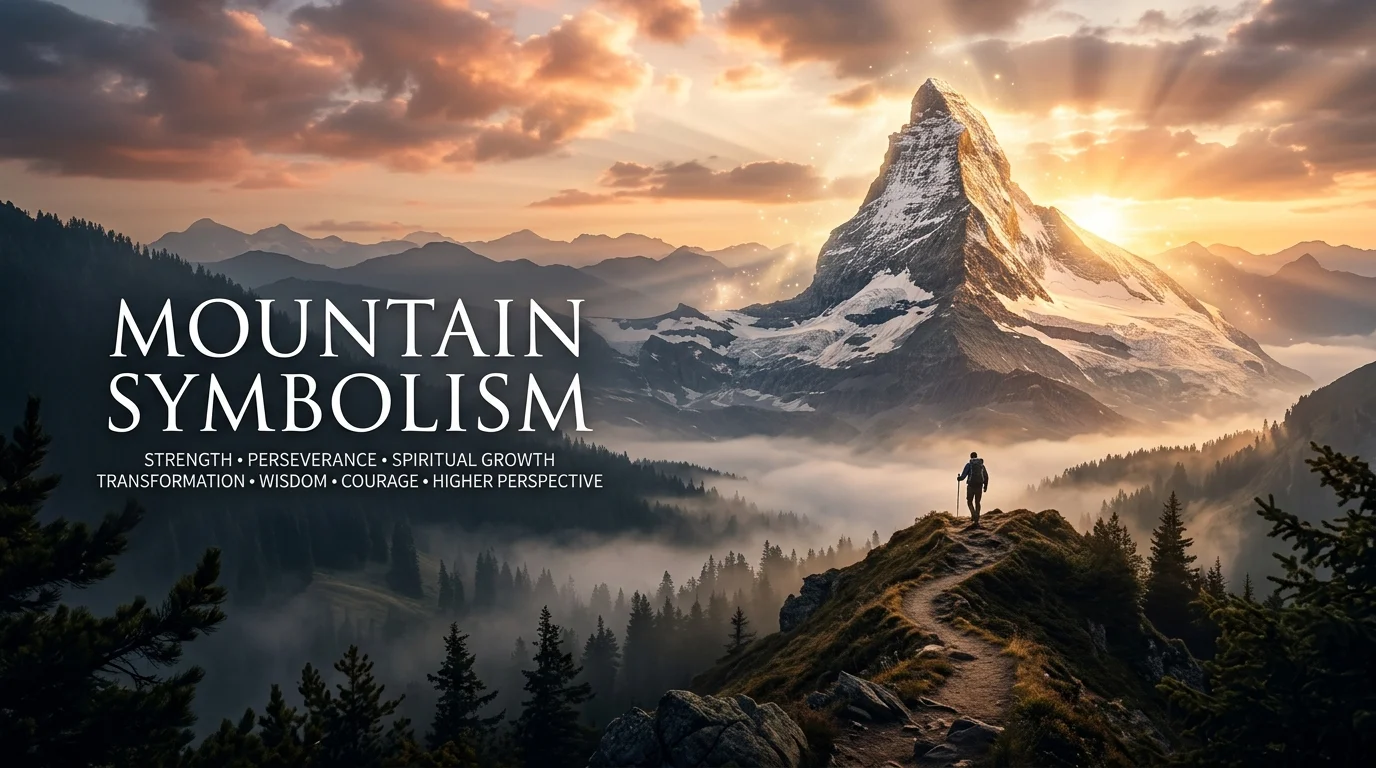
Mountains have always inspired awe because they rise above ordinary landscapes, challenge those who climb them, and offer a wider view from the summit. Mountain symbolism often represents strength, perseverance, spiritual growth, ambition, stability, and overcoming obstacles.
Across religions, mythology, literature, dreams, and modern life, mountains can symbolize both the difficulties we face and the higher perspective we gain by confronting them. Their meaning may change depending on the setting, culture, and personal experience.
Mountain Symbolism Meaning (Clear Definition)
Mountain symbolism represents strength, stability, endurance, ambition, spiritual elevation, challenges, transformation, and the journey toward achieving a higher goal.
A mountain can be both an obstacle and an inspiration. Its steep slopes may represent hardship, while its summit can symbolize achievement, enlightenment, freedom, or a new perspective.
Some of the most common mountain symbolic meanings include:
| Symbolic Meaning | What It Represents |
|---|---|
| Strength | Inner power and resilience |
| Stability | Grounding, security, and permanence |
| Perseverance | Continuing despite difficulties |
| Achievement | Reaching an important goal |
| Spiritual Growth | Moving toward wisdom or enlightenment |
| Transformation | Becoming stronger through challenges |
| Perspective | Seeing life from a broader viewpoint |
The meaning of a mountain is rarely limited to physical strength. It can also describe an inner journey—one that requires patience, courage, and determination.
What Does Mountain Symbolism Represent?
Mountain symbolism can represent many aspects of human experience. The most important interpretations include:
1. Strength and Resilience
Mountains withstand powerful winds, storms, snow, and changing seasons. Because of this, they often represent emotional strength and resilience.
A mountain can remind us that difficult circumstances do not necessarily destroy us. Like a mountain standing through countless seasons, we can learn to remain steady.
2. Challenges and Obstacles
A mountain can symbolize a difficult challenge standing between you and your desired destination.
The phrase “climbing a mountain” naturally evokes the idea of working through something demanding. The higher the mountain, the greater the perceived challenge.
3. Ambition and Achievement
Reaching a mountain summit can represent accomplishing a major goal.
Whether the goal involves education, career, relationships, personal development, or another life ambition, the summit can symbolize the moment when persistent effort finally produces results.
4. Stability and Grounding
Because mountains are deeply rooted in the earth, they can symbolize stability, security, grounding, and permanence.
Mountain imagery is sometimes used to express the desire to remain calm and centered when everything around us is changing.
5. Spiritual Elevation
Mountains rise toward the sky, making them natural symbols of spiritual aspiration and higher consciousness.
Climbing upward can represent moving beyond ordinary concerns and seeking wisdom, truth, purpose, or a deeper connection with the sacred.
6. Perspective and Wisdom
A person standing at a summit can see much farther than someone standing in a valley.
For this reason, mountains often symbolize gaining perspective. A difficult experience may look overwhelming while we are inside it, but distance and reflection can reveal a larger picture.
7. Transformation
The journey toward a summit can change the person making the climb.
Mountain symbolism therefore connects strongly with personal transformation. The destination matters, but the lessons learned along the way may matter even more.
Spiritual Meaning of Mountain Symbolism
Spiritually, mountains are often associated with higher consciousness, divine encounters, inner strength, wisdom, and spiritual transformation.
Their vertical shape creates a powerful symbolic connection between earth and sky. The journey upward can represent the soul moving toward greater awareness.
A mountain may spiritually represent:
- A journey toward enlightenment
- Connection between earth and heaven
- Inner strength and faith
- Solitude and reflection
- Spiritual awakening
- Divine presence
- Wisdom gained through hardship
- A higher perspective on life
The summit can represent a state of clarity. After struggling upward, the traveler reaches a place where the surrounding landscape becomes easier to understand.
This makes the mountain a powerful metaphor for spiritual growth: the path may be difficult, but the difficulty itself can become part of the transformation.
Biblical / Religious Meaning of Mountain Symbolism
Mountains have significant symbolic importance in several religious traditions, particularly in the Bible.
In biblical narratives, mountains are frequently associated with divine revelation, worship, covenant, prayer, transformation, and encounters with God.
For example, Mount Sinai is associated with Moses receiving the commandments. Mountains also appear in important events connected with prophets, Jesus, prayer, and revelation.
In Christianity, mountain imagery can therefore suggest:
- Divine revelation
- Faith
- Prayer and communion with God
- Sacred encounters
- Spiritual testing
- Transformation
- A closer relationship with the divine
One famous biblical image is the idea of faith being able to move a mountain. Here, the mountain can be understood symbolically as an enormous obstacle that appears impossible to overcome.
Mountains also hold important sacred meanings in other religious traditions. In Hindu traditions, Mount Meru is described as a cosmic mountain and a central axis of the universe. In Buddhism, mountains can symbolize spiritual stability, contemplation, and the journey toward awakening.
Across traditions, the recurring idea is powerful: ascending a mountain can represent moving toward something sacred, profound, or transcendent.
Mountain Symbolism in History and Culture
Mountains have shaped human imagination for thousands of years.
Ancient civilizations often treated prominent mountains as sacred places because they appeared to connect the human world with the heavens.


In Greek mythology, Mount Olympus was regarded as the home of the gods. In Japan, Mount Fuji became deeply connected with spirituality, artistic expression, pilgrimage, and cultural identity.
In many cultures, mountains have served as:
- Sacred spaces
- Places of pilgrimage
- Symbols of divine power
- Natural boundaries
- Sources of water and life
- Images of national identity
- Places for solitude and contemplation
Mountains can also represent permanence because human lifetimes are short compared with geological time. A mountain that has existed for thousands or millions of years can create a sense of continuity and endurance.
Mountain Symbolism in Literature and Art
Writers and artists have long used mountains as metaphors for human struggles and aspirations.
In literature, a mountain may represent an obstacle that a character must overcome. The climb can mirror an emotional, moral, intellectual, or spiritual journey.
A summit might symbolize:
- Success
- Self-discovery
- Freedom
- Enlightenment
- Victory
- Isolation
- A new perspective
In visual art, mountains often create dramatic contrasts between humans and nature. A tiny figure standing beneath a massive peak can emphasize the power of nature while also suggesting human courage.
Romantic landscape painters especially used mountains to inspire feelings of awe, mystery, sublimity, and spiritual wonder.
Mountain imagery continues to appear in photography, films, poetry, architecture, tattoos, logos, and contemporary visual culture because its basic symbolism is immediately understandable.
Dream Meaning of Mountain Symbolism
Dreams about mountains can have different meanings depending on the dreamer’s emotions and circumstances.
Dreaming of Climbing a Mountain
Climbing may symbolize ambition, perseverance, personal growth, or working toward a difficult goal.
If the climb feels rewarding, it may reflect confidence in your ability to overcome challenges.
Dreaming of Reaching a Mountain Summit
Reaching the summit can symbolize accomplishment, clarity, confidence, or the completion of an important personal journey.
Dreaming of a Huge or Steep Mountain
A massive mountain may represent an obstacle that currently feels overwhelming.
The dream does not necessarily predict failure. Instead, it may reflect how significant a challenge feels in waking life.
Dreaming of Coming Down a Mountain
Descending may symbolize completing a difficult phase, returning to everyday life, or gaining perspective after an intense experience.
Dreaming of a Beautiful Mountain Landscape
A peaceful mountain scene may represent inner calm, freedom, spiritual reflection, or a desire to escape everyday pressure.
Dream interpretation is highly personal, so the emotions you experienced during the dream are often more meaningful than the mountain itself.
Modern Meaning of Mountain Symbolism
Today, mountain symbolism remains closely connected with personal growth, resilience, adventure, ambition, and mental strength.
Mountains are especially common in modern motivational imagery because climbing provides an easy metaphor for achieving difficult goals.
The message is simple:
You do not have to conquer the entire mountain at once. You only have to keep moving upward.
Mountain imagery is frequently used to represent:
- Personal development
- Career ambition
- Fitness and endurance
- Adventure
- Independence
- Overcoming adversity
- Long-term goals
- Confidence
- Freedom
- Self-discovery
For some people, a mountain represents an actual adventure. For others, it represents something invisible: rebuilding confidence, pursuing a dream, overcoming fear, or becoming a stronger version of themselves.
Mountain Symbolism in Everyday Life
You do not need to live near mountains to connect with their symbolism.
When facing a difficult situation, thinking of the challenge as a mountain can change how you approach it. Instead of seeing the entire journey as impossible, you can focus on the next step.
This perspective can encourage:
Patience: Meaningful achievements rarely happen instantly.
Courage: Difficult paths require action despite uncertainty.
Persistence: Progress often happens gradually.
Perspective: Sometimes stepping back helps you understand the larger situation.
Self-trust: Every difficult climb teaches you something about your own capabilities.
The mountain becomes less about the destination and more about the person you become while climbing.
FAQs About Mountain Symbolism
What is the main meaning of mountain symbolism?
Mountain symbolism commonly represents strength, stability, perseverance, achievement, spiritual growth, and overcoming challenges.
What does a mountain symbolize spiritually?
Spiritually, a mountain can represent divine connection, enlightenment, inner strength, wisdom, prayer, and the journey toward a higher state of awareness.
What does climbing a mountain symbolize?
Climbing a mountain often symbolizes perseverance, ambition, personal growth, and overcoming obstacles to reach an important goal.
What does a mountain symbolize in dreams?
A mountain in a dream may represent a challenge, ambition, personal transformation, or a goal. Its meaning depends strongly on the dreamer’s emotions and the events surrounding the mountain.
Why are mountains considered symbols of strength?
Mountains appear permanent and powerful despite changing weather and seasons. Their endurance makes them natural symbols of resilience, stability, and lasting strength.
Conclusion
Mountain symbolism captures one of life’s most enduring ideas: meaningful growth often requires a difficult climb. Mountains can represent obstacles, ambition, strength, spiritual elevation, transformation, and the wisdom that comes from gaining a higher perspective.
Whether viewed through religion, culture, dreams, art, or everyday life, the mountain reminds us that the hardest journeys can lead to the most powerful discoveries.
Sometimes the mountain is not standing in your way it is showing you how high you can rise.

I am Luna Grace, an author passionate about exploring the meanings, history, and symbolism behind everyday signs. I enjoy sharing thoughtful insights that help readers understand symbols and their deeper significance.