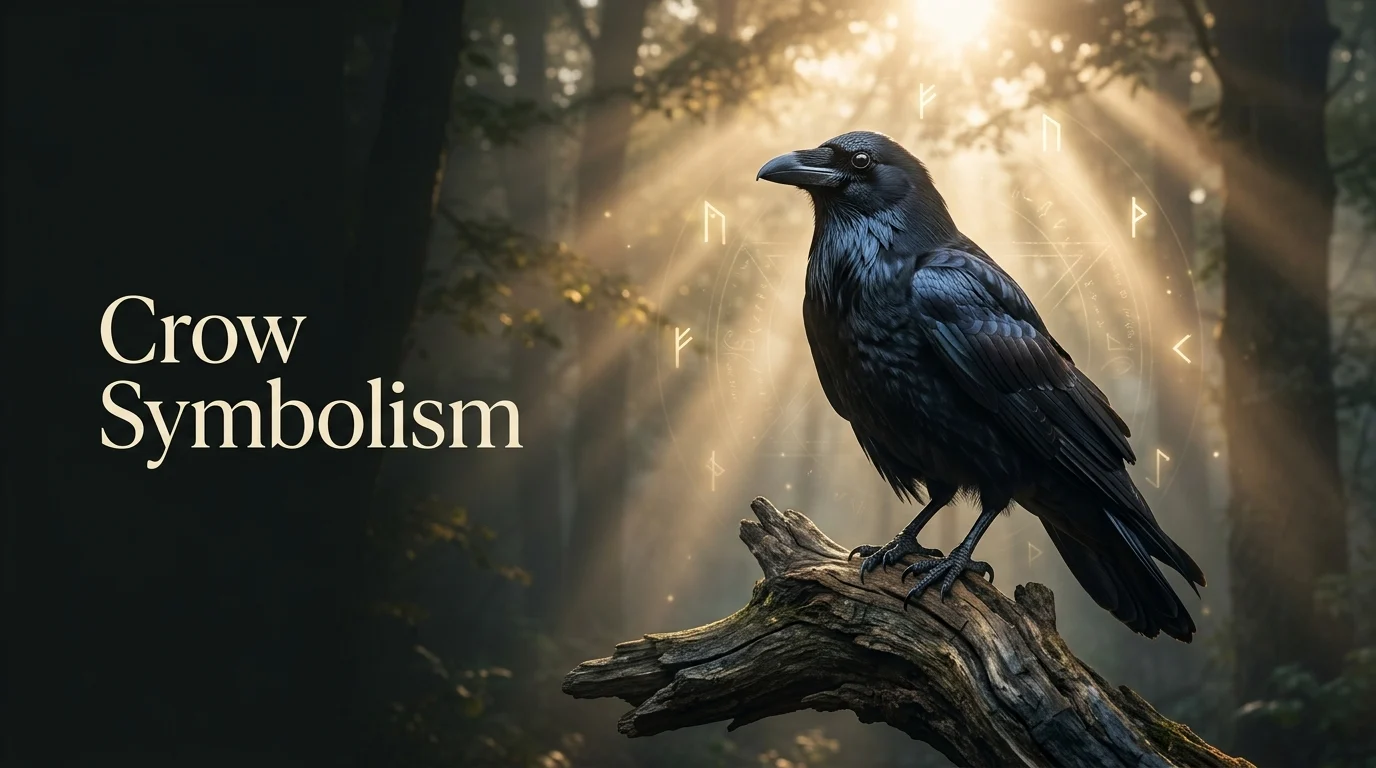
Crow symbolism has fascinated people for centuries because crows are intelligent, adaptable, observant, and deeply connected with myths and folklore. Depending on the culture or situation, a crow can symbolize wisdom, transformation, mystery, death, protection, intelligence, or spiritual awareness.
Seeing a crow does not have one universal meaning. Its symbolism often depends on context, personal beliefs, cultural traditions, and the behavior of the bird itself. Understanding these different interpretations can reveal why the crow remains such a powerful symbol in stories, dreams, religion, and modern culture.
Crow Symbolism Meaning (Clear Definition)
The simplest definition of crow symbolism is the use of the crow as a representation of deeper ideas such as intelligence, change, mystery, spiritual messages, and transformation.
Crows are often associated with the unknown because of their dark feathers, distinctive calls, and presence in many ancient legends. At the same time, their remarkable problem-solving abilities have made them symbols of wisdom and intelligence.
In symbolic traditions, a crow may represent:
- Intelligence and cleverness
- Wisdom and observation
- Transformation and change
- Mystery and the unknown
- Death and rebirth
- Protection and spiritual guidance
- Adaptability and survival
- Hidden knowledge
The meaning can be positive, negative, or somewhere in between.
What Does Crow Symbolism Represent?
Crow symbolism represents several powerful themes that appear repeatedly across cultures.
| Symbolic Meaning | What It Can Represent |
|---|---|
| Intelligence | Clever thinking, problem-solving, and awareness |
| Transformation | Personal growth, change, or a new beginning |
| Mystery | The unknown, hidden truths, or unanswered questions |
| Death | Endings, transition, and the closing of one chapter |
| Rebirth | Renewal and transformation after change |
| Wisdom | Observation, experience, and learning |
| Protection | Awareness of danger and watchfulness |
| Adaptability | Surviving challenges and adjusting to circumstances |
One of the most important ideas behind crow symbolism is seeing beyond the obvious. Crows are observant creatures, and their symbolic meaning often encourages people to pay attention to details they might otherwise overlook.
Crow Symbolism and Intelligence
Crows are known for impressive cognitive abilities, including problem-solving and using tools. This real-world intelligence has contributed to their symbolic association with cleverness, strategy, and wisdom.
Crow Symbolism and Transformation
A crow may symbolize a transition from one stage of life to another. In this interpretation, the bird is not necessarily a prediction of something negative but a reminder that change can create the possibility of growth.
Crow Symbolism and Mystery
Because crows frequently appear in folklore involving magic, spirits, and hidden knowledge, they are often connected with mystery. Their presence can symbolize curiosity about things that are not immediately understood.
Spiritual Meaning of Crow Symbolism
The spiritual meaning of crow symbolism often centers on awareness, transformation, intuition, and messages from the unseen.
In spiritual traditions, encountering a crow may be interpreted as an invitation to become more observant. It can encourage you to examine your surroundings, thoughts, and choices before moving forward.
Some spiritual interpretations include:
- A reminder to trust your intuition
- A sign of personal transformation
- Encouragement to face uncertainty
- Awareness of hidden opportunities
- A reminder to learn from past experiences
- Protection during a period of change
A crow appearing repeatedly may feel especially meaningful to someone who already views animals as spiritual symbols. However, there is no scientifically established universal spiritual message associated with seeing a crow.
The most useful interpretation is often personal: consider what was happening in your life when the encounter occurred and what the crow’s behavior made you notice.
Biblical / Religious Meaning of Crow Symbolism
Crows and ravens have a complicated but important place in biblical tradition. In many English Bible translations, references are more commonly made to ravens than to crows, and the two birds are sometimes confused in popular symbolism.
In the Hebrew Bible, a raven is notably mentioned in the story of Noah. After the flood, Noah sends a raven out from the ark to determine whether the waters have receded.
Ravens also appear in the story of the prophet Elijah. According to the biblical account, ravens provide him with food during a period of isolation.
These stories can contribute to symbolic associations with provision, survival, wilderness, and divine care.
Christian interpretations vary considerably. A dark bird should not automatically be interpreted as a symbol of evil. Biblical symbolism depends on the specific passage and its context rather than simply on the bird’s color.
Crow Symbolism in History and Culture
Crow symbolism has developed differently across civilizations.
In Norse mythology, ravens are strongly associated with Odin, who is accompanied by Huginn and Muninn. They are commonly interpreted as representing thought and memory, reinforcing the bird’s connection with knowledge and observation.
In some Native American traditions, crow symbolism varies significantly between nations and cultures. In certain traditions, the crow can be associated with transformation, intelligence, trickery, or spiritual power. It is important not to treat all Indigenous traditions as having one universal interpretation.
In parts of Celtic mythology, the crow and raven are connected with warfare, prophecy, sovereignty, and powerful supernatural figures.
Across European folklore, dark birds were sometimes associated with battlefields, death, or omens. These associations helped establish the crow’s mysterious reputation in later literature and popular culture.
Yet the crow has never represented only darkness. Its intelligence and adaptability have also made it a symbol of survival and resourcefulness.
Crow Symbolism in Literature and Art
Crows and ravens have played memorable roles in literature, poetry, painting, mythology, and visual storytelling.
One of the best-known examples is Edgar Allan Poe’s “The Raven,” where the bird becomes a haunting symbol connected with grief, memory, mystery, and psychological suffering.
Artists often use crows visually because their dark silhouettes create an immediate atmosphere of mystery. A single crow against a pale sky can suggest loneliness, while a group of crows can create feelings of movement, tension, or anticipation.
In modern storytelling, crows can represent:
- Secrets
- Intelligence
- Foreboding
- Freedom
- Loneliness
- Rebellion
- Transformation
- Connection with nature
Their symbolism remains flexible, which is one reason they continue to appear in fantasy, horror, poetry, and contemporary art.
Dream Meaning of Crow Symbolism
Dreams about crows can have many interpretations, and there is no scientifically proven universal meaning for a particular dream symbol.
A crow in a dream may reflect your personal feelings about change, uncertainty, intelligence, loss, freedom, or something mysterious.
Possible interpretations include:
- Seeing a crow: You may be paying closer attention to something you previously ignored.
- A crow flying: This may symbolize freedom, transition, or a desire for a new direction.
- A crow watching you: It may reflect feelings of being observed or a need to become more aware.
- A group of crows: This could represent community, social relationships, or overwhelming thoughts.
- A crow attacking: It may symbolize conflict, fear, or an issue you are trying to confront.
- A friendly crow: It could represent curiosity, intelligence, trust, or an unexpected connection.
The emotions in the dream are especially important. A crow that feels frightening can carry a very different personal meaning from one that feels peaceful or protective.
Modern Meaning of Crow Symbolism
Today, crow symbolism has moved beyond ancient mythology and religious traditions.
Crows are increasingly admired for their intelligence, adaptability, memory, and ability to thrive in changing environments. As a result, the modern crow can symbolize resourcefulness and resilience just as much as mystery or death.
For some people, a crow represents the ability to adapt when circumstances change. For others, it represents independence, observation, or the courage to explore the unknown.
In tattoos, artwork, jewelry, and personal symbolism, a crow may communicate ideas such as:
- Strength through change
- Independent thinking
- Intelligence
- Mystery
- Spiritual curiosity
- Resilience
- Personal transformation
The modern interpretation is often less about predicting events and more about expressing an individual’s identity or philosophy.
Why Are Crows Associated With Death?
Crows became associated with death partly because they are scavengers and have historically been seen around battlefields and places where animals or people have died.
Their dark appearance and nighttime associations in folklore strengthened this connection. However, symbolic death does not always mean literal death. It can represent endings, transition, transformation, or the beginning of a new phase.
What Does It Mean When You See a Crow?
Seeing a crow can have a simple natural explanation: crows are intelligent, widespread birds that live successfully in many environments.
Symbolically, however, some people interpret a crow encounter as a reminder to stay alert, think carefully, embrace change, or pay attention to something important in their lives.
The most meaningful interpretation depends on your circumstances and personal beliefs.
Is Crow Symbolism Positive or Negative?
Crow symbolism can be either positive or negative depending on the cultural context.
Negative interpretations may connect crows with death, fear, bad omens, or mystery. Positive interpretations associate them with intelligence, wisdom, adaptability, protection, transformation, and survival.
There is no single interpretation that applies to every crow encounter.
Frequently Asked Questions About Crow Symbolism
What is the main meaning of crow symbolism?
Crow symbolism commonly represents intelligence, transformation, mystery, wisdom, adaptability, and awareness. In some traditions, it is also associated with death and spiritual transition.
What does a crow symbolize spiritually?
Spiritually, a crow may symbolize intuition, transformation, hidden knowledge, and increased awareness. The interpretation depends strongly on the individual’s spiritual tradition and personal experience.
Is seeing a crow a good omen?
A crow is not universally considered either a good or bad omen. Some cultures view crows positively as symbols of wisdom and protection, while others associate them with death or warnings.
What does a crow symbolize in dreams?
A crow in a dream may represent change, uncertainty, intelligence, grief, freedom, or something that requires greater attention. The dreamer’s emotions and circumstances are important when interpreting it.
Why are crows associated with wisdom?
Crows are highly intelligent birds capable of complex problem-solving and adaptable behavior. Their real-world intelligence has helped establish their symbolic connection with wisdom, cleverness, and observation.
Conclusion
Crow symbolism is powerful because it contains both light and shadow. The crow can represent intelligence, mystery, transformation, wisdom, survival, and spiritual awareness, while its connection with death often points symbolically toward endings and renewal rather than literal events.
Whether encountered in mythology, literature, dreams, or everyday life, the crow invites us to look more carefully, adapt to change, and remain curious about what lies beyond the obvious.

I am Simon Michael, an author passionate about exploring symbols, their meanings, and cultural significance. I enjoy making symbolism simple, engaging, and meaningful for curious readers everywhere.