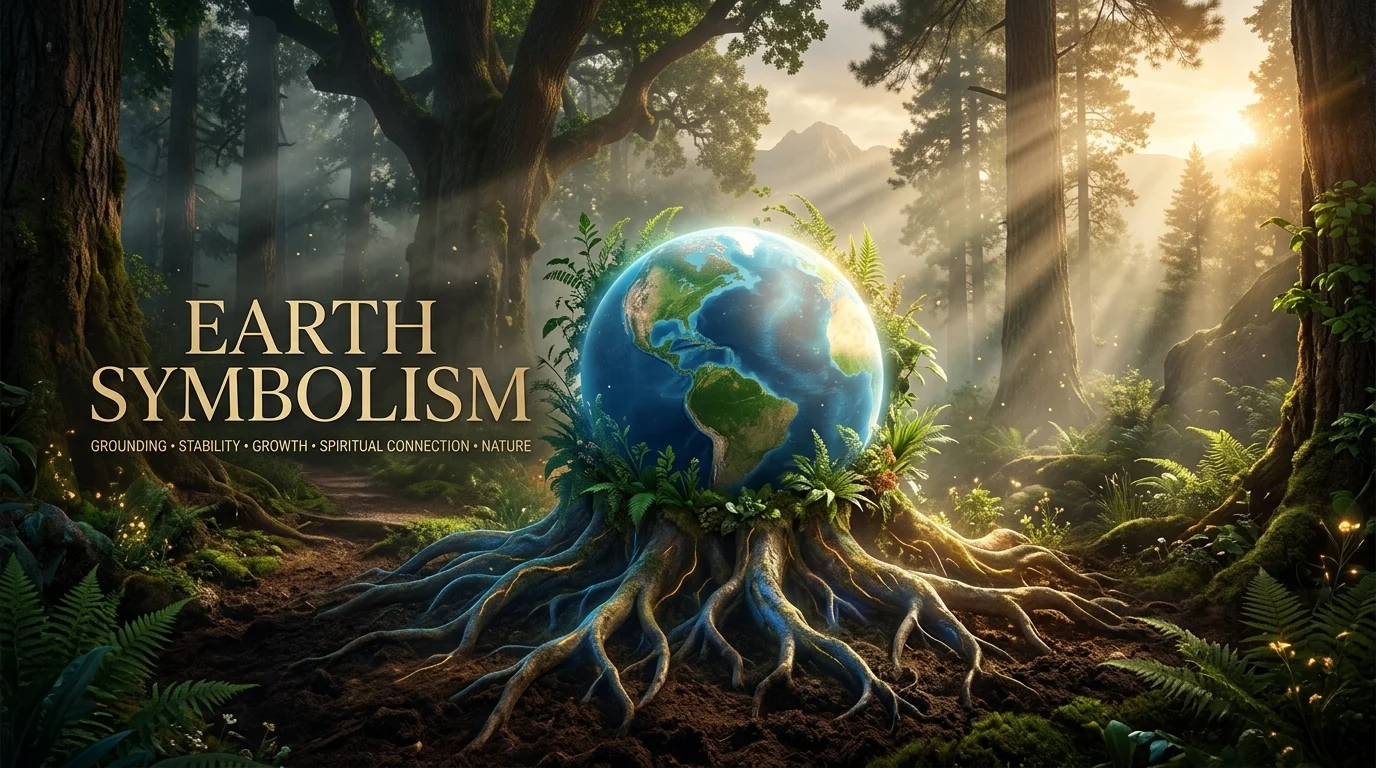
Earth symbolism is deeply connected with grounding, stability, life, fertility, strength, nourishment, and renewal. Across cultures and centuries, the earth has represented the foundation of existence the place where life begins, grows, changes, and eventually returns.
When people think about the earth symbolically, they often see more than soil, mountains, forests, and landscapes. Earth can represent our roots, our physical body, our connection to nature, and the steady foundation we need to grow.
From spiritual traditions to dreams, mythology, literature, and modern life, earth symbolism offers a powerful reminder to stay grounded while continuing to grow.
Earth Symbolism Meaning (Clear Definition)
The simplest definition of earth symbolism is the use of the earth to represent qualities such as grounding, stability, fertility, nourishment, endurance, protection, and connection to life.
Earth is solid and dependable. Unlike constantly changing elements such as fire, wind, and water, it provides a foundation on which life can develop.
Common symbolic meanings of earth include:
| Earth Symbolism | Meaning |
|---|---|
| Grounding | Staying centered and connected to reality |
| Stability | Security, balance, and a strong foundation |
| Fertility | Creation, abundance, growth, and new beginnings |
| Nourishment | Sustenance, care, and support |
| Strength | Endurance, resilience, and inner power |
| Roots | Family, heritage, identity, and belonging |
| Renewal | Transformation, cycles, death, and rebirth |
| Nature | Connection with the physical world and living things |
The meaning can change depending on the context. A fertile field may symbolize abundance, while a mountain may represent strength and endurance.
What Does Earth Symbolism Represent?
Earth symbolism can represent many aspects of human life because nearly everything physical is connected to the earth.
1. Grounding and Stability
Earth is often viewed as the ultimate symbol of grounding. To be “grounded” means to remain emotionally steady, realistic, and connected to what truly matters.
This symbolism can be especially meaningful during uncertain periods when someone needs stability and reassurance.
2. Growth and Fertility
Seeds disappear into the soil before becoming plants. Because of this natural process, earth represents growth, fertility, potential, and new beginnings.
The soil becomes a metaphor for the hidden stages of personal development. Something may appear dormant while important changes are happening beneath the surface.
3. Strength and Endurance
Mountains, rocks, and ancient landscapes have survived for generations. They therefore symbolize strength, patience, endurance, and resilience.
Earth reminds us that lasting strength does not always need to be dramatic. Sometimes it is simply the ability to remain steady through change.
4. Roots and Belonging
Roots anchor plants to the ground while connecting them to their source of nourishment. Symbolically, they can represent family, ancestry, heritage, identity, and belonging.
This is why images of roots often appear when people explore questions about where they came from and what shaped them.
5. Nourishment and Protection
The earth provides food, shelter, minerals, and resources. Symbolically, it can therefore represent care, protection, motherhood, abundance, and support.
Earth imagery can create a feeling of being held by something larger and more enduring than oneself.
Spiritual Meaning of Earth Symbolism
Spiritually, earth often represents grounding, physical existence, balance, patience, manifestation, and connection with nature.
Many spiritual systems view the natural world as a source of wisdom. Earth teaches through its cycles: seeds are planted, plants grow, leaves fall, and new life emerges again.
The spiritual meaning of earth can include:
- Grounding: Returning attention to the present moment.
- Balance: Creating harmony between physical and spiritual life.
- Patience: Understanding that meaningful growth takes time.
- Manifestation: Turning ideas, intentions, or dreams into something tangible.
- Connection: Recognizing humanity’s relationship with nature.
- Renewal: Accepting natural cycles of endings and beginnings.
- Inner strength: Developing stability during difficult circumstances.
In spiritual symbolism, earth can also encourage people to slow down. While modern life often emphasizes speed and constant change, the earth operates according to slower and more natural rhythms.
Biblical / Religious Meaning of Earth Symbolism
In biblical and religious traditions, earth frequently carries meanings related to creation, human existence, humility, mortality, fertility, stewardship, and the relationship between humanity and the Creator.
In the Bible, the earth is presented as part of God’s creation. Humanity’s connection to the ground is also emphasized through the biblical account of creation and the imagery of humans being formed from dust.
This gives earth an important symbolic tension: it can represent both the gift of physical life and the humility of human mortality.
The idea of returning to dust can remind people that earthly life is temporary. At the same time, fertile land, gardens, fields, and harvests can symbolize blessing, abundance, provision, and renewal.
Other religious and spiritual traditions also give the earth sacred significance. In many cultures, Earth is personified as a mother figure who gives life and nourishment.
The exact meaning differs among traditions, so earth symbolism should always be interpreted within its specific religious and cultural context.
Earth Symbolism in History and Culture
Earth has been central to human culture since the beginning of civilization. Early societies depended directly on soil, rainfall, seasons, crops, animals, and landscapes for survival.
Because of this dependence, earth became associated with life, fertility, motherhood, abundance, and divine power.
Ancient cultures often personified the earth as a goddess or mother. In Greek mythology, Gaia represents the primordial Earth, while Roman tradition associated the earth with Terra.
Agricultural societies also developed rituals around planting and harvesting. The earth was not simply viewed as physical material; it was part of a sacred cycle connecting humans, nature, food, birth, death, and renewal.
Earth symbolism also appears in traditional ceremonies, architecture, pottery, burial customs, agriculture, and seasonal celebrations.
Across these traditions, one theme repeatedly appears: the earth is both a source of life and a reminder of humanity’s place within nature.
Earth Symbolism in Literature and Art
Writers and artists have long used earth imagery to communicate ideas that go beyond the physical landscape.
A mountain may symbolize ambition, permanence, obstacles, or spiritual elevation.
A garden may represent paradise, innocence, fertility, or personal transformation.
A desert may symbolize isolation, spiritual testing, emptiness, or purification.
A forest floor may suggest mystery, hidden growth, or connection with the unconscious.
Soil and roots often appear in literature when characters are exploring their origins. A character who returns to their homeland may symbolically be “returning to their roots.”
In visual art, earth tones such as brown, ochre, clay, and muted green can create feelings of warmth, stability, simplicity, and natural connection.
Artists may also use mountains, fields, trees, stones, and soil to communicate permanence or the passage of time.
Dream Meaning of Earth Symbolism
Dreams involving earth can have different meanings depending on the details and emotions involved. There is no single interpretation that applies to every dream.
Some common symbolic possibilities include:
- Standing on solid ground: Stability, security, or emotional balance.
- Digging in soil: Exploring hidden feelings, memories, or personal potential.
- Planting seeds: Starting something that may develop gradually.
- Fertile soil: Growth, opportunity, abundance, or creativity.
- Dry or cracked earth: Exhaustion, stagnation, or a need for renewal.
- Being buried in earth: Feeling overwhelmed, restricted, or undergoing major transformation.
- Returning to the earth: A desire for simplicity, grounding, nature, or emotional restoration.
- Walking through a beautiful landscape: Peace, connection, or a renewed appreciation for life.
The most useful interpretation usually comes from considering what happened in the dream and how you felt during it.
Modern Meaning of Earth Symbolism
Today, earth symbolism has taken on additional meanings connected with environmental awareness, sustainability, mindfulness, simplicity, and responsible living.
As people become more aware of environmental challenges, the earth increasingly symbolizes the shared home of humanity and the responsibility to protect natural systems.
Earth imagery is also common in modern wellness practices. Gardening, walking in nature, spending time barefoot outdoors, and caring for plants can all be associated with grounding and reconnecting with the physical world.
The modern symbolic message is often simple:
Take care of the ground beneath you, and remember that your life is connected to something larger than yourself.
Earth can also symbolize a return to simplicity. In a world filled with digital distractions and constant notifications, natural environments can remind people to slow down and reconnect with physical reality.
Earth Symbolism and the Four Elements
In traditions that recognize the classical four elements—earth, water, fire, and air—each element is often associated with different qualities.
Earth is commonly connected with the physical and material side of existence.
- Earth: Stability, body, grounding, material reality
- Water: Emotion, intuition, flow, cleansing
- Fire: Passion, transformation, energy
- Air: Thought, communication, freedom, intellect
Earth therefore represents the foundation upon which the other symbolic qualities can operate.
Without grounding, passion can become impulsive, emotions can become overwhelming, and ideas can remain disconnected from practical action.
Earth Symbolism in Everyday Life
You do not need to study mythology or religion to experience earth symbolism.
Everyday objects and experiences can carry these meanings naturally.
A garden can represent patient growth. A family home can symbolize roots and belonging. A stone can represent endurance. A mountain can inspire courage and perspective.
Even caring for a plant can become a small lesson in earth symbolism: growth requires nourishment, patience, consistency, and the right conditions.
This makes earth symbolism particularly relatable. Its messages are not limited to ancient stories—they can be found in ordinary experiences.
Common Earth Symbols and Their Meanings
Several natural images are especially powerful when interpreting earth symbolism:
Mountains
Mountains represent strength, permanence, achievement, perspective, and overcoming challenges.
Soil
Soil represents fertility, hidden potential, nourishment, and the beginning of growth.
Roots
Roots symbolize ancestry, family, identity, stability, and connection to one’s origins.
Stones and Rocks
Stones can represent endurance, protection, permanence, wisdom, and resilience.
Gardens
Gardens often symbolize fertility, abundance, harmony, care, beauty, and renewal.
Caves
Caves may represent the subconscious, mystery, protection, introspection, or transformation.
Fields
Fields can symbolize opportunity, harvest, abundance, labor, and the results of patience.
Frequently Asked Questions About Earth Symbolism
What is the main meaning of earth symbolism?
Earth symbolism mainly represents grounding, stability, fertility, nourishment, strength, and connection to the physical world. It can also symbolize growth, roots, and renewal.
What does earth symbolize spiritually?
Spiritually, earth often symbolizes grounding, patience, balance, manifestation, physical existence, and connection with nature. It encourages a person to remain centered while growing.
What does earth symbolize in the Bible?
Biblical earth symbolism can relate to creation, human mortality, humility, fertility, provision, and stewardship. Earth imagery often highlights humanity’s physical connection with creation.
What does earth symbolize in dreams?
Earth in dreams can represent stability, personal growth, hidden potential, grounding, or transformation. The meaning depends strongly on the dream’s setting and the dreamer’s emotions.
What does earth symbolize in love?
In relationships, earth can symbolize stability, loyalty, commitment, security, and a dependable foundation. It can represent a connection that grows slowly but has lasting strength.
Conclusion
Earth symbolism ultimately reminds us of where we come from and what helps us grow. It represents grounding, strength, nourishment, roots, fertility, patience, and renewal.
if it appears in spirituality, religion, mythology, dreams, art, or everyday life, earth carries a timeless message: strong growth begins with strong roots.

I am Leon James, Administrator at SymboJoy, passionate about symbols, special characters, emojis, and creative text. I help make digital expression simple, useful, inspiring, and enjoyable.