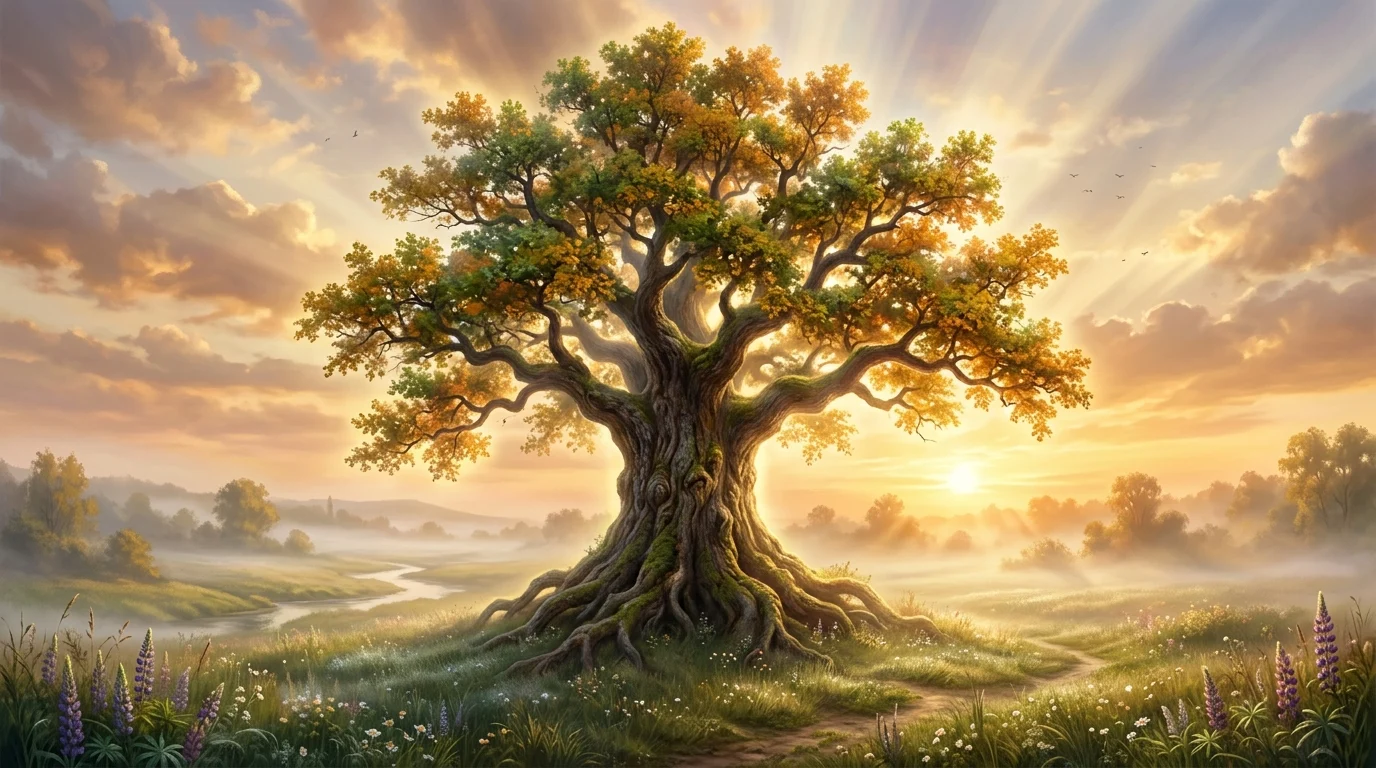
Have you ever stood beneath the sprawling branches of an ancient oak and felt a sense of wonder? You’re not alone. For millennia, humans have looked to trees as powerful symbols of life, wisdom, and connection. Tree symbolism is the study of these deep meanings, exploring how different cultures and traditions interpret the significance of trees. It’s about understanding the messages we’ve attached to these majestic beings from the roots that anchor them to the earth to the branches that reach toward the sky.
if we realize it or not, tree symbolism touches our daily lives. It appears in our stories, our art, and even our dreams. This exploration into the world of tree symbolism will uncover its rich history, spiritual depths, and surprising relevance to our modern world.
Tree Symbolism Meaning (Clear Definition)
So, what exactly does “tree symbolism” mean? At its core, tree symbolism is the practice of using trees as metaphors or representations for broader concepts, ideas, and beliefs. A tree can symbolize strength because of its sturdy trunk, growth through its expanding branches, and wisdom due to its long lifespan. It’s a visual shorthand for complex ideas that we can all understand intuitively.
While trees as a whole hold specific meanings, different species carry their own unique symbolism. For instance, the oak often represents strength and endurance, while the willow is linked to flexibility and grace. The evergreen, which stays green all year, is a symbol of eternal life and resilience. Understanding these nuances is what makes studying tree symbolism so fascinating .
What Does Tree Symbolism Represent?
Tree symbolism represents a wide range of powerful concepts that are universally understood. It is a language of life itself. Think about the journey of a tree: it starts as a tiny seed, pushes through the soil, and grows into a magnificent structure. This process is a perfect metaphor for personal growth, potential, and the cycle of life.
Trees also represent the connection between the physical and spiritual realms. Their roots are firmly planted in the earth, while their branches reach up toward the heavens. This makes them a powerful symbol of grounding, stability, and a connection to something greater than ourselves . They remind us of our own need to be rooted in our values while still aspiring for greater things. By understanding what trees represent, we can better understand our own lives and the world around us.
Spiritual Meaning of Tree Symbolism
On a spiritual level, tree symbolism often speaks to our inner journey and our relationship with the divine. Many spiritual traditions see the tree as a representation of the self. Its roots symbolize our connection to our ancestors, our past, and our foundations. Its trunk represents our current life and the strength we carry, and its branches and leaves represent our future, our potential, and the legacy we will leave behind.
The concept of the “World Tree” is also common in many spiritual belief systems. This is a cosmic tree that connects different realms of existence—the underworld, the earth, and the heavens. For example, the Norse Yggdrasil and the sacred trees of Hindu mythology serve as pillars of creation and existence, representing the interconnectedness of all life and the cycle of birth, death, and rebirth . These spiritual interpretations remind us to look inward for strength and outward for connection.
Biblical / Religious Meaning of Tree Symbolism
Trees hold profound significance in religious texts, especially the Bible, where they are used to illustrate core theological concepts. Tree symbolism in the Bible begins in the very first book, Genesis, with the Tree of Life and the Tree of the Knowledge of Good and Evil in the Garden of Eden. The Tree of Life symbolizes eternal life and communion with God, while the Tree of Knowledge represents choice and the consequences of disobedience.
Throughout scripture, trees are used as metaphors for faith, righteousness, and God’s provision. A “tree planted by streams of water” represents a person who is faithful and prospers (Psalm 1:3). In the New Testament, Jesus is referred to as the “true vine,” and his sacrifice is associated with a tree. This connection from the Old Testament to the New Testament highlights the importance of tree symbolism as evidence of early artists’ and writers’ embrace of biblical metaphor and devotional connotations . The use of trees in religious art and architecture further demonstrates their sacred role, with artists drawing parallels between a tree’s life cycle and the events in the Gospels .
Tree Symbolism in History and Culture
For centuries, tree symbolism has been a cornerstone of human culture and history. Ancient civilizations recognized the immense value and power of trees, weaving them into the fabric of their societies. In Celtic culture, certain trees like the oak were considered sacred, acting as doorways to the Otherworld. The Druids, the Celtic priestly class, often held their rituals in oak groves.
In ancient India, tree symbolism was equally important. The banyan tree, for instance, is a symbol of eternal life and is often associated with the Hindu god Vishnu. It was also a place of shelter for weary travelers, and its extreme usefulness made it a candidate for religious protection and encouragement of planting . This practice of sacred groves can be seen across many cultures, from the Classical Greek and Roman worlds to early medieval legends . These examples show that tree symbolism isn’t just an abstract idea; it has guided human actions and beliefs for thousands of years.
Tree Symbolism in Literature and Art
The power of tree symbolism is beautifully and powerfully expressed in literature and art. Writers and artists have used trees for centuries to add depth and meaning to their work. In literature, a tree can be a character, a setting, or a symbol that drives the plot forward. Think of the symbolic importance of the “burning bush” or the sacred trees in European religious iconography from 1300-1800, which are just one example of how tree forms were used to embody and reflect Christian themes .
In art, the tree can be a central figure, representing everything from the fragility of life to the strength of a nation. Painters often used seasonal change in trees to emphasize themes of spiritual transformation . Today, trees continue to inspire creativity, serving as potent symbols for the human condition, the environment, and our search for meaning. The fundamental insight shared by many medieval thinkers—that all natural objects have a symbolic meaning—is a powerful testament to the tree’s role as a source of spiritual messages .
Dream Meaning of Tree Symbolism
When trees appear in our dreams, they often carry a message from our subconscious. Tree symbolism in dreams can be a reflection of your personal growth, health, and self-esteem. The condition of the tree is often key to understanding its message:
- A Tree in Full Bloom: This usually signifies a period of growth, happiness, and success in your life.
- A Barren or Dead Tree: This might indicate feelings of sadness, stagnation, or a fear of losing something important.
- A Tall, Strong Tree: This symbolizes confidence, inner strength, and a solid foundation.
- Branches Breaking or a Tree Falling: This could represent a feeling of instability, a fear of failure, or a major change on the horizon.
Dreaming of a tree is often an invitation to examine your own “roots” and your current life path. It can be a prompt to think about your inner strength and how you are growing.
Modern Meaning of Tree Symbolism
In our modern world, tree symbolism has taken on a new and urgent meaning. While the ancient associations of strength, growth, and wisdom remain, the tree has also become a powerful symbol for environmentalism and the health of our planet. The fight to protect forests has made trees a symbol of activism, resilience, and the interconnectedness of all life on Earth.
Modern tree symbolism also reflects a desire for grounding in a fast-paced, technological world. People are drawn to the idea of “forest bathing” or simply spending time in nature to de-stress and reconnect. The tree, with its slow, steady, and patient life, reminds us of the importance of patience and balance. It is a symbol of sustainability, legacy, and the hope for a greener future. The tree’s semiotic function—communicating with each other and with us humans—is something we are only beginning to fully appreciate today .
FAQ
1. What is the most common meaning of tree symbolism?
The most common meaning of tree symbolism is life, growth, and the connection between the earth and the sky. It represents our own personal development and our search for meaning.
2. What does an oak tree symbolize?
An oak tree is a classic symbol of strength, endurance, and wisdom due to its size and long lifespan. It was considered a sacred tree in many ancient cultures.
3. What does a tree symbolize in a dream?
In a dream, a tree often represents the dreamer’s self and their personal growth. The condition of the tree, whether healthy or barren, offers clues about the dreamer’s state of mind and life.
4. Why is tree symbolism important in religion?
Tree symbolism is important in religion because it provides a powerful visual metaphor for spiritual truths. Trees often act as a bridge between the physical world and the divine, representing creation, knowledge, and eternal life.
5. How is tree symbolism used today?
Today, tree symbolism is used to represent environmentalism, personal growth, and our need for connection to nature. It has become a symbol of resilience and the fight for a sustainable future.
Conclusion
From the ancient stories of the world’s great religions to the modern fight for our planet, tree symbolism has been a constant and powerful force in human culture. It reminds us of our roots, our potential for growth, and our connection to everything around us. By understanding what trees symbolize, we can gain a deeper appreciation for the natural world and for ourselves. The tree’s life cycle mirrors our own, and its presence continues to anchor us, inspire us, and encourage us to reach a little higher.

I am Luna Grace, an author passionate about exploring the meanings, history, and symbolism behind everyday signs. I enjoy sharing thoughtful insights that help readers understand symbols and their deeper significance.