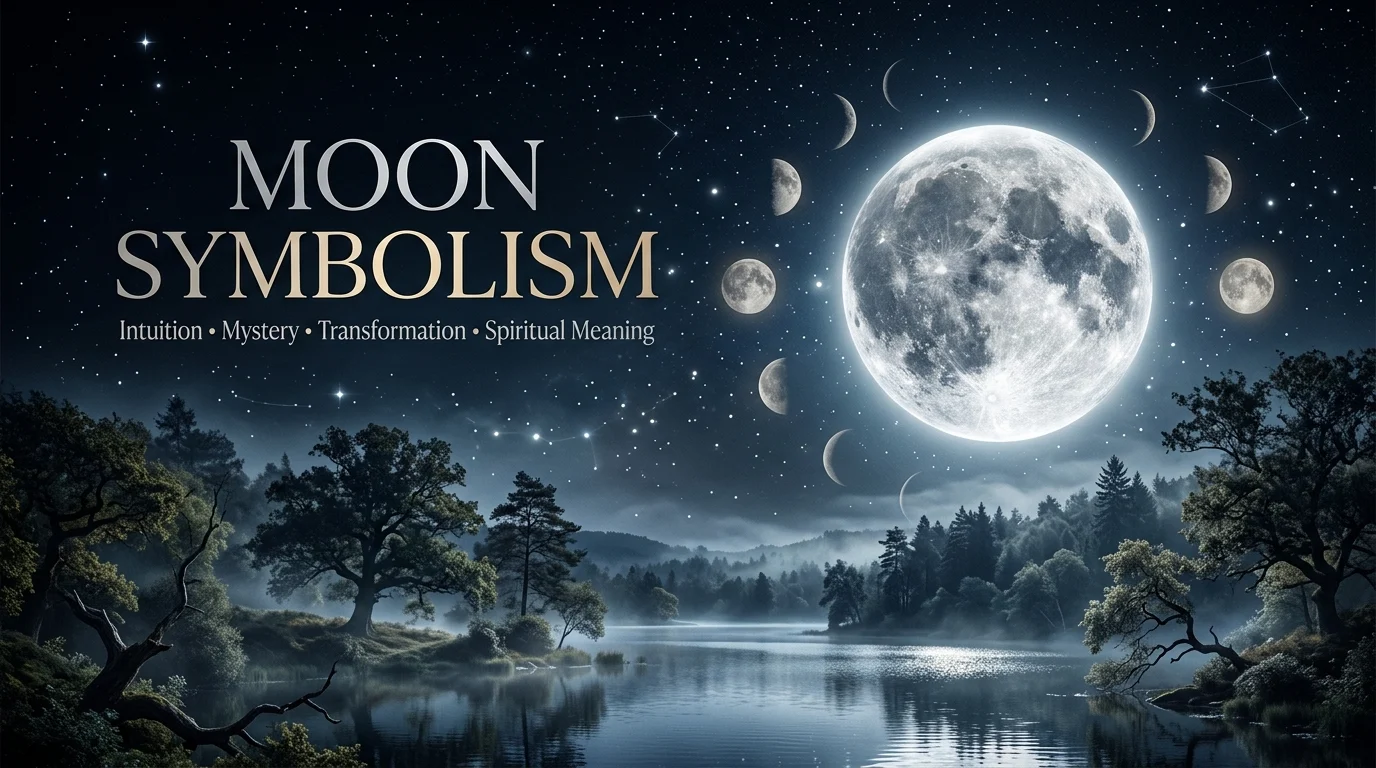
The moon has fascinated humanity for thousands of years. It lights the night, changes shape throughout its cycle, and appears closely connected with time, tides, seasons, and human imagination. Moon symbolism often represents intuition, mystery, transformation, femininity, emotional depth, renewal, and the hidden parts of life.
Across religions, mythology, literature, art, and everyday language, the moon carries many layers of meaning. While interpretations vary between cultures, its changing phases make it a powerful symbol of growth, endings, beginnings, and the natural rhythm of life.
Moon Symbolism Meaning (Clear Definition)
Moon symbolism refers to the meanings and ideas associated with the moon, including intuition, transformation, mystery, emotions, renewal, cycles, and the subconscious mind.
Unlike the constant appearance of the sun, the moon seems to transform from night to night. Its phases provide a natural metaphor for change: something can disappear from sight without truly disappearing.
Common moon symbolism includes:
| Moon Symbolism | Common Meaning |
|---|---|
| 🌙 Crescent moon | New beginnings, potential, growth |
| 🌕 Full moon | Completion, illumination, awareness |
| 🌑 New moon | Renewal, rest, inner reflection |
| 🌘 Waning moon | Release, endings, letting go |
| Moonlight | Guidance, hope, hidden truth |
| Lunar cycle | Change, rhythm, transformation |
| Night moon | Mystery, intuition, subconscious thoughts |
The moon can therefore symbolize both light and darkness—not necessarily good versus evil, but the visible and invisible sides of existence.
What Does Moon Symbolism Represent?
Moon symbolism can represent several powerful themes:
- Intuition: Trusting inner feelings and subtle impressions.
- Transformation: Accepting that life naturally moves through different phases.
- Mystery: Representing what remains unknown or hidden.
- Emotional depth: Connecting with feelings, memories, and the inner self.
- Renewal: Beginning again after a period of darkness or difficulty.
- Femininity: In many traditions, the moon is associated with feminine energy, motherhood, fertility, and nurturing.
- Cycles: Reflecting the recurring patterns found in nature and human life.
One of the moon’s most meaningful lessons is that change does not necessarily mean loss. A phase may end simply because another phase is beginning.
Spiritual Meaning of Moon Symbolism
Spiritually, the moon is often viewed as a symbol of inner wisdom, intuition, reflection, and spiritual transformation.
Moonlight does not create its own visible brightness in the same way sunlight appears to. Symbolically, this can represent reflected wisdom—the ability to discover truth by looking inward and paying attention to what is often overlooked.
The lunar cycle can also encourage personal reflection.
The new moon is commonly associated with intentions and fresh starts. The waxing moon can symbolize growth and developing energy. The full moon represents fullness, clarity, or completion, while the waning moon can symbolize release and surrender.
These interpretations are spiritual traditions rather than scientific claims, but they can provide meaningful frameworks for reflection.
Moon Symbolism and Intuition
The moon’s connection with nighttime makes it a natural symbol of the unseen. It can represent the quiet inner voice that becomes easier to notice when external distractions become less intense.
For many people, moon imagery therefore evokes contemplation, stillness, dreams, and self-awareness.
Biblical / Religious Meaning of Moon Symbolism
The moon appears in several religious traditions, but its meaning depends strongly on the specific faith and passage being considered.
In the Bible, the moon is frequently mentioned as part of God’s creation and as a marker of times and seasons. In Genesis, the heavenly bodies are described as serving to mark signs, seasons, days, and years. The moon also appears in prophetic and poetic imagery, sometimes associated with signs, heavenly events, or changing circumstances.
Importantly, biblical references to the moon do not establish one universal symbolic meaning. Its significance depends on context.
In Islamic tradition, the lunar calendar has major importance because Islamic months are determined by lunar observation. The crescent moon is therefore strongly associated with the passage of sacred months and religious occasions, although the crescent itself is not a universal theological symbol representing Islam in every context.
In various other religious and spiritual traditions, lunar cycles have been connected with fertility, timekeeping, ritual observance, death and rebirth, and the rhythms of nature.
Moon Symbolism in History and Culture
Before modern clocks and calendars, observing the moon provided a practical way to understand the passage of time. Lunar cycles influenced calendars, agricultural practices, navigation, festivals, and religious observances.
Ancient civilizations often incorporated the moon into mythology.
In ancient Greek mythology, Selene was associated with the moon, while Artemis became connected with lunar imagery in later traditions. In Roman mythology, Luna personified the moon.
In ancient Egyptian religion, lunar associations appeared through several deities and religious traditions, including Khonsu, a god strongly connected with the moon and time.
In Hindu traditions, Chandra is associated with the moon and appears throughout religious and mythological stories.
Across cultures, the moon has frequently represented a combination of beauty, mystery, time, fertility, and change.
Moon Symbolism in Literature and Art
The moon is one of the most enduring images in poetry, novels, paintings, music, and visual storytelling.
Writers often use the moon to create atmosphere or reveal a character’s emotional state. A bright full moon might suggest romance or revelation, while a hidden or fading moon can create feelings of loneliness, uncertainty, or transition.
In poetry, moonlight can symbolize longing, beauty, solitude, or imagination.
Artists also use the moon to contrast darkness with light. Because it illuminates only part of a nighttime landscape, it naturally creates a sense of mystery and incomplete knowledge.
In modern visual culture, moon imagery frequently appears in fantasy, romance, spiritual artwork, tattoos, jewelry, and photography.
Dream Meaning of Moon Symbolism
Dreams involving the moon can have different meanings depending on the dreamer’s emotions, experiences, and cultural background. There is no scientifically established universal interpretation for a particular moon dream.
However, common symbolic interpretations include:
- Seeing a full moon: A feeling of completion, awareness, or emotional intensity.
- Seeing a crescent moon: New beginnings, possibility, or personal growth.
- A disappearing moon: Uncertainty, transition, or something temporarily outside your awareness.
- A bright moon: Hope, clarity, guidance, or inspiration.
- A dark or obscured moon: Confusion, hidden emotions, or unresolved questions.
- A moon over water: Emotional reflection, sensitivity, and inner exploration.
The most useful question is often: How did the moon make you feel in the dream? Your emotional response may provide more personal context than the image alone.
Modern Meaning of Moon Symbolism
Today, moon symbolism remains remarkably popular.
People use moon imagery to express personal growth, emotional depth, independence, mystery, femininity, spirituality, and the belief that life moves through cycles.
The moon is especially common in tattoos and jewelry. A crescent moon may represent a fresh chapter, while a sequence of lunar phases can symbolize personal evolution or the passage of time.
Social media, photography, fashion, interior design, and contemporary art have also transformed the moon into a powerful visual symbol of calmness, beauty, and self-discovery.
At a personal level, the moon can serve as a reminder that you do not have to remain in one phase forever. Difficult periods can change, just as darkness gradually gives way to light.
Why Is the Moon a Symbol of Transformation?
The moon appears to change throughout its cycle, making it a natural metaphor for transformation.
It moves from darkness to a crescent, grows toward fullness, and gradually fades before beginning again. This repeating pattern can symbolize growth, completion, release, and renewal.
For this reason, moon symbolism often resonates with people experiencing major life transitions.
What Does a Full Moon Symbolize?
A full moon commonly symbolizes completion, illumination, emotional intensity, abundance, and heightened awareness.
In spiritual and cultural traditions, it may represent reaching the fullest expression of a particular phase before moving toward release and renewal.
What Does a Crescent Moon Symbolize?
A crescent moon often symbolizes new beginnings, hope, potential, growth, and the early stages of transformation.
Because the crescent appears at the beginning or end of lunar phases, it can also represent transition and the promise of what is yet to come.
Is Moon Symbolism Connected to Feminine Energy?
Yes. Many cultural and spiritual traditions have associated the moon with femininity, motherhood, fertility, intuition, and cyclical change.
However, these associations are cultural and symbolic rather than universal rules about gender or personality.
What Does the Moon Symbolize Spiritually?
Spiritually, the moon commonly represents intuition, inner reflection, mystery, transformation, emotional awareness, and renewal.
Its recurring phases can remind people that life naturally contains periods of growth, fullness, rest, endings, and new beginnings.
Conclusion
Moon symbolism is ultimately a symbol of cycles, mystery, intuition, transformation, and renewal. From ancient mythology to modern art, the moon continues to inspire people because it reflects something deeply familiar about life: nothing remains in exactly the same phase forever.
if you see the moon as a spiritual symbol, a cultural image, a literary metaphor, or simply a beautiful part of the night sky, its changing light offers a timeless reminder to embrace change and trust the journey,

I am Leon James, Administrator at SymboJoy, passionate about symbols, special characters, emojis, and creative text. I help make digital expression simple, useful, inspiring, and enjoyable.