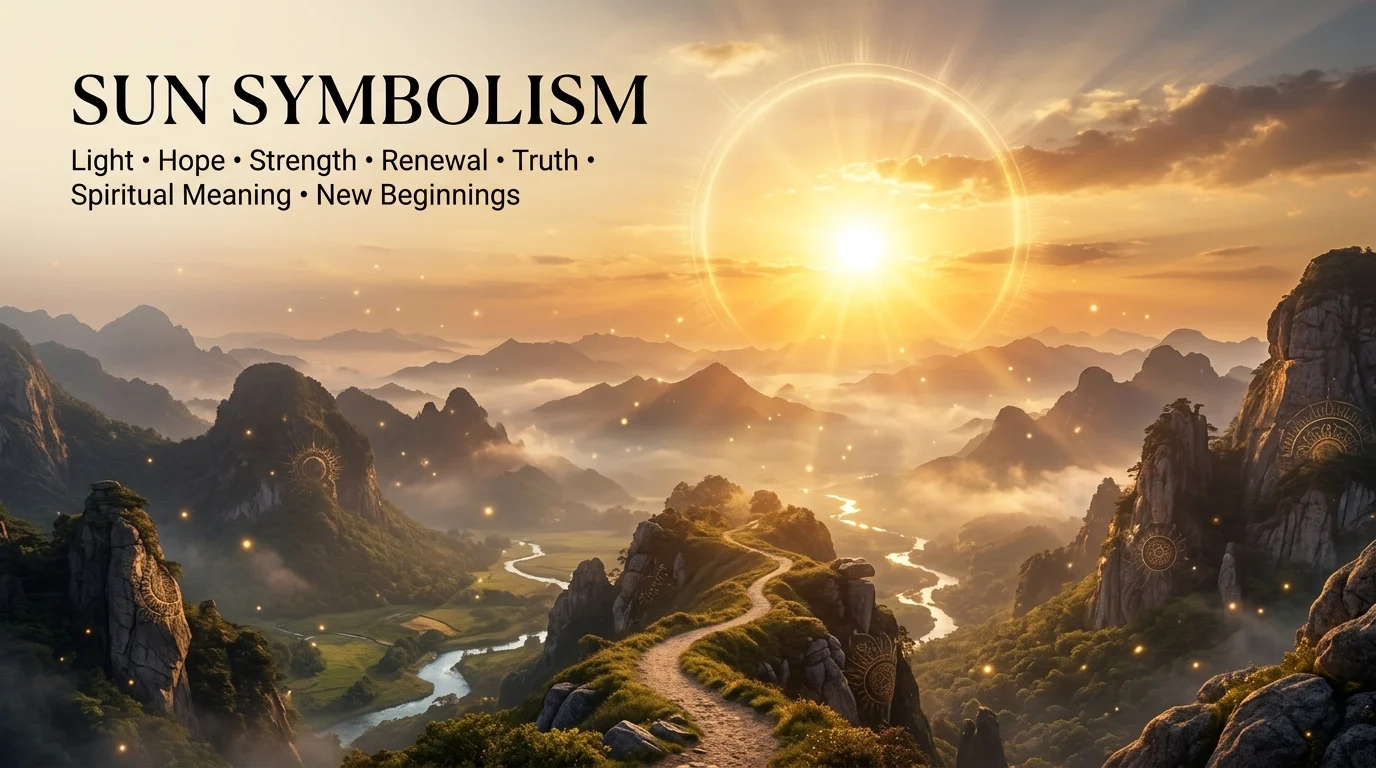
The sun symbolism has fascinated humanity for thousands of years. As the source of daylight, warmth, and life, the sun often represents light, power, vitality, renewal, truth, hope, and spiritual awakening. Across cultures and belief systems, its daily rising and setting have also made it a powerful symbol of death and rebirth, cycles, transformation, and new beginnings.
if you encounter the sun in mythology, religious traditions, dreams, art, or everyday life, its meaning often points toward illumination and life-giving energy.
Sun Symbolism Meaning (Clear Definition)
Sun symbolism refers to the symbolic meanings associated with the sun, including life, light, strength, truth, vitality, renewal, and spiritual illumination.
Because the sun makes life on Earth possible, it naturally became associated with creation and existence. Its light can also symbolize knowledge overcoming ignorance, while its warmth represents comfort, growth, and emotional strength.
Common meanings of the sun include:
| Sun Symbolism | Meaning |
|---|---|
| Light | Knowledge, clarity, and truth |
| Warmth | Love, comfort, and emotional support |
| Sunrise | New beginnings and hope |
| Sunset | Completion, reflection, and transition |
| Fire | Energy, passion, and transformation |
| Golden light | Success, abundance, and confidence |
| Rising sun | Renewal, rebirth, and opportunity |
The exact interpretation depends on the cultural, spiritual, or personal context in which the sun appears.
What Does Sun Symbolism Represent?
The sun represents much more than brightness. Its constant presence in the natural world has made it a universal metaphor for life and strength.
1. Life and Vitality
Plants need sunlight to grow, and people have always depended on the sun for warmth and light. Because of this, the sun commonly symbolizes life force, energy, health, and vitality.
2. Light and Truth
Sunlight reveals what darkness conceals. Symbolically, this makes the sun a representation of truth, awareness, understanding, and clarity.
3. Strength and Power
The sun’s immense energy has inspired associations with authority, courage, leadership, and personal power. In mythology, solar deities were often connected with rulers and divine authority.
4. Hope and New Beginnings
A sunrise can feel like a promise that another day is possible. For this reason, the rising sun frequently symbolizes hope, renewal, opportunity, and fresh starts.
5. Growth and Abundance
Sunlight supports natural growth, so the sun can represent prosperity, creativity, fertility, abundance, and the conditions needed for something to flourish.
6. Transformation
The sun moves through a daily cycle from sunrise to sunset and returns again. This repeating pattern can symbolize change, transformation, endings, and beginnings.
Spiritual Meaning of Sun Symbolism
Spiritually, the sun is often viewed as a symbol of divine light, consciousness, inner strength, awakening, and connection to something greater than ourselves.
Its light can represent the search for truth and wisdom. A person going through uncertainty may interpret sunlight as a reminder that clarity can eventually emerge from difficult periods.
The sun can also symbolize the inner self. Just as the physical sun radiates energy outward, people may associate it with confidence, generosity, creativity, and the ability to bring warmth into the lives of others.
Sun Spiritual Meaning in Everyday Life
Seeing a sunrise may encourage you to embrace a new chapter. Feeling sunlight after a difficult period can become a personal reminder of resilience and renewal.
In this sense, sun symbolism is not necessarily about predicting the future. Instead, it can provide a meaningful way to reflect on growth, hope, and personal transformation.
Biblical / Religious Meaning of Sun Symbolism
The sun appears throughout religious traditions as an important image of light, creation, order, glory, and divine power.
In Christianity and the Bible, physical sunlight can be associated with God’s creation and the contrast between light and darkness. Biblical imagery frequently uses light to communicate truth, righteousness, guidance, and divine presence.
The sun also appears in Christian symbolism in connection with glory and resurrection. Images of radiant light can represent spiritual renewal and victory over darkness.
Other religious and spiritual traditions have likewise regarded the sun as sacred or connected it with divine forces. In Hindu traditions, Surya, the sun deity, is associated with light, energy, vitality, and cosmic order.
Ancient Egyptian religion prominently featured Ra, a solar deity associated with kingship, creation, and divine authority.
These traditions differ significantly, but they share an important theme: the sun is often connected with life-giving power and sacred illumination.
Sun Symbolism in History and Culture
The sun has been one of humanity’s most enduring symbols because every civilization could observe its enormous influence.
Ancient societies watched the sun to understand seasons, agriculture, navigation, and the passage of time. This practical importance gradually became intertwined with mythology and religious symbolism.
Ancient Egypt
The Egyptian sun god Ra was one of the most important divine figures in ancient Egyptian religion. Solar imagery was closely connected with kingship, creation, protection, and cosmic order.
Ancient Greece and Rome
The sun was associated with divine figures connected to light and the solar cycle. Helios in Greek mythology was traditionally portrayed as driving the sun across the sky.
Hindu Traditions
Surya is traditionally regarded as the sun deity and represents light, energy, health, and life. The sun also has an important place in spiritual practices and traditional devotional culture.
Japan
Japan has a particularly strong solar association. The imperial tradition connects the Japanese imperial family with Amaterasu, the Shinto sun goddess.
Indigenous and Other Cultural Traditions
Across many Indigenous cultures and other traditional societies, the sun has been connected with creation, seasonal cycles, fertility, spiritual power, and the rhythms of nature. Meanings vary greatly between individual cultures, so sun symbolism should always be understood within its specific tradition.
Sun Symbolism in Literature and Art
Artists and writers have long used the sun to communicate ideas that are difficult to express directly.
In literature, a sunrise may symbolize hope, rebirth, or a new chapter, while a setting sun can represent endings, aging, reflection, or mortality.
Golden sunlight can create feelings of happiness and abundance. Harsh sunlight, however, may symbolize exposure, truth, judgment, or uncomfortable revelation.
In visual art, artists often use the sun as a focal point. Radiating lines, golden halos, bright skies, and solar circles can suggest divinity, authority, enlightenment, or transcendence.
The meaning often depends on the surrounding imagery. A sun rising over a peaceful landscape creates a very different emotional message from a red sun disappearing behind a storm.
Dream Meaning of Sun Symbolism
Dreams involving the sun can have many interpretations, and personal circumstances matter more than any universal definition.
A bright sun may symbolize optimism, confidence, clarity, or positive energy.
A sunrise can represent a new beginning, recovery, hope, or an opportunity to move forward.
A sunset may suggest closure, transition, reflection, or the end of one stage of life.
A darkened or eclipsed sun may symbolize uncertainty, hidden emotions, confusion, or a temporary loss of clarity.
A warm sun can represent comfort, happiness, emotional security, or connection.
Rather than treating dream symbolism as a fixed prediction, it can be more useful to ask what the sun made you feel and what was happening in your life when you had the dream.
Modern Meaning of Sun Symbolism
Today, the sun remains a powerful symbol in fashion, tattoos, jewelry, branding, personal spirituality, and popular culture.
A sun tattoo may represent strength, optimism, rebirth, freedom, or personal growth. A rising sun can symbolize overcoming hardship and starting again.
The sun is also frequently used to communicate positivity. Expressions such as “bringing light” or “being a ray of sunshine” connect sunlight with kindness, happiness, and emotional warmth.
Modern environmental awareness has added another dimension. Solar energy has made the sun a symbol of sustainability, natural power, independence, and a cleaner future.
For many people, the sun has therefore become both an ancient spiritual symbol and a modern representation of optimism and possibility.
Sun Symbolism and Personal Growth
The sun can offer a simple metaphor for personal development.
Growth does not always happen instantly. Just as a seed requires light, time, water, and care, personal transformation often requires patience and consistent effort.
Sun symbolism can remind us to:
- Seek clarity instead of remaining in confusion.
- Let difficult experiences become opportunities for growth.
- Begin again after setbacks.
- Share warmth and encouragement with others.
- Protect your energy and recognize your own strength.
- Accept that life naturally moves through cycles of change.
The most meaningful symbolism is often the kind that connects with your own experience.
FAQs About Sun Symbolism
What is the main meaning of sun symbolism?
The main meaning of sun symbolism is life, light, energy, strength, truth, hope, and renewal. Its interpretation can change depending on culture and personal context.
What does the sun symbolize spiritually?
Spiritually, the sun often symbolizes divine light, consciousness, inner strength, spiritual awakening, truth, and the life-giving force of existence.
What does a sunrise symbolize?
A sunrise commonly represents new beginnings, hope, renewal, opportunity, and personal transformation. It can be especially meaningful after a period of difficulty or uncertainty.
What does a sun tattoo symbolize?
A sun tattoo may represent strength, vitality, optimism, freedom, rebirth, personal growth, or a new chapter in life. The surrounding design can add additional meaning.
What does the sun symbolize in dreams?
In dreams, the sun may symbolize clarity, happiness, confidence, hope, or renewal. A sunrise often suggests beginnings, while an eclipse or darkened sun may reflect uncertainty or hidden concerns.
Conclusion: The Enduring Power of Sun Symbolism
Sun symbolism continues to resonate because the sun represents something fundamental to human existence: light after darkness, energy after exhaustion, and the possibility of beginning again.
if it appears in mythology, religion, dreams, literature, art, or personal expression, the sun can remind us that change is part of life and that even after darkness, another sunrise can come.

I am Leon James, Administrator at SymboJoy, passionate about symbols, special characters, emojis, and creative text. I help make digital expression simple, useful, inspiring, and enjoyable.