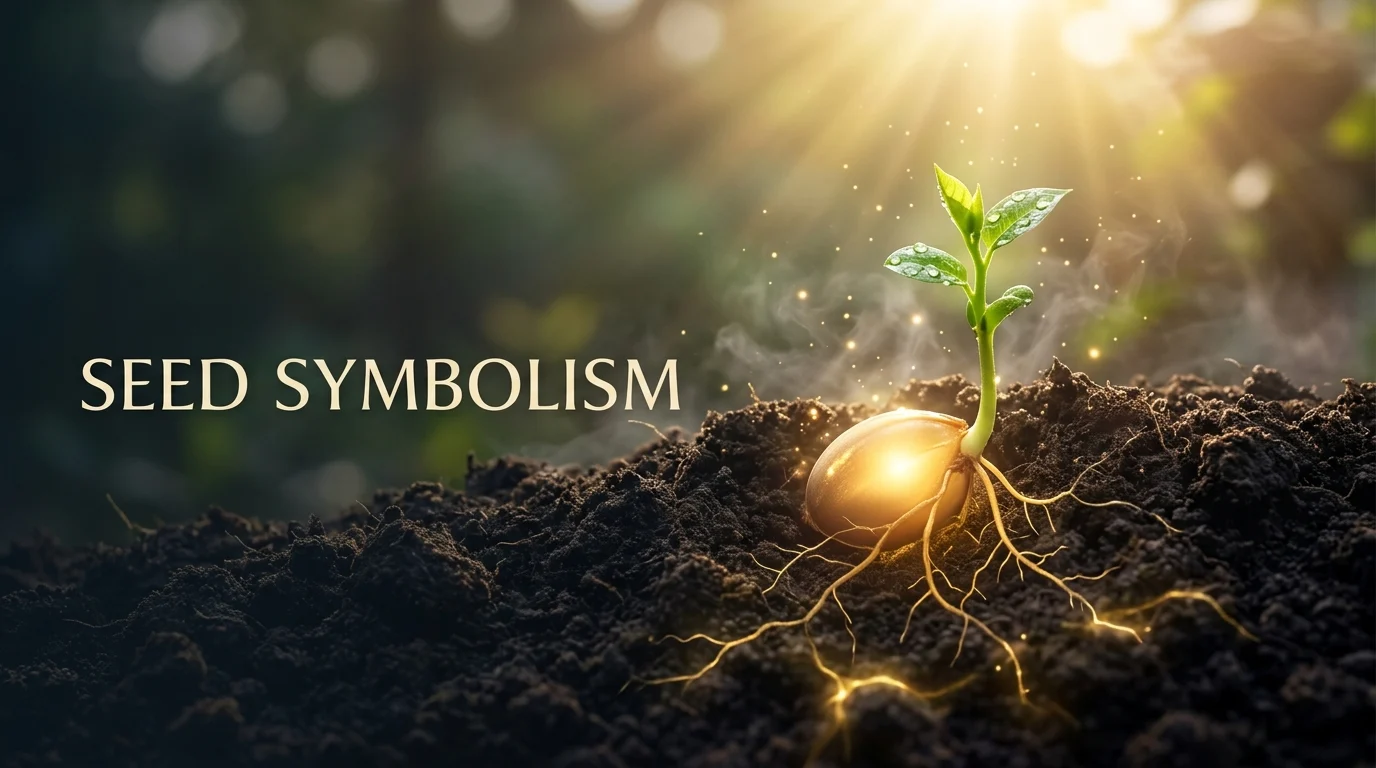
Seed symbolism is deeply connected with growth, potential, renewal, patience, fertility, and new beginnings. A tiny seed contains the possibility of becoming something much larger, making it a powerful symbol across spirituality, religion, mythology, literature, dreams, and everyday life.
Seeds remind us that meaningful change often begins quietly. Before a tree becomes visible, it first exists as an unseen possibility beneath the soil.
Seed Symbolism Meaning (Clear Definition)
Seed symbolism represents potential, growth, new beginnings, fertility, transformation, patience, and the hidden promise of the future.
A seed may look small and ordinary, but it carries everything needed to begin a new life cycle. Symbolically, this makes the seed a powerful representation of untapped potential.
In many interpretations, a seed can symbolize:
- New beginnings — starting a new chapter in life
- Potential — something valuable that has not yet fully developed
- Growth — personal, emotional, spiritual, or material development
- Patience — allowing progress to happen naturally
- Fertility — creation, abundance, and the continuation of life
- Transformation — changing from one form into another
- Hope — believing in something before its results become visible
- Renewal — beginning again after difficulty or loss
The central message is simple: great things can begin in very small and hidden ways.
What Does Seed Symbolism Represent?
Seed symbolism can have several meanings depending on the context.
1. Potential and Possibility
A seed represents what could become. It symbolizes dreams, talents, ideas, relationships, and opportunities that have not yet reached their full expression.
2. Growth and Development
Seeds naturally represent growth. Their journey from soil to sprout, plant, flower, and fruit mirrors the stages of human development.
3. New Beginnings
Finding or planting a seed may symbolize the beginning of something important. It can represent a fresh relationship, career, project, personal goal, or spiritual journey.
4. Patience
A seed does not become a tree overnight. Its symbolism encourages patience and reminds us that invisible progress is still progress.
5. Fertility and Creation
Because seeds create new life, they have long represented fertility, reproduction, creativity, and abundance.
6. Transformation
The seed changes dramatically as it grows. Symbolically, this reflects how people can evolve while remaining connected to their original identity.
7. Hope
A seed can represent hope because its future cannot always be seen immediately. Planting one is an act of trust in what has not yet appeared.
Quick Symbolism Guide
| Seed Symbolism | Common Meaning |
|---|---|
| Seed being planted | New beginning |
| Germinating seed | Personal growth |
| Seed becoming a tree | Long-term success |
| Many seeds | Abundance and possibilities |
| Dry seed | Dormant potential |
| Seed in fertile soil | Favorable conditions |
| Seed in poor soil | Struggle or missed opportunity |
| Giving someone a seed | Sharing hope or opportunity |
| Harvest from a seed | Rewards of patience and effort |
Spiritual Meaning of Seed Symbolism
Spiritually, seeds often represent the hidden beginnings of transformation.
A person may go through a period when nothing seems to be changing. Yet, just like a seed beneath the soil, important growth may be happening where it cannot be seen.
Seed symbolism can therefore encourage:
- Faith in the growth process
- Spiritual renewal
- Inner transformation
- Trust in divine timing
- Patience during difficult seasons
- Hope for the future
- Cultivating positive intentions
A seed can also symbolize the idea that what we nurture eventually grows. This can apply to kindness, wisdom, relationships, habits, beliefs, and personal ambitions.
The spiritual lesson is not simply to wait. It is to plant wisely and nurture consistently.
Biblical / Religious Meaning of Seed Symbolism
Seeds have important symbolic meanings in Christianity and other religious traditions.
In the Bible, seeds are frequently associated with faith, God’s word, spiritual growth, fertility, harvest, and the consequences of one’s actions.
One of the best-known examples is the Parable of the Sower, in which seeds fall on different types of ground. The story uses agricultural imagery to illustrate how people receive and respond to spiritual teachings.
The mustard seed is another famous biblical symbol. Its very small size is used to communicate the extraordinary potential of faith.
Biblical seed symbolism can therefore point toward:
- Faith
- Spiritual growth
- God’s word
- Fruitfulness
- Abundance
- Resurrection
- Renewal
- Sowing and reaping
The broader religious idea is powerful: something seemingly small can produce something far greater than its original appearance suggests.
Seeds also appear symbolically in other religious and cultural traditions, where they may represent life, fertility, rebirth, creation, and the continuity of generations.
Seed Symbolism in History and Culture
Agricultural societies naturally developed strong symbolic relationships with seeds because human survival depended on planting and harvesting.
Across ancient cultures, seeds were connected with the cycles of birth, death, renewal, fertility, and seasonal change.
Planting a seed meant trusting that the future would provide a harvest. As a result, seeds became natural symbols of hope and abundance.
In fertility traditions, seeds could represent reproduction and the continuation of family lines. In agricultural ceremonies, they could symbolize prosperity and protection from famine.
The recurring pattern of seed → plant → flower or fruit → new seed also mirrors the human understanding of life’s cycles.
This makes seed symbolism especially universal: different cultures may interpret particular plants differently, but the fundamental idea of a seed carrying future life is widely recognizable.
Seed Symbolism in Literature and Art
Seeds are powerful literary and artistic symbols because they allow creators to represent an entire story through a single small object.
In literature, a seed may symbolize an idea that eventually grows into a major event. A writer might describe a “seed of doubt,” a “seed of hope,” or a “seed of change.”
The metaphor works because readers instinctively understand the process of growth.
In visual art, seeds can appear alongside:
- Soil and roots
- Sprouting plants
- Flowers
- Trees
- Harvests
- Human hands
- Light
- Water
Artists may use these combinations to communicate rebirth, hope, creation, vulnerability, or the passage of time.
The seed is particularly effective as an artistic symbol because it represents something that is simultaneously small in the present and enormous in possibility.
Dream Meaning of Seed Symbolism
Dreaming about seeds is often interpreted in relation to potential, personal growth, opportunities, and new beginnings. However, dream symbolism is subjective, so the meaning depends heavily on the dreamer’s circumstances and emotions.
Planting Seeds in a Dream
Planting seeds may symbolize starting something new or investing effort into a future goal.
Seeing Seeds Sprout
Sprouting seeds can represent progress, hope, healing, or the early results of something you have been nurturing.
Finding a Seed
Discovering a seed may symbolize an unexpected opportunity, hidden talent, or possibility.
Many Seeds
A large number of seeds may represent numerous opportunities, ideas, responsibilities, or possibilities.
Dead or Damaged Seeds
These may symbolize disappointment, neglected potential, or something that needs different conditions to grow.
Eating Seeds
Eating seeds can sometimes symbolize absorbing knowledge, gaining nourishment, or taking something small and turning it into personal strength.
Rather than treating a dream as a fixed prediction, it can be more useful to ask: What in my life currently feels like a seed—something small that could become important?
Modern Meaning of Seed Symbolism
Today, seed symbolism remains highly relevant because modern life is filled with beginnings that require time to develop.
A business idea can be a seed.
A new friendship can be a seed.
A daily habit can be a seed.
A creative project can be a seed.
A personal decision can be a seed.
The metaphor encourages people to focus not only on immediate results but also on consistent cultivation.
For example, learning one new skill each day may seem insignificant. Over months or years, however, those small efforts can produce remarkable results.
This is why seed symbolism fits modern ideas such as:
- Personal development
- Goal setting
- Entrepreneurship
- Creativity
- Mindfulness
- Emotional growth
- Sustainable living
The seed reminds us that small actions can have long-term consequences.
What Does It Mean to Plant a Seed Symbolically?
To plant a seed symbolically means to begin an action or intention whose results will appear later.
It can represent starting a relationship, pursuing a dream, developing a habit, spreading an idea, or investing in your future.
What Does a Seed Symbolize Spiritually?
Spiritually, a seed commonly symbolizes potential, faith, renewal, spiritual growth, patience, and transformation.
It can represent trusting that meaningful change is developing even when the results are not yet visible.
What Does a Seed Symbolize in the Bible?
In biblical symbolism, seeds can represent faith, God’s word, spiritual growth, fruitfulness, and the principle of sowing and reaping.
The mustard seed is especially associated with the extraordinary potential of faith despite its small beginning.
What Does a Seed Symbolize in Dreams?
A seed in a dream can symbolize new opportunities, potential, growth, or something beginning to develop.
The condition of the seed and what happens to it in the dream can change the interpretation.
Why Are Seeds a Symbol of Hope?
Seeds symbolize hope because they contain the possibility of future life even when that life is not yet visible.
Planting a seed requires trust that careful attention today can lead to something beautiful tomorrow.
Conclusion
Seed symbolism teaches one of life’s most enduring lessons: beginnings do not have to be impressive to be meaningful. A tiny seed can represent a dream, a decision, a relationship, a spiritual awakening, or a new chapter waiting to grow.
Its message is one of potential, patience, faith, renewal, and hope. Sometimes the most important growth happens quietly, beneath the surface, long before anyone can see the result.

I am Luna Grace, an author passionate about exploring the meanings, history, and symbolism behind everyday signs. I enjoy sharing thoughtful insights that help readers understand symbols and their deeper significance.