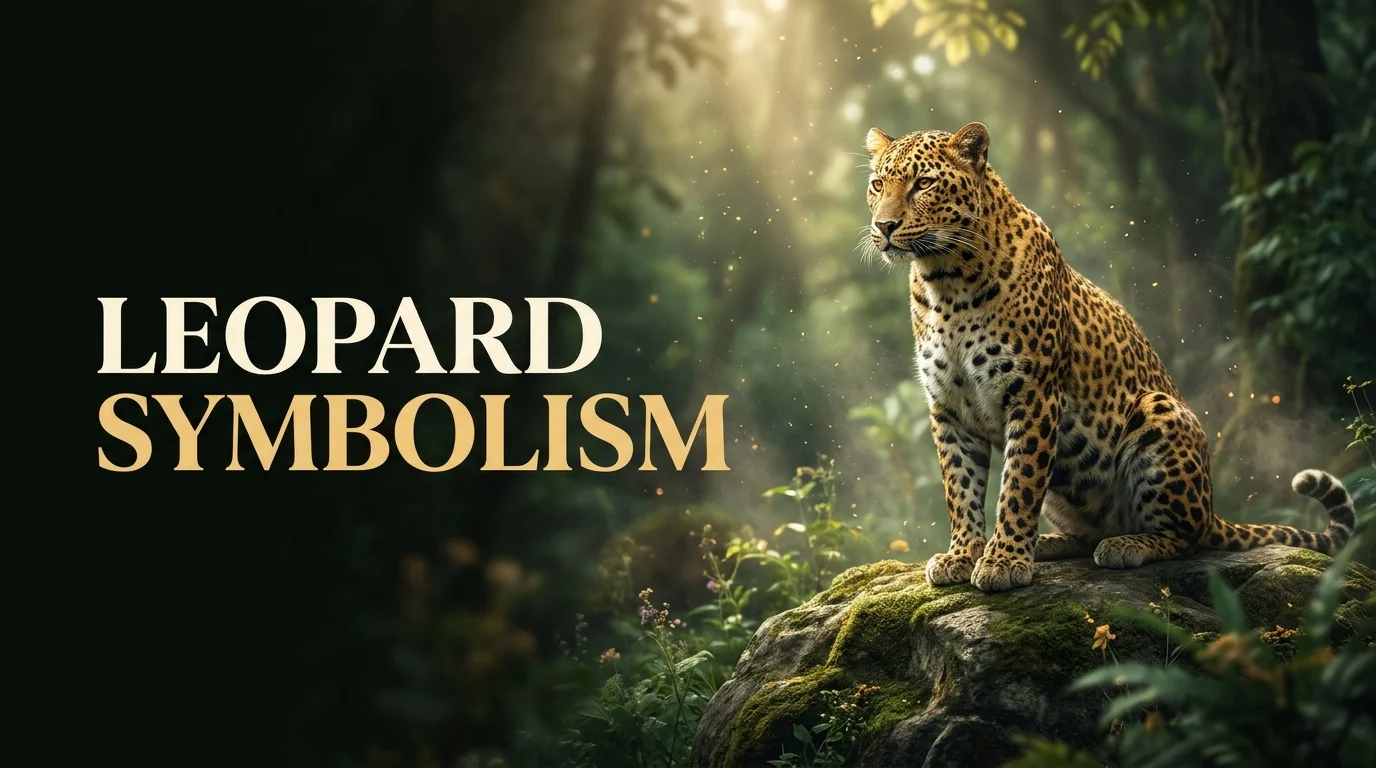
Leopard symbolism is often associated with strength, independence, courage, mystery, and the ability to move through life with confidence. Known for its beautiful spotted coat, quiet movements, and remarkable adaptability, the leopard represents a powerful combination of patience and personal power.
Across different cultures and spiritual traditions, the leopard has been viewed as a symbol of leadership, protection, intelligence, and hidden strength. Its solitary nature also reminds us that independence can be a gift and that true confidence does not always need to be displayed.
Whether you encounter a leopard in a dream, see one repeatedly in artwork, or feel drawn to this magnificent animal, its symbolism can inspire you to trust your instincts, embrace change, and recognize your inner strength.
Leopard Symbolism Meaning (Clear Definition)
Leopard symbolism represents strength, courage, independence, patience, adaptability, mystery, and confidence. It encourages people to act wisely, trust their instincts, and remain determined when facing challenges.
The leopard is a powerful predator, but its success depends on more than physical strength. It observes its surroundings, waits for the right moment, and moves with precision. These qualities make it a meaningful symbol of strategic thinking and self-control.
The leopard’s spotted coat also gives it a connection to individuality and the beauty of being different. Its distinctive appearance helps it blend into its environment, representing the balance between standing out and knowing when to remain unseen.
At its heart, leopard symbolism teaches an important lesson: real power comes from combining courage with patience and independence with wisdom.
What Does Leopard Symbolism Represent?
The leopard carries several symbolic meanings that can relate to personal growth, relationships, spiritual development, and everyday decisions.

1. Strength and Personal Power
The leopard symbolizes physical and emotional strength. It reminds you that you can face difficult situations without losing your sense of self or allowing fear to control your choices.

2. Independence and Freedom
Leopards often live and hunt alone. Symbolically, this behavior represents self-reliance, individuality, and the confidence to follow your own path without depending on constant approval from others.

3. Patience and Strategy
A leopard observes before acting. It represents the wisdom of waiting for the right opportunity instead of rushing into decisions that could have lasting consequences.

4. Mystery and Intuition
Its quiet movements and ability to remain concealed connect the leopard with mystery, awareness, and the importance of paying attention to subtle signs in your surroundings.

5. Adaptability and Resilience
Leopards survive in a variety of habitats. Their adaptability symbolizes the ability to respond to changing circumstances while remaining connected to your core values.
Other meanings include protection, leadership, determination, and the courage to embrace your individuality.
Leopard Symbolism at a Glance
| Symbolic quality | Meaning |
|---|---|
| Strength | Inner power and resilience |
| Independence | Trusting your own direction |
| Courage | Facing fear and uncertainty |
| Patience | Waiting for the right opportunity |
| Mystery | Respecting the unknown |
| Adaptability | Adjusting to life’s changes |
| Intuition | Listening to your inner awareness |
| Confidence | Recognizing your abilities |
| Protection | Guarding your boundaries |
| Transformation | Growing through challenges |
These meanings are symbolic interpretations rather than universal rules. Their significance depends on your personal experiences, cultural background, and the context in which the leopard appears.
Spiritual Meaning of Leopard Symbolism
The spiritual meaning of leopard symbolism centers on inner strength, intuition, independence, and the courage to move through life’s uncertainties.
In contemporary spiritual interpretations, the leopard can represent a call to become more aware of your surroundings, trust your judgment, and act with purpose.
1. Trust Your Inner Wisdom
A leopard relies on keen senses and careful observation. Spiritually, this can encourage you to listen to your intuition while also considering facts and practical circumstances.
If you are facing a difficult decision, the leopard can serve as a reminder to slow down, observe carefully, and choose with confidence.
2. Embrace Your Inner Power
The leopard does not need to demonstrate its strength constantly. Its presence alone can communicate confidence.
As a spiritual symbol, it encourages you to recognize your abilities without feeling the need to prove yourself to everyone. Quiet confidence can be just as powerful as visible achievement.
3. Protect Your Energy and Boundaries
Because leopards are often solitary and territorial, they can symbolize the importance of healthy personal boundaries.
This interpretation encourages you to protect your time, make thoughtful decisions about relationships, and recognize when you need space to restore your energy.
It does not mean isolating yourself from others. Instead, it highlights the importance of balancing connection with independence.
4. Move Through Change With Courage
The leopard’s adaptability makes it a meaningful symbol during periods of uncertainty.
A new job, a personal transition, or the end of an important chapter may require you to leave familiar surroundings. Leopard symbolism can remind you that flexibility and determination help you navigate change.
5. Discover the Power of Patience
The leopard does not succeed through constant movement. It waits, watches, and acts when circumstances are favorable.
Spiritually, this represents the value of timing. Not every opportunity requires an immediate response, and not every challenge must be confronted before you are ready.
The spiritual message of the leopard is to trust yourself, remain observant, protect your boundaries, and act when the moment is right.
Biblical / Religious Meaning of Leopard Symbolism
The leopard appears in the Bible as an animal associated with swiftness, danger, and the power of the natural world. Its religious meaning is different from the positive interpretations often found in modern spiritual symbolism.
In Jeremiah 13:23, the leopard is mentioned in a passage about the difficulty of changing deeply established behavior. The image emphasizes how challenging it can be to alter something that has become deeply ingrained.
In Daniel 7:6, a leopard-like beast appears in a prophetic vision. The creature has four wings and four heads, contributing to the chapter’s imagery of kingdoms and political power.
In Hosea 13:7, leopard imagery appears in a warning about judgment. Together, these passages demonstrate that the animal can represent danger, swiftness, and formidable power within biblical literature.
What Does a Leopard Symbolize in Christianity?
The leopard does not have one universal Christian symbolic meaning. Its significance depends on the biblical passage and its context.
Some readers may use the animal as a personal reminder of vigilance, self-examination, and the need to overcome harmful habits. However, meanings such as independence, intuition, or spiritual protection should not automatically be treated as established biblical teachings.
In other religious and cultural traditions, the leopard may be associated with royalty, bravery, authority, or sacred power. These interpretations vary widely, so it is important not to assume that every tradition understands the animal in the same way.
Leopard Symbolism in History and Culture
Throughout history, the leopard’s strength, striking appearance, and hunting ability have made it a powerful figure in art, storytelling, royal imagery, and cultural traditions.
Its symbolism varies considerably across regions and historical periods.
African Cultural Traditions
Leopards have held important roles in various African societies, where they may be associated with royal authority, prestige, courage, and spiritual significance.
In some historical settings, leopard skins were used in royal clothing and ceremonial regalia. Such uses could communicate status, leadership, or authority.
However, Africa contains many distinct cultures and traditions. Leopard symbolism is not identical across the continent, and individual communities may understand the animal differently.
Ancient Egypt
Leopard and other spotted-cat imagery appeared in ancient Egyptian art and religious contexts. Animal skins, including leopard skins, were associated with certain priestly garments and ceremonial representations.
The spotted skin became a recognizable feature in some depictions of priests, including the sem-priest associated with funerary and ritual practices.
These representations show how the leopard’s distinctive appearance could become connected with religious ceremony and authority.
Asian Traditions
In parts of Asia, leopards have appeared in hunting traditions, decorative arts, folklore, and royal imagery. Their speed, stealth, and strength have made them compelling subjects for artists and storytellers.
In regions where large cats coexist with human communities, the leopard may be respected as a formidable wild animal while also appearing in stories that explore the relationship between people and nature.
Modern Popular Culture
Today, leopard imagery is common in fashion, jewelry, tattoos, photography, and branding.
Leopard prints frequently communicate boldness, confidence, individuality, and glamour. In other settings, the animal’s camouflage and hunting abilities emphasize strategy, mystery, and quiet strength.
These modern associations demonstrate how an animal’s physical characteristics can develop into broader cultural symbols.
Leopard Symbolism in Literature and Art
In literature and art, the leopard often represents the tension between beauty and danger, visibility and concealment, and freedom and control.
Its distinctive spots, powerful body, and ability to disappear into its surroundings make it visually striking and rich in metaphorical possibilities.
The Leopard as a Symbol of Power
Writers may use the leopard to represent a character who possesses strength, authority, or a strong sense of independence.
A leopard appearing in a story can suggest that a character is capable but cautious, powerful but unwilling to reveal every intention.
The Leopard as a Symbol of Mystery
Because the leopard can remain hidden in dense vegetation or move quietly through its environment, it often fits stories involving secrets, uncertainty, and the unknown.
In poetry and fiction, its silent presence may create a sense of anticipation or suggest that something important remains beneath the surface.
The Leopard as a Symbol of Beauty and Individuality
The leopard’s coat is instantly recognizable. In visual art, it can symbolize natural beauty, distinctiveness, and the idea that individuality is a source of strength.
Artists may also use leopard patterns to communicate luxury, boldness, or untamed energy.
The Leopard in William Blake’s Poetry
William Blake’s poem The Tyger is often associated with the power and mystery of the tiger, not the leopard. The distinction matters because these animals can share symbolic themes without being interchangeable in a specific literary work.
Leopards appear in other literary and artistic traditions, where their meanings depend on the particular story, image, and cultural setting.
Ultimately, the leopard’s role in literature and art reflects humanity’s fascination with wildness, beauty, danger, and independence.
Dream Meaning of Leopard Symbolism
Dreaming about a leopard can be interpreted as a reflection of confidence, fear, independence, ambition, or a situation that requires careful attention. Dreams do not have universally fixed meanings, so your feelings and circumstances are important.
Here are some common symbolic interpretations.
| Leopard dream | Possible interpretation |
|---|---|
| Seeing a calm leopard | Confidence, self-awareness, or quiet strength |
| Being chased by a leopard | Feeling pressured or avoiding a difficult situation |
| A leopard attacking you | Conflict, fear, or a perceived threat |
| A leopard watching you | Heightened awareness or a need to examine your surroundings |
| A friendly leopard | Acceptance of your strength or independence |
| A leopard hiding in grass | Uncertainty, concealed concerns, or patience |
| A leopard climbing a tree | Ambition, perspective, or adapting to challenges |
| A leopard protecting you | A desire for security or stronger personal boundaries |
What Does It Mean to Dream of a Leopard Chasing You?
A leopard chasing you may reflect a problem, responsibility, or emotion that you feel unable to confront. Consider whether something in your waking life is creating pressure or making you feel vulnerable.
Rather than assuming the dream predicts danger, use it as an opportunity to reflect on what is causing stress and what practical steps might help.
What Does a Friendly Leopard Mean in a Dream?
A friendly leopard may symbolize feeling more comfortable with your own power, confidence, or independence. It could also represent a desire to balance strength with trust and emotional openness.
The meaning depends on whether you felt safe, curious, excited, or uneasy during the dream.
What Does a Black Leopard Mean in a Dream?
A black leopard, commonly called a black panther, may symbolize mystery, hidden strength, transformation, or the parts of yourself you are still learning to understand.
Because dark animals can evoke different emotions, your personal associations with darkness and the animal are important to consider.
Modern Meaning of Leopard Symbolism
In modern life, leopard symbolism is often used to express confidence, individuality, resilience, ambition, and self-reliance.
The animal offers several useful metaphors for navigating personal and professional challenges.
Leopard Symbolism in Personal Growth
The leopard can represent the courage to become more comfortable with who you are.
Its symbolism encourages you to recognize your strengths, accept your individuality, and avoid measuring your worth entirely through other people’s opinions.
For example, someone beginning a new career might use leopard imagery as a reminder to trust their abilities while remaining willing to learn.
Leopard Symbolism in Relationships
In relationships, the leopard may represent independence, personal boundaries, and mutual respect.
It can remind you that a healthy connection allows both people to maintain their individuality. Independence does not have to mean emotional distance; it can coexist with loyalty, trust, and genuine affection.
Leopard Symbolism in Career and Leadership
The leopard’s patience and strategic behavior offer useful metaphors for leadership and professional development.
Its symbolism encourages you to observe situations carefully, prepare before taking action, and recognize opportunities without rushing into every available option.
A thoughtful leader can be decisive without being impulsive and confident without needing to dominate others.
Leopard Symbolism in Tattoos
Leopard tattoos can carry several personal meanings, depending on the design and the wearer’s intentions.
Common interpretations include:
- Strength: Overcoming adversity and standing firm.
- Freedom: Living independently and following your own path.
- Courage: Facing challenges with determination.
- Mystery: Embracing complexity and individuality.
- Resilience: Adapting and continuing after setbacks.
- Confidence: Recognizing your personal power.
A realistic leopard tattoo may emphasize strength and natural beauty, while a leopard-print design may communicate boldness, style, and individuality.
Leopard Symbolism as a Personal Reminder
You can apply the leopard’s symbolism in simple, practical ways:
- Pause and observe before making an important decision.
- Set boundaries that protect your time and well-being.
- Practice patience when progress seems slow.
- Adapt your approach when circumstances change.
- Trust your abilities without ignoring useful advice.
- Take action when preparation and opportunity come together.
These lessons turn symbolism into a practical reminder rather than a prediction about the future.
Frequently Asked Questions About Leopard Symbolism
1. What Does a Leopard Symbolize Spiritually?
Spiritually, a leopard commonly represents inner strength, intuition, independence, patience, and adaptability. Its symbolism can encourage you to trust your judgment and approach challenges with courage and awareness.
2. Is a Leopard a Symbol of Good Luck?
A leopard may be interpreted as a symbol of confidence, opportunity, or protection in some personal and cultural contexts. However, it is not universally considered a good-luck symbol, and its meaning varies between traditions.
3. What Does a Leopard Symbolize in the Bible?
In the Bible, the leopard is associated with qualities such as swiftness and formidable power, and it appears in passages concerning human behavior, judgment, and prophetic visions. Its meaning depends on the specific passage rather than a single universal interpretation.
4. What Does It Mean When You See a Leopard in a Dream?
A leopard dream may reflect confidence, fear, independence, ambition, or a situation that requires careful attention. Consider the leopard’s behavior, your emotions during the dream, and what is happening in your life.
5. What Does a Leopard Tattoo Symbolize?
A leopard tattoo often represents strength, courage, freedom, individuality, mystery, and resilience. Its exact meaning depends on the design and the personal significance the wearer attaches to the animal.
Conclusion: The Deeper Meaning of Leopard Symbolism
Leopard symbolism reminds us that strength is most effective when guided by patience, awareness, and wisdom. The leopard represents the courage to stand independently, the intelligence to recognize opportunities, and the adaptability to navigate change.
if you encounter its image in a dream, cultural tradition, or work of art, the leopard can serve as a powerful reminder to trust your abilities and embrace your individuality. Sometimes, the strongest path forward is not to move faster, but to observe carefully, remain confident, and act at the right moment.

I am Simon Michael, an author passionate about exploring symbols, their meanings, and cultural significance. I enjoy making symbolism simple, engaging, and meaningful for curious readers everywhere.


