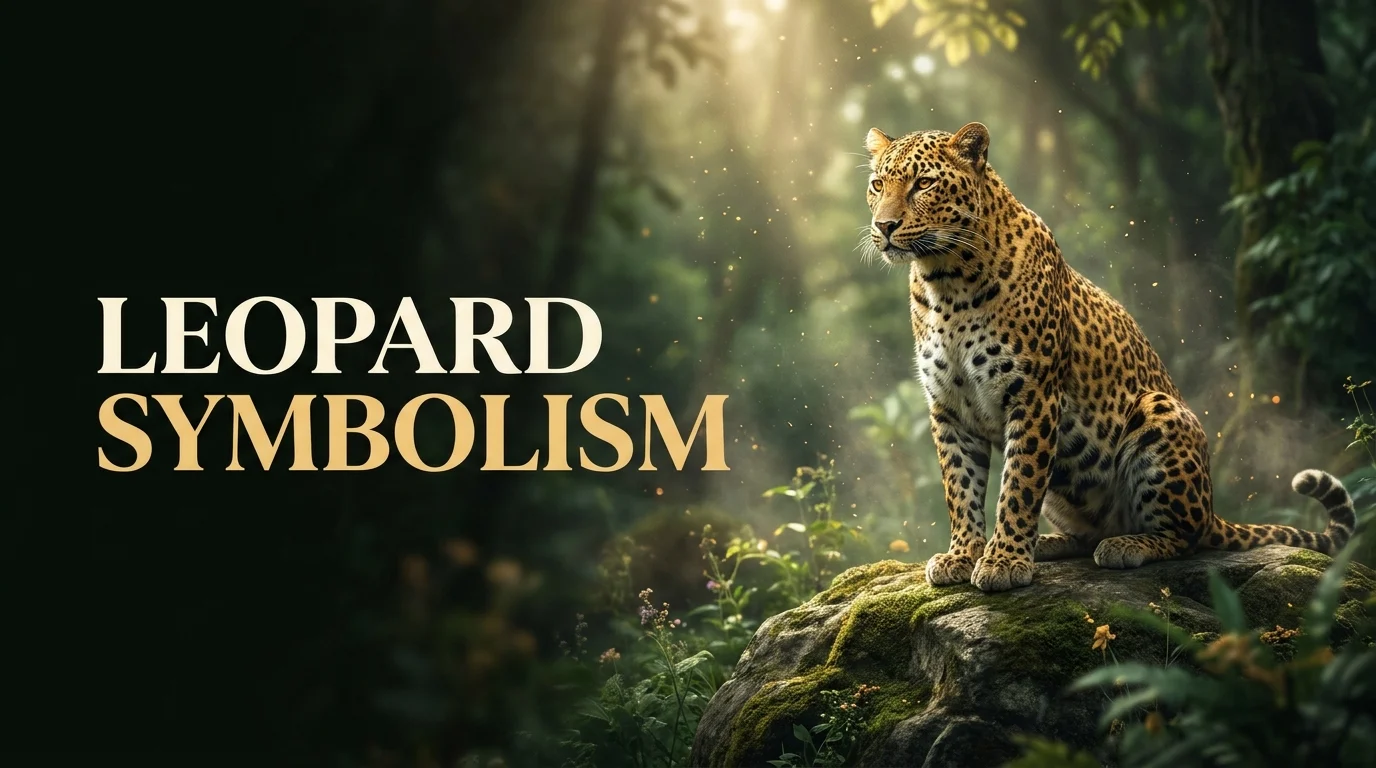
Leopard symbolism represents strength, courage, independence, stealth, protection, and the ability to adapt to changing circumstances. Known for its beautiful spotted coat, exceptional hunting skills, and quiet confidence, the leopard has long inspired people across cultures and spiritual traditions.
Seeing a leopard in nature, dreaming about one, or feeling drawn to this powerful icon can inspire reflection on your own instincts, personal boundaries, and inner strength. Its symbolism reminds us that true power does not always need to be loud or visible. Sometimes, the strongest individuals are those who observe carefully, act wisely, and trust their abilities.
Whether you are exploring the spiritual meaning of a leopard, its cultural significance, or what it might represent in a dream, this guide explains the most common interpretations and how they may relate to everyday life.
Leopard Symbolism Meaning (Clear Definition)
Leopard symbolism is the interpretation of the leopard as a representation of personal power, independence, patience, courage, mystery, and adaptability.
As a solitary and highly adaptable predator, the leopard symbolizes the ability to move confidently through difficult situations without depending entirely on others. Its quiet movements and keen awareness also connect it with strategic thinking, observation, and well-timed action.
The leopard’s meaning can vary depending on the situation, cultural tradition, or personal experience.
For example, a leopard appearing in a dream may represent confidence or an unresolved fear, while a leopard in a work of art might symbolize royalty, danger, elegance, or untamed nature.
At its heart, leopard symbolism encourages you to recognize your strengths, respect your instincts, and move forward with confidence.
What Does Leopard Symbolism Represent?
The leopard carries several powerful symbolic meanings. Each reflects a different aspect of its natural behavior and the qualities people associate with this remarkable icon .
Here are the most common interpretations of leopard symbolism.
| Symbolic meaning | Interpretation |
|---|---|
| Strength and power | Having the courage to face challenges |
| Independence | Trusting yourself and making your own decisions |
| Stealth and patience | Observing carefully before taking action |
| Adaptability | Adjusting to new situations and environments |
| Mystery | Exploring hidden truths and deeper understanding |
| Protection | Defending your boundaries and loved ones |
| Confidence | Recognizing your abilities without seeking approval |
| Transformation | Developing through challenges and personal change |
Strength and Personal Power
The leopard is a natural symbol of physical strength and quiet authority. Its muscular body, powerful leaps, and ability to survive in demanding environments make it an inspiring image of resilience.
Symbolically, the leopard encourages you to recognize your own capabilities. You may not control every challenge that comes your way, but you can develop the courage and discipline to respond effectively.
Its strength is not simply about overcoming others. It is also about mastering yourself.
Independence and Self-Reliance
Unlike many social predators, leopards generally live and hunt alone. This behavior connects them with independence, self-reliance, and personal freedom.
Leopard symbolism may encourage you to become more comfortable making decisions without constantly seeking approval. It can also remind you that spending time alone can help you understand your values and goals.
Independence, however, does not mean rejecting support. It means knowing that you can stand on your own while still appreciating meaningful relationships.
Stealth, Patience, and Strategy
Leopards are known for their ability to approach prey quietly and use their surroundings to their advantage.
This makes them powerful symbols of patience, careful observation, and strategic action.
In everyday life, this symbolism can encourage you to think before speaking, prepare before making important decisions, and avoid revealing every plan before the right moment.
Sometimes, success comes from taking a thoughtful step rather than making a dramatic move.
Adaptability and Survival
Leopards live in a variety of habitats, including forests, grasslands, mountains, and other environments. Their ability to adapt is one of their defining characteristics.
As a symbol, the leopard represents flexibility and resourcefulness. It reminds you that changing your approach does not mean abandoning your goals.
When life becomes uncertain, leopard symbolism encourages you to remain alert, learn from your surroundings, and find new ways to move forward.
Spiritual Meaning of Leopard Symbolism
The spiritual meaning of leopard symbolism is often associated with inner strength, intuition, personal transformation, independence, and the courage to face uncertainty.
Although spiritual interpretations differ among individuals and traditions, the leopard can serve as a meaningful reminder to reconnect with your instincts and approach life’s challenges with awareness.
Trusting Your Intuition
A leopard observes its surroundings carefully before acting. Spiritually, this behavior can represent the importance of listening to your inner voice.
You may encounter situations in which information is incomplete or the right decision is not immediately obvious. Leopard symbolism can remind you to pause, observe, and consider what your experience is telling you.
Intuition works best when combined with thoughtful judgment rather than fear or impulsiveness.
Embracing Your Inner Strength
The leopard often symbolizes strength that remains hidden until it is needed.
This interpretation can be especially meaningful when you are experiencing a difficult period, rebuilding your confidence, or learning to stand up for yourself.
You may possess more resilience than you realize. The leopard encourages you to recognize that strength and use it responsibly.
Walking Your Own Path
Because leopards are generally solitary icon , they can symbolize a personal spiritual journey.
This does not mean you must isolate yourself from others. Instead, it suggests that some forms of growth require quiet reflection, honest self-examination, and the willingness to make choices that reflect your deepest values.
The leopard reminds you that your path does not have to look like everyone else’s.
Transformation Through Challenges
Leopard symbolism can also represent transformation, particularly the kind that develops through experience.
Difficult circumstances may reveal weaknesses, but they can also help you discover new abilities and priorities. The leopard serves as a reminder to adapt without losing your sense of identity.
Its message is not that every hardship has a predetermined spiritual purpose, but that you can learn, change, and become more capable through the challenges you face.
The Leopard as a Spirit icon
In contemporary spiritual language, a leopard spirit icon is often associated with confidence, independence, intuition, and strategic thinking.
People who identify with this symbolism may see themselves as observant, determined, private, or comfortable working independently.
The leopard can also represent a need to establish stronger boundaries or act with greater confidence.
These interpretations are personal beliefs rather than scientifically established facts. You can use them as tools for reflection without treating them as predictions or absolute truths.
Biblical / Religious Meaning of Leopard Symbolism
The leopard appears in the Bible as a real icon and as a metaphor, particularly in passages discussing danger, judgment, speed, and the difficulty of changing established behavior.
Its biblical meaning is therefore more complex than a simple symbol of strength or good fortune.
The Leopard in the Bible
In Jeremiah 13:23, the leopard is used in a comparison about whether a person can change the color of their skin. The passage emphasizes the difficulty of changing deeply established habits or patterns.
Here, the leopard represents a recognizable natural characteristic used to communicate a spiritual and moral message.
In Daniel 7:6, a beast resembling a leopard appears in a vision. The imagery forms part of a larger symbolic description of kingdoms and political power.
In Revelation 13:2, a beast is described as having features resembling those of a leopard, a bear, and a lion. This imagery contributes to the passage’s portrayal of a powerful and threatening beast.
These passages show that the leopard’s biblical symbolism depends on context. It may represent natural characteristics, speed, or threatening power rather than consistently signifying something positive.
What Does a Leopard Mean Spiritually in Christianity?
For Christians, reflecting on the leopard can provide an opportunity to consider discipline, the limits of human control, and the importance of spiritual discernment.
Jeremiah’s comparison, in particular, invites reflection on deeply rooted behavior and the challenge of genuine change.
However, the Bible does not establish the leopard as a universal sign of divine protection, personal destiny, or a specific spiritual message. Such interpretations should be distinguished from the meaning of the biblical passages themselves.
Leopard Symbolism in History and Culture
Throughout history, leopards have attracted attention because of their beauty, strength, camouflage, and ability to move through their environments with remarkable control.
Their cultural meanings vary considerably, reflecting the different ways communities have understood and represented the icon.
Leopard Symbolism in African Cultures
Leopards have held important symbolic and political roles in various African societies, although meanings differ across regions and historical periods.
In some West African and Central African traditions, leopard imagery has been associated with authority, leadership, prestige, and royal power. Leopard skins, patterns, and representations have appeared in ceremonial objects, regalia, and artistic traditions.
The icon strength and elusive nature can make it an emblem of status and power.
These associations should not be treated as universal across Africa. The continent contains many distinct cultures, each with its own traditions, beliefs, and interpretations.
Leopard Symbolism in Ancient Egypt
In ancient Egyptian religious and artistic traditions, leopard skins were associated with certain priestly roles, including the sem-priest, who wore a distinctive icon skin during rituals.
The leopard-skin garment became a recognizable element of priestly imagery and funerary art.
This association connected the icon with ritual authority and the performance of sacred duties. It illustrates how the leopard’s physical appearance could become a meaningful part of religious symbolism.
Leopard Symbolism in Asian Traditions
Leopards and other large spotted cats have appeared in Asian art, folklore, and traditional visual culture.
In different settings, their images may evoke hunting prowess, courage, beauty, wildness, or the power of nature. Their spotted coats can also become decorative motifs representing luxury and prestige.
Because Asian traditions are diverse, there is no single interpretation of the leopard that applies to every region or belief system.
Leopard Symbolism in European Culture
In European heraldic and artistic traditions, leopard imagery has sometimes represented bravery, nobility, strength, and authority.
The heraldic term leopard can refer to a stylized lion-like icon , particularly in a walking pose with its head facing the viewer. Therefore, a heraldic leopard is not always intended to depict the modern zoological leopard.
This distinction is important when interpreting coats of arms, historical emblems, and medieval artwork.
Leopard Symbolism in Literature and Art
In literature and visual art, the leopard offers a rich combination of beauty, danger, mystery, and power.
Writers and artists often use the icon to communicate ideas that go beyond its physical appearance.
The Leopard as a Symbol of Power
A leopard can represent a character who possesses considerable strength but does not reveal it immediately.
In a story, a leopard-like figure might be quiet, observant, and highly capable, waiting for the right moment to act.
This imagery can suggest that genuine power depends on self-control as much as physical ability.
The Leopard as a Symbol of Mystery
The leopard’s spotted coat helps it blend into its surroundings, making it an effective symbol of concealment and the unknown.
An artist might use a leopard to suggest that appearances do not reveal everything. A character or situation may contain hidden motives, unrecognized abilities, or secrets waiting to be discovered.
This interpretation makes the leopard especially suitable for stories involving suspense, discovery, and personal transformation.
The Leopard as a Symbol of Beauty and Danger
The leopard’s elegant appearance contrasts with its role as a powerful predator.
Artists can use this contrast to explore the relationship between attraction and danger, grace and strength, or beauty and unpredictability.
In this sense, the leopard reminds viewers that something can be visually captivating while still demanding respect.
The Leopard in Modern Visual Art
Today, leopard imagery appears in paintings, photography, fashion, graphic design, and decorative art.
Its distinctive spots can communicate confidence, luxury, boldness, or individuality. In wildlife photography, the icon may instead represent the importance of protecting wild habitats and respecting nature.
The intended meaning depends on the artist’s choices and the context in which the image appears.
Dream Meaning of Leopard Symbolism
Dreaming about a leopard can have several possible interpretations. The meaning may depend on what the icon does, how you feel during the dream, and what is happening in your waking life.
Dream interpretations are subjective, and there is no reliable evidence that a leopard dream predicts a specific future event.
Here are some common symbolic interpretations.
| Leopard dream | Possible interpretation |
|---|---|
| Seeing a calm leopard | Confidence, independence, or awareness |
| Being chased by a leopard | Feeling pressured or avoiding a difficult issue |
| A leopard attacking you | Experiencing conflict, fear, or vulnerability |
| A leopard protecting you | Wanting security, courage, or stronger boundaries |
| A leopard hiding in the bushes | Uncertainty, caution, or something you have not fully examined |
| A friendly leopard | Becoming comfortable with your own strength |
| A leopard cub | Developing confidence or nurturing a new responsibility |
| Escaping from a leopard | Seeking freedom from pressure or a challenging situation |
Dreaming of a Leopard Watching You
If a leopard watches you quietly in a dream, you might interpret the scene as a reminder to pay attention to your surroundings.
It could reflect a situation in which you feel observed, uncertain, or aware that you need to make an important decision.
Consider whether you have recently needed to be more cautious or attentive in your personal or professional life.
Dreaming of a Black Leopard
A black leopard, commonly called a black panther, may symbolize mystery, hidden strength, independence, or the unknown.
If the icon feels peaceful, the dream might reflect growing confidence or an interest in exploring unfamiliar aspects of yourself. If it feels threatening, it may reflect anxiety or uncertainty.
The emotions you experience during the dream are often more useful for personal reflection than any fixed symbolic definition.
Dreaming of a Leopard Attacking You
An attacking leopard may represent a conflict, pressure, or fear that feels difficult to control.
Rather than assuming the dream predicts danger, consider whether something in your waking life is making you feel threatened, overwhelmed, or defensive.
The dream can be an invitation to identify the source of that stress and decide what practical steps might help.
Modern Meaning of Leopard Symbolism
In modern life, leopard symbolism frequently represents confidence, individuality, ambition, adaptability, and bold self-expression.
The icon image is widely recognizable, allowing it to communicate strength and elegance in many different settings.
Leopard Symbolism in Fashion
Leopard print has become a distinctive fashion pattern associated with boldness, glamour, confidence, and individuality.
For some people, wearing leopard print expresses a willingness to stand out. For others, it represents timeless style or a connection with nature-inspired design.
Its meaning is personal and can change with cultural trends.
Leopard Symbolism in Personal Development
The leopard can serve as a useful metaphor for developing confidence and making thoughtful decisions.
Its symbolism encourages you to:
- Trust your abilities without constantly seeking approval.
- Observe a situation before responding.
- Protect your time, energy, and personal boundaries.
- Adapt when circumstances change.
- Act decisively when the moment is right.
- Recognize that independence and cooperation can coexist.
These ideas can be applied to relationships, career decisions, personal goals, and everyday challenges.
Leopard Symbolism in Leadership
As a leadership symbol, the leopard can represent strategic thinking, composure, decisiveness, and self-reliance.
A leader inspired by these qualities does not need to dominate every conversation. Instead, they can listen carefully, assess risks, and act when they have enough information.
The leopard also offers a reminder that strength should be balanced with responsibility. Confidence becomes more valuable when it is guided by good judgment and respect for others.
Leopard Symbolism in Nature and Conservation
Beyond personal symbolism, the leopard represents the beauty and complexity of the natural world.
Leopards face threats in many parts of their range, including habitat loss, declining prey populations, and conflict with humans. Their conservation is important for maintaining healthy ecosystems.
In this context, the leopard can symbolize wilderness, ecological balance, and the responsibility to protect wildlife.
Respecting the icon in its natural habitat is an important part of appreciating what it represents.
Frequently Asked Questions About Leopard Symbolism
1. What does a leopard symbolize spiritually?
A leopard commonly symbolizes inner strength, intuition, independence, patience, and adaptability in contemporary spiritual interpretations. Its meaning may encourage you to trust your judgment and approach challenges with confidence.
2. Is seeing a leopard a good sign?
Seeing a leopard can feel meaningful and may inspire reflection on courage, awareness, and personal power. However, there is no universal evidence that encountering a leopard predicts good fortune or a particular future event.
3. What does a leopard symbolize in dreams?
A leopard in a dream may represent confidence, hidden fears, independence, or a challenging situation, depending on the dream’s context. Your emotions and current life circumstances can help you explore what the dream means to you.
4. What does a black leopard symbolize?
A black leopard, often called a black panther, can symbolize mystery, hidden strength, elegance, and the unknown. Its interpretation depends on personal associations and the context in which the icon appears.
5. What does the leopard symbolize in the Bible?
In the Bible, the leopard appears in passages associated with unchanging characteristics, visionary beasts, and threatening power. Its meaning varies by passage rather than representing one consistent spiritual message.
Conclusion: The Deeper Meaning of Leopard Symbolism
Leopard symbolism brings together strength, independence, patience, mystery, and adaptability. Its quiet confidence reminds us that real power often comes from understanding ourselves, observing carefully, and choosing the right moment to act.
Whether the leopard appears in a dream, a spiritual reflection, a cultural tradition, or a work of art, it offers a meaningful reminder to trust your abilities while remaining thoughtful and aware.
The leopard’s most enduring lesson is simple: be confident in your strength, flexible in the face of change, and wise enough to know when to act.

I am Simon Michael, an author passionate about exploring symbols, their meanings, and cultural significance. I enjoy making symbolism simple, engaging, and meaningful for curious readers everywhere.


