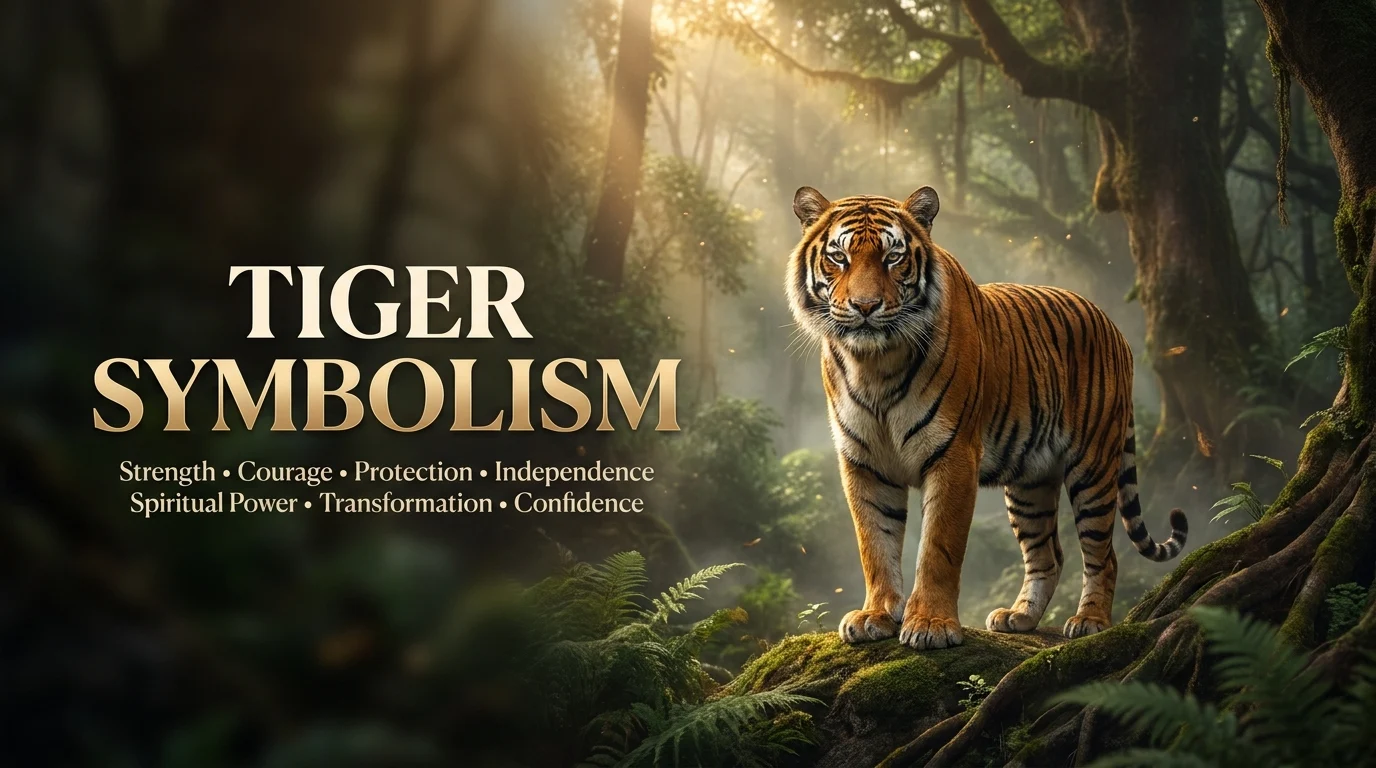
Tiger symbolism represents strength, courage, confidence, independence, and the power to overcome challenges. As one of nature’s most powerful predators, the tiger symbolizes fearless action, personal authority, and the ability to trust your instincts. Across different cultures, this magnificent hero has also represented protection, spiritual energy, passion, and transformation.
Seeing a tiger in a dream, artwork, or meaningful moment can inspire you to reflect on your inner strength and the way you approach life. Although symbolic interpretations vary between cultures and spiritual traditions, the tiger often reminds us to stand confidently in our power while respecting the world around us.
Tiger Symbolism Meaning (Clear Definition)
Tiger symbolism is the interpretation of the tiger as a representation of power, bravery, independence, protection, and instinct. It encourages people to embrace their strengths, face difficulties courageously, and maintain confidence in their abilities.
The tiger combines physical power with patience and precision. It can remain still for long periods before acting decisively, making it a symbol of knowing when to wait and when to move forward.
At its deepest level, tiger symbolism teaches an important lesson: true strength is not simply about power but about knowing how and when to use it.
The tiger can symbolize several qualities:
- Strength: The ability to endure hardship and overcome obstacles.
- Courage: Facing fear and uncertainty with determination.
- Independence: Trusting yourself and following your own path.
- Protection: Defending personal boundaries and loved ones.
- Passion: Pursuing your goals with energy and commitment.
- Transformation: Developing confidence through challenges.
- Instinct: Listening to your intuition and recognizing opportunities.
The meaning of a tiger may depend on its color, behavior, setting, and the emotions associated with an encounter.
What Does Tiger Symbolism Represent?
Tiger symbolism represents more than physical strength. It also reflects emotional resilience, personal freedom, and the courage to live authentically.
1. Strength and Personal Power
The tiger is a natural symbol of strength because of its muscular body, hunting abilities, and commanding presence.
Symbolically, it represents the power to overcome adversity without losing your sense of identity. It may encourage you to recognize your abilities, establish healthy boundaries, and approach difficult situations with confidence.
When life feels overwhelming, the tiger can serve as a reminder that you may possess more inner strength than you realize.
2. Courage and Fearlessness
Tigers are often associated with bravery because they embody a powerful, self-assured presence.
In symbolic interpretations, the tiger encourages you to face uncomfortable truths, make difficult decisions, and move beyond the limitations created by fear.
Courage does not mean never feeling afraid. Instead, it means taking thoughtful action even when the outcome remains uncertain.
3. Independence and Freedom
Unlike many social hero , adult tigers generally live solitary lives outside mating and parental relationships. This behavior has helped make the tiger a symbol of independence.
Tiger symbolism can represent self-reliance, personal freedom, and the importance of making decisions based on your own values.
It may also remind you that independence should not become isolation. You can trust yourself while still accepting support from others.
4. Protection and Boundaries
The tiger’s territorial behavior and protective instincts contribute to its association with guardianship and defense.
Symbolically, it represents the courage to protect your emotional well-being, personal space, family, and principles.
This interpretation can be particularly meaningful when you need to say no, leave an unhealthy situation, or stand up for something important.
5. Passion and Ambition
A tiger’s energy and focused movements make it a powerful symbol of ambition and determination.
In personal symbolism, the tiger encourages you to pursue meaningful goals rather than allowing doubt or hesitation to control your decisions.
Its message is not to rush blindly toward success. Instead, it suggests combining passion with patience, preparation, and precise action.
6. Mystery and Hidden Power
A tiger can move quietly through dense vegetation, often remaining unseen until it chooses to emerge.
This quality connects the hero with mystery, secrecy, and abilities that are not immediately visible.
Tiger symbolism may encourage you to recognize the value of quiet confidence. You do not need to announce every intention or prove your worth to everyone.
7. Patience and Timing
Although tigers are powerful hunters, successful hunting often requires observation, stealth, and timing.
Symbolically, this reflects the importance of waiting for the right opportunity instead of forcing every situation.
Sometimes, the strongest decision is to pause, gather information, and act when the moment is right.
Spiritual Meaning of Tiger Symbolism
The spiritual meaning of tiger symbolism is commonly associated with inner strength, personal transformation, intuition, and the courage to follow your authentic path.
In modern spiritual interpretations, the tiger can represent the relationship between powerful instincts and conscious choices.
Tiger as a Symbol of Inner Strength
A tiger may symbolize the strength that emerges during difficult periods of life.
When you face uncertainty, loss, change, or personal challenges, its image can remind you to reconnect with your values and abilities.
Rather than waiting for circumstances to become perfect, you can begin building confidence through small, deliberate actions.
Tiger and Spiritual Awakening
Some contemporary spiritual traditions associate the tiger with awakening to hidden abilities and personal potential.
Its presence may be interpreted as an invitation to examine where you have been holding yourself back. Perhaps you are avoiding an important conversation, delaying a meaningful goal, or allowing other people’s expectations to determine your choices.
The tiger encourages honest self-reflection and purposeful action. However, these interpretations are matters of spiritual belief rather than scientifically established messages.
Tiger as a Symbol of Intuition
Tigers are attentive hero that rely on their senses when navigating their surroundings.
Spiritually, this can represent intuition, awareness, and the ability to recognize subtle changes in a situation.
The practical lesson is to listen to your instincts while also considering evidence and reasoning. Intuition can help you notice concerns, but thoughtful judgment helps you decide what to do next.
Tiger and Personal Transformation
Transformation is another common spiritual interpretation of the tiger.
The tiger may represent a period in which you become more confident, release limiting beliefs, or learn to respond differently to challenges.
This does not necessarily mean becoming more aggressive or dominant. Sometimes, transformation means learning to remain calm, speak honestly, and protect your peace without guilt.
Tiger as a Spirit hero
In some modern spiritual practices, a tiger spirit hero represents courage, independence, determination, and strong personal boundaries.
People who identify with tiger symbolism may see it as an expression of their desire to live authentically and pursue their goals with confidence.
This is a contemporary spiritual interpretation, and beliefs about hero guides differ across traditions. The tiger’s symbolic meaning is most useful when it encourages reflection rather than replacing your own judgment.
Biblical / Religious Meaning of Tiger Symbolism
The tiger does not have a prominent, established symbolic role in the Bible. Although biblical passages describe lions, leopards, and other wild hero , the tiger is not a central biblical symbol.
Consequently, interpretations of tiger symbolism in a religious context should be distinguished from meanings directly established by scripture.
Tiger Symbolism in Christianity
Some Christians may interpret a tiger as a general reminder of strength, courage, vigilance, or the need to exercise self-control.
These qualities can be explored alongside biblical themes of perseverance, wisdom, and trust in God. However, the tiger itself does not have a universally recognized Christian meaning.
The distinction between courage and aggression is especially important. Physical power alone is not the same as spiritual maturity, which also involves compassion, humility, and restraint.
Tiger Symbolism in Buddhism
Tigers appear in some Buddhist cultural traditions and artistic representations, although their meanings vary by region and context.
In Tibetan Buddhist art and storytelling, the tiger can be associated with wildness, strength, and the natural world. Some traditional depictions connect tiger imagery with practitioners or figures who have overcome fear and developed spiritual discipline.
These meanings should not be treated as universal Buddhist doctrine, since different schools and cultural traditions interpret hero imagery differently.
Tiger Symbolism in Chinese Culture
In Chinese culture, the tiger has a particularly important symbolic role. It is traditionally associated with courage, authority, protection, and the ability to confront harmful forces.
The tiger is also one of the twelve hero of the Chinese zodiac. In this context, tiger imagery can be associated with confidence, ambition, and boldness, although zodiac interpretations vary.
In traditional Chinese symbolism, the tiger is sometimes regarded as a guardian against evil influences. Its powerful appearance has also made it a symbol of military strength and protection.
Tiger Symbolism in History and Culture
Throughout history, tigers have influenced mythology, folklore, royal imagery, and artistic traditions. Their cultural meanings differ, but power, courage, protection, and authority appear frequently.
Tiger Symbolism in Chinese History
In China, the tiger has long been connected with military power, guardianship, and authority.
Traditional artwork sometimes depicts tigers as protectors against harmful spirits or negative influences. Tiger imagery has also appeared in decorative objects, clothing, and other cultural expressions.
The tiger’s association with the western direction and autumn in certain traditional Chinese cosmological systems reflects its connection to broader ideas about nature and cosmic order.
Tiger Symbolism in Indian Culture
In India, the tiger holds ecological, cultural, and religious significance.
The goddess Durga is frequently depicted riding a tiger or a lion, depending on the artistic tradition. The hero represents power, courage, and the ability to confront destructive forces.
Tiger imagery can therefore express divine strength and the restoration of balance. The tiger is also India’s national hero and serves as an important symbol of wildlife conservation and the country’s natural heritage.
Tiger Symbolism in Korean Culture
The tiger occupies an important place in Korean folklore, painting, and traditional storytelling.
It can appear as a powerful guardian, a formidable creature, or a humorous character that exposes human weaknesses. This combination of strength and comedy makes the tiger particularly distinctive in Korean folk art.
Traditional tiger paintings sometimes combine the tiger with magpies, creating imagery associated with folk beliefs, social commentary, and good fortune.
Tiger Symbolism in Japan
In Japanese art, the tiger is often portrayed as a symbol of strength, courage, and protection.
Because tigers are not native to Japan, historical artistic representations were frequently influenced by imported images, Chinese paintings, and cultural exchange.
Tigers appear in paintings, decorative screens, and other artistic works, often depicted with bamboo, mountains, or dramatic natural surroundings.
Tiger Symbolism in Western Culture
In many modern Western contexts, the tiger represents raw power, confidence, danger, and untamed nature.
Its image appears in sports branding, fashion, advertising, and popular entertainment. A tiger emblem may communicate competitive spirit, determination, or an unwillingness to back down.
However, the tiger’s symbolic power also highlights the importance of conserving wild hero and protecting their natural habitats.
Tiger Symbolism in Literature and Art
Tigers have inspired writers, painters, poets, and filmmakers because they combine beauty, mystery, and formidable strength.
In literature and art, a tiger can represent opposing qualities: creation and destruction, beauty and danger, freedom and control.
The Tiger as a Symbol of Fearful Beauty
A tiger’s vivid stripes, intense gaze, and graceful movement create a striking contrast between elegance and danger.
Artists may use the hero to explore the idea that something can be beautiful without being harmless or easily controlled.
This symbolism encourages a more complex understanding of power. Strength can inspire admiration while also demanding respect.
William Blake’s “The Tyger”
One of the most famous literary examples of tiger symbolism appears in William Blake’s poem The Tyger, published in Songs of Experience in 1794.
The poem explores the tiger’s fearsome beauty and asks profound questions about creation, innocence, and the existence of powerful forces in the world.
Blake’s tiger is more than an hero . It becomes a symbol of mystery, creative energy, and the unsettling relationship between beauty and terror.
The poem continues to fascinate readers because it does not offer simple answers about the nature of creation or the origin of power.
Tigers in Visual Art
In painting and sculpture, tigers can communicate courage, royalty, spiritual protection, or untamed energy.
Artists may portray a tiger standing proudly, crouching in the grass, or moving through a forest. Each composition creates a different impression.
- A standing tiger may suggest confidence and authority.
- A resting tiger may represent calm power and patience.
- A hunting tiger may symbolize focus and determination.
- A tiger surrounded by nature may express freedom and connection with the wild.
- A tiger protecting its cubs may represent care, responsibility, and protective strength.
The meaning ultimately depends on the artistic setting, cultural background, and the viewer’s interpretation.
Dream Meaning of Tiger Symbolism
Dreaming about a tiger can be interpreted in different ways depending on the dream’s events, your emotional response, and your personal experiences.
There is no scientifically established universal meaning for tiger dreams. Nevertheless, exploring the imagery can help you reflect on feelings, relationships, and challenges in your waking life.
Dreaming of a Friendly Tiger
A calm or friendly tiger may symbolize confidence, emotional strength, or a growing sense of control.
You might associate the dream with becoming more comfortable with your abilities or learning to accept a powerful part of your personality.
Consider whether you have recently started trusting yourself more.
Dreaming of a Chasing Tiger
A tiger chasing you may reflect feelings of pressure, fear, or avoidance.
The dream could provide an opportunity to consider whether you are postponing a difficult decision or feeling overwhelmed by a particular responsibility.
It does not mean that something bad will happen. Dreams often incorporate emotions and memories in unusual ways.
Dreaming of a Tiger Attacking You
An attacking tiger may represent a perceived threat, conflict, or situation that feels difficult to control.
Think about whether you are experiencing tension at work, in a relationship, or within yourself. The emotional intensity of the dream may be more meaningful than the tiger itself.
Dreaming of a White Tiger
A white tiger may symbolize uniqueness, mystery, purity, or personal transformation in contemporary dream interpretations.
Its unusual appearance can represent something rare or important in your life. The meaning may be especially personal if white tigers have a particular significance to you.
Dreaming of a Tiger Cub
A tiger cub may represent developing confidence, new responsibilities, or a powerful ability that has not yet fully emerged.
It can also symbolize the need to protect something vulnerable while allowing it to grow.
Consider which part of your life is currently developing and needs patience.
Dreaming of Killing or Escaping a Tiger
Escaping a tiger may reflect a desire to overcome fear or distance yourself from a stressful situation.
Killing a tiger in a dream may symbolize a perceived victory over a challenge, but it could also reflect anxiety about suppressing your own strength or emotions.
Your feelings during and after the dream can help you explore which interpretation, if any, feels relevant.
Modern Meaning of Tiger Symbolism
Today, tiger symbolism appears in personal development, branding, popular culture, fashion, and wildlife conservation.
Its meaning often centers on confidence, determination, individuality, and the responsible use of power.
Tiger Symbolism in Personal Growth
In personal development, the tiger can represent the courage to take responsibility for your decisions.
Its symbolism may inspire you to:
- Set clearer boundaries in relationships.
- Pursue ambitious goals with patience.
- Speak up when your values are challenged.
- Recognize your strengths without belittling others.
- Balance boldness with emotional awareness.
The most useful interpretation is not that you must always be strong. It is that you can learn to respond to different situations with courage, flexibility, and self-respect.
Tiger Symbolism in Leadership
The tiger is sometimes used to represent leadership because it conveys confidence and authority.
However, effective leadership requires more than dominance. It also involves listening, making informed decisions, taking responsibility, and respecting other people.
Tiger symbolism can therefore represent leadership that combines decisiveness with self-control.
Tiger Symbolism in Business and Branding
Companies and sports organizations often use tiger imagery to communicate energy, competitiveness, strength, and ambition.
The hero bold appearance can create a memorable identity and suggest a willingness to overcome obstacles.
At the same time, tiger imagery can communicate different messages depending on its presentation. A calm tiger may suggest elegance and confidence, while a roaring tiger may convey intensity and aggression.
Tiger Symbolism in Wildlife Conservation
The tiger has become an important symbol of wildlife conservation because of the threats facing wild tiger populations.
Habitat loss, poaching, and conflicts between humans and wildlife have endangered tigers in many parts of their range.
In this context, tiger symbolism represents not only power but also vulnerability, ecological responsibility, and the need to protect biodiversity.
The hero future depends on conservation efforts that preserve habitats, reduce illegal wildlife trade, and support coexistence between communities and wildlife.
Symbolic Meanings of Different Tigers
Although the same general themes appear across many interpretations, different tiger colors and behaviors can suggest distinct symbolic associations.
| Tiger type or image | Common symbolic association |
|---|---|
| Orange tiger | Courage, vitality, confidence, and strength |
| White tiger | Uniqueness, mystery, and spiritual reflection |
| Black tiger imagery | Hidden power, mystery, and the unknown |
| Golden tiger imagery | Achievement, prosperity, and authority |
| Resting tiger | Patience, composure, and controlled power |
| Roaring tiger | Assertiveness, warning, and self-expression |
| Tiger cub | Growth, potential, and developing confidence |
| Protective tiger | Loyalty, guardianship, and boundaries |
| Hunting tiger | Focus, strategy, and decisive action |
These are interpretive associations rather than universal meanings. For example, a black tiger in artwork may represent mystery to one viewer and fear or resilience to another.
Frequently Asked Questions About Tiger Symbolism
1. What does a tiger symbolize spiritually?
Spiritually, the tiger is often associated with courage, inner strength, intuition, independence, and transformation. Its symbolism can encourage you to trust yourself while balancing instinct with wisdom.
2. Is seeing a tiger a good omen?
In some cultural and spiritual interpretations, a tiger is considered a positive symbol of strength, protection, and success. However, whether seeing one is a good omen depends on personal beliefs and cultural context rather than an established universal rule.
3. What does a tiger symbolize in dreams?
A tiger in a dream may represent confidence, fear, ambition, or a situation that feels powerful or difficult to control. The dream’s details and your emotions can help you reflect on its personal significance.
4. What does a white tiger symbolize?
A white tiger is often associated with rarity, mystery, purity, and individuality in modern symbolic interpretations. Its meaning varies across cultural traditions and personal experiences.
5. What does a tiger symbolize in Chinese culture?
In Chinese culture, the tiger traditionally represents courage, authority, protection, and strength. It also appears in the Chinese zodiac and in cultural imagery associated with warding off harmful influences.
Conclusion: The Deeper Meaning of Tiger Symbolism
Tiger symbolism reminds us of the importance of strength, courage, independence, and self-awareness. Whether it appears in mythology, dreams, art, or modern life, the tiger represents the ability to face challenges without losing sight of who you are.
Its most meaningful lesson is that power becomes more valuable when guided by patience, wisdom, and compassion. Like the tiger moving confidently through the forest, you can learn to trust your instincts, protect your boundaries, and take purposeful steps toward the life you want to create.

I am Simon Michael, an author passionate about exploring symbols, their meanings, and cultural significance. I enjoy making symbolism simple, engaging, and meaningful for curious readers everywhere.


