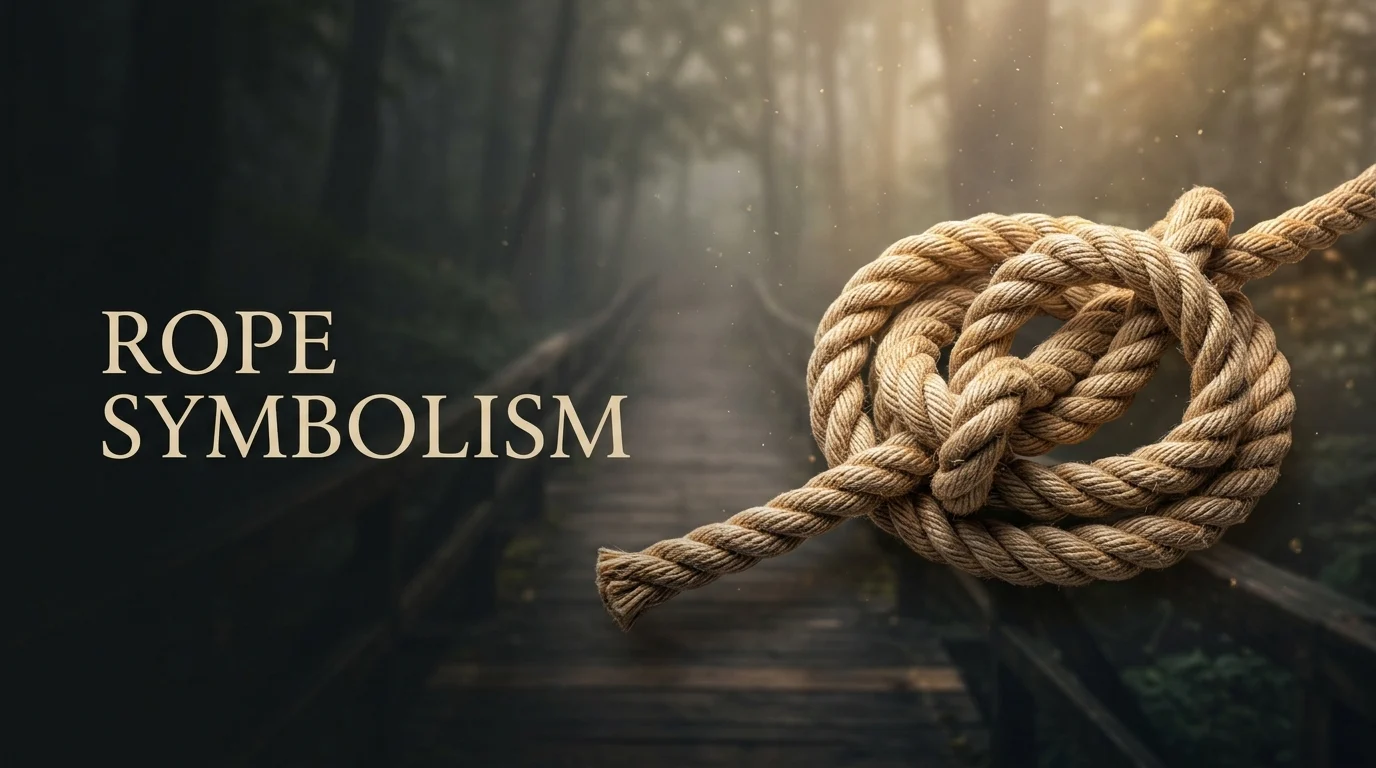
Rope symbolism is deeply connected with connection, strength, unity, support, security, and resilience. Across cultures and traditions, a rope can represent the bonds that hold people together, the challenges that test them, or the paths that help them move forward.
Because rope can tie, bind, secure, pull, rescue, or connect, its meaning often depends on the context in which it appears. In spiritual traditions, dreams, literature, and everyday life, rope symbolism can carry both positive and cautionary meanings.
Rope Symbolism Meaning (Clear Definition)
At its simplest, rope symbolism represents connection, strength, unity, support, and binding. A rope is made from individual fibers woven or twisted together, making it a natural symbol of cooperation and collective strength.
A single strand may be fragile, but many strands joined together can withstand considerable pressure. This makes rope a powerful metaphor for relationships, teamwork, perseverance, and emotional bonds.
Depending on the situation, rope may symbolize:
- Connection – linking people, places, or ideas
- Strength – the ability to withstand pressure
- Unity – many parts becoming stronger together
- Support – something that helps you remain steady
- Security – protection from falling or becoming lost
- Commitment – a bond that holds something together
- Restraint – limitations, obligations, or feeling trapped
- Resilience – surviving tension and difficult circumstances
- Guidance – following a dependable path through uncertainty
The meaning changes according to whether the rope is strong, broken, loose, tied, or used for a particular purpose.
What Does Rope Symbolism Represent?
Rope commonly represents the bonds and forces that connect different parts of life.
Connection and Relationships
A rope can symbolize the invisible ties between family members, friends, partners, and communities. Its interwoven structure reflects the idea that relationships become stronger through trust and shared experiences.
Strength and Resilience
Rope is designed to handle tension. Symbolically, this makes it an image of endurance and the ability to remain strong during difficult periods.
Unity and Cooperation
Many strands become one functional object when woven together. This represents teamwork and the idea that people can accomplish more when they work together.
Support and Protection
A rope can help someone climb, cross a dangerous area, or prevent a fall. Symbolically, it may represent someone or something providing stability when life feels uncertain.
Commitment and Bonding
Knots and ropes can create lasting connections. For this reason, rope may symbolize promises, commitments, loyalty, and responsibilities.
Restriction and Feeling Trapped
Rope does not always have a positive meaning. When used to bind or restrain, it can symbolize limitations, control, dependence, or circumstances that prevent freedom.
Spiritual Meaning of Rope Symbolism
Spiritually, rope symbolism can represent connection, perseverance, guidance, protection, and the bonds between the physical and spiritual worlds.
A rope may serve as a metaphor for staying connected to faith during challenging circumstances. Just as a climber depends on a secure rope, a person may depend on spiritual beliefs, prayer, community, or inner strength during difficult times.
A rope can also symbolize a spiritual journey. Its length may represent the path ahead, while knots can represent important experiences, lessons, commitments, or turning points.
A strong, secure rope may suggest stability and trust. A fraying or broken rope can symbolize uncertainty, weakened relationships, or the need to restore an important connection.
Biblical / Religious Meaning of Rope Symbolism
Ropes appear in religious stories and traditions in various practical and symbolic contexts. Their meanings can include bondage, deliverance, connection, service, and rescue.
In a biblical context, rope-related imagery may be understood through broader themes of being bound, released, rescued, or connected. Such interpretations should be distinguished from direct biblical statements, because not every modern symbolic meaning of rope has a specific scriptural definition.
The broader religious symbolism can include:
- Bondage – being constrained by circumstances or wrongdoing
- Deliverance – being released from difficulty
- Faith and trust – relying on something stronger than oneself
- Connection – relationships between people and communities
- Rescue – receiving help during danger
- Commitment – remaining faithful to a responsibility or promise
The specific meaning depends strongly on the religious tradition and the context in which rope imagery appears.
Rope Symbolism in History and Culture
Rope has been essential to human civilization for thousands of years. It has been used for construction, transportation, agriculture, sailing, climbing, fishing, lifting, and securing objects.
Because of its practical importance, rope naturally developed symbolic associations with labor, cooperation, survival, discipline, and craftsmanship.
In maritime cultures, rope is strongly associated with ships, navigation, exploration, and the uncertain power of the sea. A properly tied rope represents preparation and reliability.
In traditional crafts, the making of rope demonstrates patience and skill. Fibers must be combined and strengthened through a deliberate process, reinforcing its symbolic connection with unity.
Ropes and knots have also appeared in ceremonies and traditions as representations of relationships, promises, protection, and commitment.
Rope Symbolism in Literature and Art
In literature, rope can be a flexible symbol because its meaning changes with the story.
A rope stretched between two places can represent a connection between opposing worlds. A rope helping a character climb can symbolize hope, rescue, or an opportunity to escape hardship.
A knot may represent something complicated or difficult to resolve. Writers sometimes use expressions involving knots to describe emotional conflicts, complicated relationships, or problems that require patience.
In visual art, rope can symbolize both connection and restriction. An open rope may suggest possibility or freedom, while tightly wound or tangled rope may evoke emotional pressure, confusion, or confinement.
Dream Meaning of Rope Symbolism
Dreaming about rope often relates to relationships, responsibilities, support, control, or personal challenges.
The condition and use of the rope are important when interpreting the dream.
| Rope DreamPossible Symbolic Meaning | |
|---|---|
| Strong rope | Stability, support, resilience |
| Broken rope | Separation, disappointment, weakened connection |
| Tied rope | Commitment, responsibility, restriction |
| Climbing a rope | Progress, ambition, overcoming challenges |
| Pulling a rope | Competition, struggle, determination |
| Untangling rope | Resolving confusion or emotional problems |
| Holding a rope | Seeking security or guidance |
| Long rope | A journey, opportunity, or lasting connection |
| Tangled rope | Complicated relationships or circumstances |
| Loose rope | Uncertainty, instability, or freedom |
Dream symbolism is highly personal. Your emotions during the dream and the circumstances surrounding the rope may be more meaningful than the object itself.
Modern Meaning of Rope Symbolism
Today, rope symbolism continues to appear in relationships, psychology, design, storytelling, sports, and popular culture.
A rope can represent the idea of holding on when circumstances become difficult. It may also symbolize teamwork because several individual strands must work together to create strength.
In modern personal symbolism, rope can remind us that strength does not always come from standing alone. Sometimes resilience comes from knowing when to accept support and when to offer it to someone else.
At the same time, rope can represent boundaries and limitations. A person may feel metaphorically “tied” to a responsibility, relationship, expectation, or situation.
This dual meaning makes rope especially powerful: the same thing that provides security can sometimes restrict freedom.
Common Rope Symbolism Meanings
The most common symbolic associations of rope include:
- Strength
- Connection
- Unity
- Support
- Security
- Commitment
- Resilience
- Guidance
- Responsibility
- Restriction
- Perseverance
- Cooperation
What Does a Broken Rope Symbolize?
A broken rope often symbolizes separation, loss, failure, weakened relationships, or the end of an attachment. In some contexts, however, it can represent freedom from an unhealthy restriction.
What Does a Rope Symbolize Spiritually?
Spiritually, rope can symbolize connection, faith, support, perseverance, and guidance. It may represent staying connected to one’s beliefs or finding strength through relationships and spiritual practices.
What Does It Mean to Dream About a Rope?
Dreaming about a rope can symbolize support, responsibility, connection, struggle, or the desire for security. The meaning depends on whether the rope was holding, tying, breaking, climbing, or helping you escape.
What Does a Rope Knot Symbolize?
A rope knot can symbolize commitment, stability, complexity, or an emotional bond. A tightly secured knot may represent something dependable, while a tangled knot may suggest a problem or relationship that needs to be carefully resolved.
Is Rope Symbolism Positive or Negative?
Rope symbolism can be either positive or negative. It may represent strength, support, and connection, but it can also symbolize restriction, control, or feeling trapped depending on the context.
Conclusion
Rope symbolism ultimately reflects the powerful forces that connect, support, strengthen, and sometimes restrain us. From relationships and teamwork to spiritual journeys and dreams, rope reminds us that what holds us together can also shape the direction of our lives.
A strong rope can represent resilience, while a broken rope can mark separation or a new beginning. Its deepest message is often about understanding what we are connected to, what supports us, and what may be time to release.

I am Leon James, Administrator at SymboJoy, passionate about symbols, special characters, emojis, and creative text. I help make digital expression simple, useful, inspiring, and enjoyable.