Blue symbolism is deeply connected with peace, trust, wisdom, freedom, and emotional calm. Across cultures and centuries, blue has often represented the vastness of the sky and sea, making it a powerful color associated with depth, stability, spirituality, and inner reflection.
From ancient traditions to modern design, blue can communicate both emotional comfort and quiet strength. Its meaning can change depending on the shade, cultural setting, personal experience, and situation in which it appears.
Blue Symbolism Meaning (Clear Definition)
Blue symbolism refers to the ideas, emotions, and qualities people traditionally associate with the color blue.
In simple terms, blue commonly symbolizes:
- Peace and tranquility
- Trust and loyalty
- Wisdom and intelligence
- Spirituality and faith
- Freedom and openness
- Stability and security
- Emotional depth
- Communication and truth
- Healing and renewal
- Mystery and the unknown
Blue often creates a feeling of spaciousness because it reminds us of open skies and deep oceans. For this reason, it can represent both freedom and emotional depth.
However, blue does not have one universal meaning. A bright blue may feel energetic and optimistic, while a dark blue can suggest authority, seriousness, or mystery.
What Does Blue Symbolism Represent?
Blue symbolism represents a combination of emotional, psychological, spiritual, and cultural meanings.
| Blue Symbolism | What It Represents |
|---|---|
| Peace | Calmness, relaxation, and harmony |
| Trust | Reliability, loyalty, and honesty |
| Wisdom | Knowledge, insight, and thoughtful understanding |
| Freedom | Open skies, independence, and possibility |
| Spirituality | Faith, contemplation, and connection with the divine |
| Healing | Emotional balance, restoration, and comfort |
| Truth | Sincerity, clarity, and honest communication |
| Mystery | Depth, imagination, and the unknown |
Blue as a Symbol of Peace
Blue is frequently associated with calm environments. The sight of a clear sky or still water can naturally create a sense of quiet and relaxation.
Blue as a Symbol of Trust
Blue is commonly used to communicate dependability and professionalism. Its association with stability makes it a popular choice in institutions and settings where confidence matters.
Blue as a Symbol of Wisdom
Dark and deep shades of blue can suggest knowledge, maturity, and thoughtful judgment. This connection makes blue particularly powerful when representing intellectual depth.
Blue as a Symbol of Freedom
The open blue sky has long served as a visual metaphor for freedom. It can represent independence, limitless possibilities, and the desire to explore beyond familiar boundaries.
Spiritual Meaning of Blue Symbolism
Spiritually, blue is often associated with peace, divine connection, intuition, truth, and inner awareness.
Because blue is strongly connected with the sky and water, it can symbolize something larger than ordinary human experience. Looking at an endless blue sky, for example, may evoke feelings of wonder, humility, and spiritual openness.
In some spiritual traditions, blue is connected with communication and the expression of truth. It may encourage a person to speak honestly while also listening with compassion.
Blue can also represent emotional healing. Its peaceful character makes it a symbolic reminder to slow down, reflect, and regain inner balance.
Blue and the Throat Chakra
In Hindu and modern spiritual practices involving chakras, blue is commonly associated with the Vishuddha, or throat chakra. This connection relates blue with communication, self-expression, authenticity, and speaking one’s truth.
It is important to distinguish traditional religious teachings from modern spiritual interpretations, as chakra symbolism varies between traditions and contemporary practices.
Biblical / Religious Meaning of Blue Symbolism
Blue has meaningful associations in several religious traditions, although its interpretation differs across historical and cultural contexts.
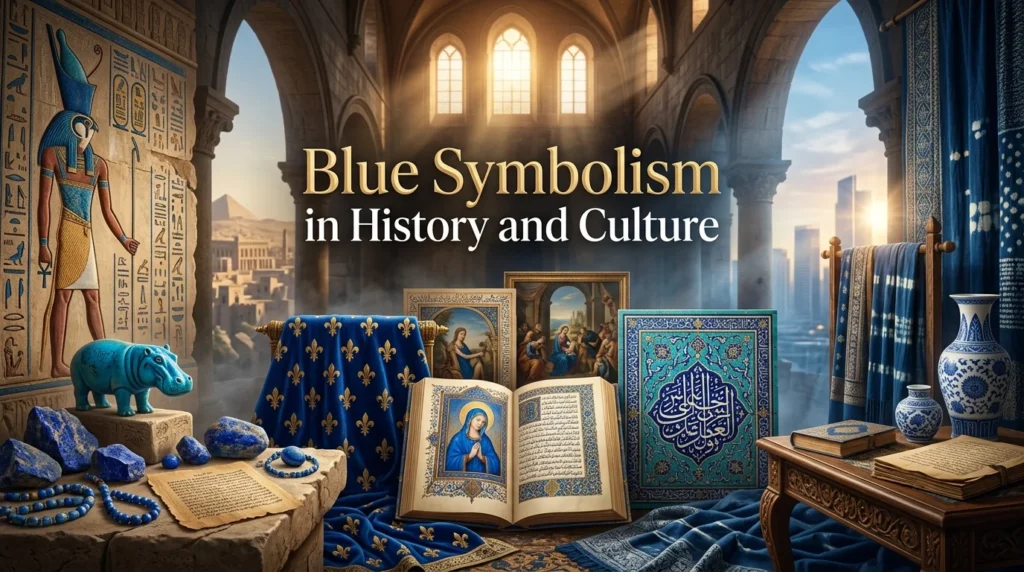
In the Hebrew Bible, blue or blue-purple materials appear in descriptions of sacred objects and priestly garments. One important example is tekhelet, a distinctive blue dye associated with ritual fringes and other sacred contexts.
Blue has therefore sometimes been interpreted in Jewish tradition as a reminder of divine commandments and spiritual awareness.
In Christianity, blue has also developed important symbolic associations. In Western Christian art, blue is especially associated with the Virgin Mary, often expressing qualities such as purity, humility, devotion, and heavenly significance.
These meanings are not universal across every denomination or historical period. Religious color symbolism has developed differently across cultures and artistic traditions.
Blue Symbolism in History and Culture
Blue has held a fascinating position throughout human history.
In the ancient world, producing durable blue pigments could be difficult and expensive. Certain natural blue materials therefore became associated with status, craftsmanship, or sacred art.
Egyptian blue, one of the earliest known synthetic pigments, was used in ancient Egyptian art and objects. Blue could be connected with the heavens, water, life, and the supernatural.
In later European art, ultramarine made from lapis lazuli became particularly valuable. Artists sometimes reserved this costly pigment for important subjects, contributing to blue’s association with prestige and sacred imagery.
Across different cultures, blue has also been connected with protection, spirituality, royalty, mourning, or social identity. Its meaning has never been completely fixed.
Cultural Meanings of Blue
Blue can symbolize different things around the world:
- Western cultures: Trust, calmness, professionalism, and stability
- Jewish tradition: Spiritual remembrance and religious observance through associations with tekhelet
- Christian art: Heaven, devotion, and the Virgin Mary
- Ancient Egypt: Sky, water, life, and supernatural associations
- Modern global culture: Technology, communication, reliability, and peace
This cultural variation is one reason color symbolism should always be interpreted within context.
Blue Symbolism in Literature and Art
Writers and artists have long used blue to communicate emotions that are difficult to express directly.
In literature, blue can suggest longing, melancholy, solitude, serenity, mystery, or hope. The phrase “feeling blue,” for example, reflects the color’s long-standing association with sadness in English-speaking culture.
Artists can use blue to control the emotional atmosphere of an entire composition. Cool blue tones may make a scene feel distant or peaceful, while intense blue can create drama and visual focus.
Pablo Picasso’s Blue Period provides one of the most famous examples of blue being strongly associated with emotional mood. During this period, his predominantly blue paintings conveyed themes of poverty, loneliness, hardship, and melancholy.
Blue can therefore communicate both comfort and sadness—a reminder that symbolism often depends on context rather than a single fixed definition.
Dream Meaning of Blue Symbolism
Seeing blue in a dream may be interpreted as a symbol of peace, emotional reflection, communication, freedom, or spiritual awareness.
The meaning can change depending on what the blue object or environment looked like and how you felt during the dream.
For example:
- Clear blue sky: Freedom, hope, or emotional openness
- Blue ocean: Emotional depth, intuition, or the unknown
- Bright blue light: Clarity, inspiration, or spiritual awareness
- Dark blue surroundings: Reflection, seriousness, or hidden emotions
- Blue clothing: Calmness, confidence, or self-expression
- Blue flowers: Peace, affection, remembrance, or emotional sensitivity
Dream interpretation is subjective rather than scientifically fixed. Your personal experiences and emotions are often more important than a universal color dictionary.
Modern Meaning of Blue Symbolism
Today, blue remains one of the most recognizable symbolic colors in everyday life.
Businesses often use blue to communicate trust, competence, security, and reliability. It appears frequently in technology, finance, healthcare, transportation, and corporate branding.
Blue also plays an important role in conversations about mental well-being and relaxation. Soft blue environments may be perceived as peaceful, while brighter blues can create a more energetic atmosphere.
Different shades communicate different impressions:
- Light blue: Peace, softness, openness, and freshness
- Sky blue: Freedom, optimism, and clarity
- Royal blue: Confidence, importance, and sophistication
- Navy blue: Authority, professionalism, and stability
- Turquoise: Healing, freshness, creativity, and emotional balance
- Electric blue: Energy, modernity, and bold expression
Blue’s modern popularity comes partly from its remarkable versatility. It can feel gentle and comforting or powerful and authoritative depending on how it is used.
Why Is Blue Associated With Calmness?
Blue is commonly associated with calmness because it reminds people of peaceful natural environments such as clear skies and quiet water.
Its cool visual character can also create an impression of stability and spaciousness, although individual reactions to color naturally vary.
What Does Blue Mean Spiritually?
Spiritually, blue can symbolize peace, truth, intuition, communication, faith, and a deeper connection with the unseen or transcendent.
Its meaning varies between religious and spiritual traditions, so personal and cultural context matters.
What Does the Color Blue Symbolize in Love?
Blue can symbolize loyalty, trust, emotional depth, and faithful affection in relationships.
Unlike the passion traditionally associated with red, blue often represents a quieter and more stable form of love.
What Does Dark Blue Symbolize?
Dark blue commonly represents authority, wisdom, stability, seriousness, confidence, and mystery.
It can create a feeling of strength without the intensity often associated with brighter colors.
What Does Light Blue Symbolize?
Light blue often symbolizes peace, innocence, openness, freshness, and emotional calm.
It can create a gentle atmosphere and is frequently associated with clear skies and tranquil water.
Conclusion: The Deeper Meaning of Blue Symbolism
Blue symbolism is ultimately about depth, peace, trust, and the freedom to look beyond the surface. From the endless sky to the mysterious ocean, blue reminds us of both calmness and possibility.
Whether it appears in art, spirituality, dreams, relationships, or everyday life, blue can invite us to slow down, communicate honestly, seek wisdom, and find peace within ourselves.

I am Luna Grace, an author passionate about exploring the meanings, history, and symbolism behind everyday signs. I enjoy sharing thoughtful insights that help readers understand symbols and their deeper significance.