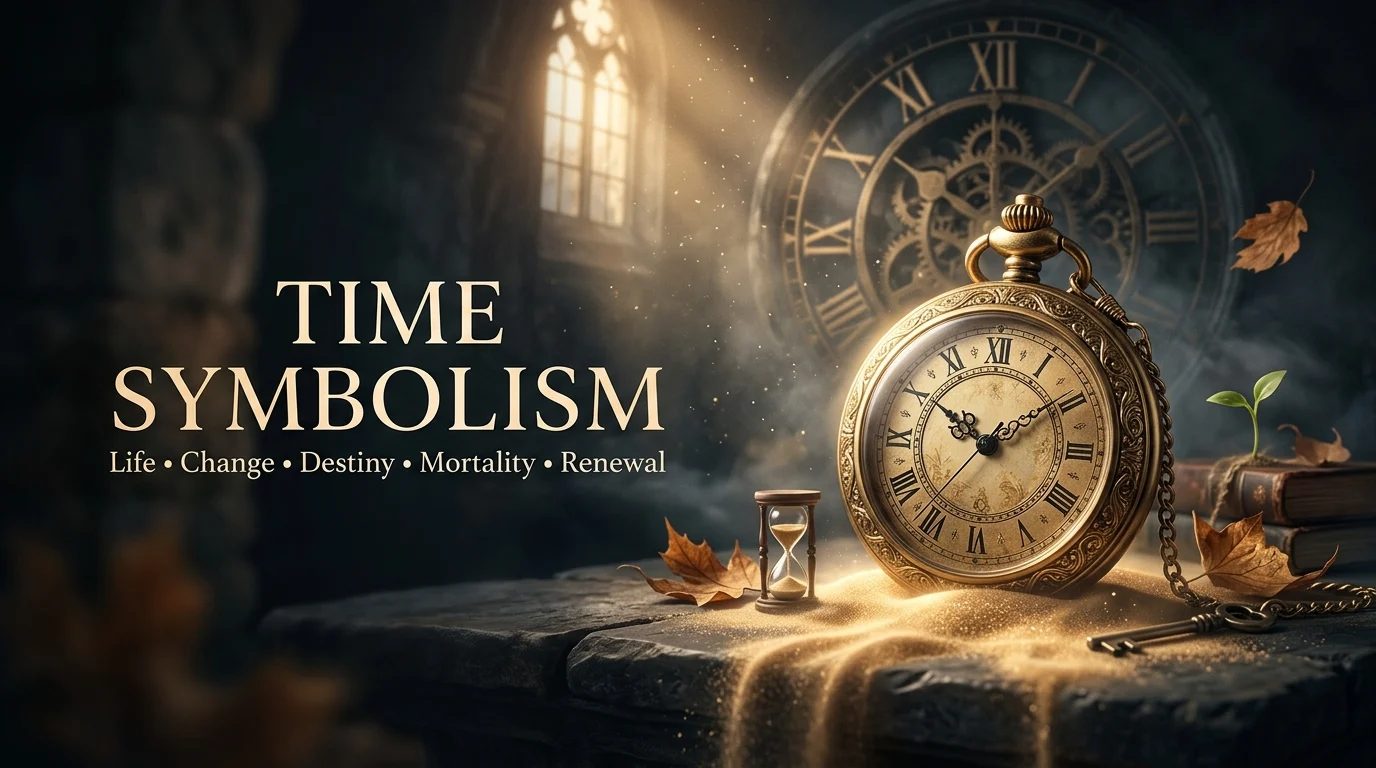
Time symbolism represents the passage of life, change, mortality, growth, opportunity, and the connection between the past, present, and future. Across cultures, time has symbolized both the limits of human existence and the possibility of renewal. It reminds us that every moment carries meaning and that life is constantly moving forward.
From ancient sundials and hourglasses to modern clocks, time has inspired people to reflect on their choices, relationships, dreams, and purpose. Its symbolism can be hopeful, spiritual, mysterious, or even unsettling, depending on how it appears in everyday life, religion, literature, and art.
Time Symbolism Meaning (Clear Definition)
Time symbolism is the use of time, clocks, calendars, seasons, and the movement of days to represent deeper ideas about human existence. It commonly symbolizes change, mortality, patience, destiny, progress, and the importance of the present moment.
Time can carry several meanings:
- Life and mortality: Time reminds us that human life is limited.
- Change and transformation: Everything develops, evolves, and eventually changes.
- Opportunity: Time represents the moments available to pursue goals and dreams.
- Patience and wisdom: Waiting and experience can lead to understanding.
- Memory and nostalgia: Time connects us to experiences and people from the past.
- Hope and renewal: A new day or season can symbolize a fresh beginning.
- Destiny and uncertainty: The future represents possibilities that have not yet unfolded.
At its heart, time symbolizes the movement of life and the meaning we create as we experience it.
What Does Time Symbolism Represent?
Time symbolism represents several important aspects of human life. Its meaning often depends on whether time is portrayed as passing quickly, standing still, repeating itself, or moving toward a particular moment.
|
Symbolic meaning
|
What it represents
|
| — | — |
|
Mortality
|
The temporary nature of human life
|
|
Change
|
Growth, endings, and transformation
|
|
Patience
|
Trusting the process and allowing things to develop
|
|
Opportunity
|
The importance of recognizing meaningful moments
|
|
Memory
|
Experiences, relationships, and personal history
|
|
Destiny
|
The unknown possibilities of the future
|
|
Renewal
|
New beginnings and fresh opportunities
|
|
Wisdom
|
Knowledge gained through experience
|
Time as a Symbol of Life
Time is closely connected to life because every human experience takes place within it. Childhood, adulthood, aging, and the different stages of personal development all demonstrate how life moves through time.
A clock can therefore represent the journey from birth to old age. Its movement may remind us to value our experiences rather than focus entirely on what comes next.
Time as a Symbol of Change
Time represents the natural process of change. Flowers bloom and fade, seasons shift, relationships develop, and people discover new ways of understanding themselves.
In symbolic imagery, a changing landscape or an aging tree can communicate the same message as a moving clock: nothing remains exactly as it was.
Time as a Symbol of Opportunity
Time can also represent the opportunities available in the present. A ticking clock may encourage someone to act, make a decision, or pursue an important goal.
This interpretation does not mean every moment must be productive. Rather, it suggests that awareness of time can help us recognize what genuinely matters.
Spiritual Meaning of Time Symbolism
Spiritually, time often represents divine timing, personal growth, patience, transformation, and the relationship between human life and something greater than ourselves.
In many spiritual traditions, time is more than a measurement. It is a way of reflecting on life’s cycles, the consequences of actions, and the importance of being present.
Divine Timing and Trust
Time can symbolize the belief that certain experiences unfold according to a greater order. The idea of divine timing encourages patience when circumstances do not develop as quickly as expected.
For some people, this meaning offers comfort during uncertainty. It can encourage them to remain hopeful while continuing to make thoughtful choices.
Time and Personal Growth
Spiritual growth often involves reflection, learning, and gradual transformation. Time symbolizes the process of becoming more self-aware and developing greater compassion, wisdom, and understanding.
Just as a seed needs time to grow, personal change may require consistent effort and patience.
The Power of the Present Moment
Time symbolism can also encourage mindfulness. The past cannot be physically revisited, and the future has not yet arrived.
The present is where people can respond to their circumstances, appreciate their relationships, and make decisions. Spiritually, this makes the current moment a symbol of awareness and possibility.
Repeating Cycles and Renewal
The daily movement from sunrise to sunset and the yearly return of seasons can symbolize spiritual renewal.
These recurring patterns may represent the idea that endings are not always final. Sometimes, they prepare the way for new experiences and a different stage of life.
Biblical / Religious Meaning of Time Symbolism
In the Bible and other religious traditions, time can symbolize divine authority, human mortality, patience, spiritual preparation, and the relationship between earthly life and eternity.
Biblical interpretations of time are particularly associated with God’s timing, the seasons of life, and the importance of using one’s days wisely.
Time in the Bible
Ecclesiastes 3:1 famously describes the idea that there is a season and an appropriate time for different human experiences. Its surrounding verses explore contrasting moments, including birth and death, planting and harvesting, mourning and dancing.
This passage connects time with the changing circumstances of human life. It suggests that experiences that seem opposite can each have their place within life’s broader journey.
Psalm 90:12 also expresses the importance of recognizing the limited nature of human life and developing wisdom.
God’s Timing and Patience
In Christian interpretation, time can symbolize trust in God’s purposes. Believers may understand periods of waiting as opportunities for prayer, spiritual maturity, and perseverance.
This does not mean every delay has an obvious explanation. Rather, the symbolism of patience encourages faithfulness even when the future remains uncertain.
Time and Eternity
Many religious traditions distinguish between earthly time and eternity. Human life is experienced through days and years, while eternity represents existence beyond ordinary temporal limits.
In Christianity, this distinction can make time a reminder of life’s spiritual significance and the hope of eternal life.
Time in Other Religious Traditions
Religious understandings of time are not identical.
- Hindu traditions: Time is often understood through vast cosmic cycles of creation, preservation, and dissolution, although interpretations vary.
- Buddhist traditions: Impermanence emphasizes that experiences and conditioned things are constantly changing.
- Islam: Time is connected with accountability, worship, patience, and the importance of using one’s life meaningfully.
Across these traditions, time can prompt reflection on impermanence, responsibility, spiritual discipline, and the wider order of existence.
Time Symbolism in History and Culture
Throughout history, people have used natural cycles and timekeeping devices to understand their world. The sun, moon, stars, seasons, and mechanical clocks have all become powerful cultural symbols.
Ancient Sundials and the Movement of the Sun

Ancient sundials used the position of the sun to indicate time. Their symbolism is closely connected with nature, daylight, human observation, and the relationship between the heavens and everyday life.
Because sunlight moves across the sky, sundials can also suggest the passage of life and the steady movement of the natural world.
The Hourglass and Mortality

The hourglass is one of the clearest symbols of time’s passing. Its falling sand represents the gradual movement toward an ending.
In historical artwork, hourglasses have often appeared alongside skulls, candles, and other objects associated with mortality. Together, these objects communicate the idea that life is temporary and should be approached thoughtfully.
Calendars and the Cycles of Nature
Calendars have helped societies organize agricultural work, religious festivals, public events, and everyday responsibilities.
Symbolically, calendars represent order, planning, collective memory, and the repetition of natural cycles. The beginning of a new year, for example, is often associated with reflection, renewal, and the possibility of change.
Clocks and Modern Civilization
Mechanical clocks changed how people organized work, travel, education, and public life.
Over time, clocks became symbols of punctuality, discipline, responsibility, and social expectations. A clock can represent the structure that makes coordinated life possible, but it can also symbolize pressure and the feeling of having too little time.
Time Symbolism in Literature and Art
In literature and art, time is frequently used to explore memory, aging, identity, love, loss, regret, and the uncertainty of the future.
Writers and artists can represent time directly through clocks and calendars or indirectly through changing landscapes, repeated events, fading objects, and characters growing older.
Time as Memory in Literature
In literature, time often connects the present with the past. A character may remember childhood, revisit an important place, or struggle with an experience that continues to shape their identity.
Flashbacks and shifts between different periods allow writers to show how earlier experiences influence present decisions.
Time can therefore symbolize the lasting emotional effects of memory and the difficulty of separating who we were from who we are.
Time as an Image of Mortality
Poetry and visual art often use clocks, autumn leaves, fading flowers, and aging faces to express the temporary nature of life.
A flower losing its petals, for example, can suggest beauty that cannot remain unchanged forever. Such images can communicate sadness, but they can also emphasize the importance of appreciating beauty while it lasts.
Time and the Future
Stories about journeys, prophecy, waiting, and imagined futures often use time to explore hope and uncertainty.
A sunrise may symbolize a future filled with possibilities, while a darkening sky can represent the closing of an opportunity or the approach of an unknown event.
The Clock as an Artistic Symbol

Clocks in art can communicate very different ideas depending on their appearance.
- A broken clock may suggest disruption, loss, or an experience outside ordinary time.
- A stopped clock may represent a moment that feels emotionally frozen.
- A melting clock may suggest the instability of time or the strange nature of human perception.
- A clock without hands may represent uncertainty, freedom, or the absence of direction.
The visual context determines which interpretation is most appropriate.
Dream Meaning of Time Symbolism
Dreams involving time may reflect personal concerns about deadlines, aging, change, memory, or uncertainty. Their meanings are subjective, and there is no universal interpretation that applies to everyone.
The details of the dream and the emotions experienced during it are important.
Dreaming of a Clock
A clock in a dream may reflect awareness of responsibilities, deadlines, or an important decision. If the clock is ticking loudly, the dream might connect with a feeling of pressure or urgency.
A peaceful clock, on the other hand, might represent routine, stability, or a comfortable sense of direction.
Dreaming of Running Out of Time
Dreaming that time is running out may be associated with stress, fear of missing an opportunity, or concern about an unfinished task.
It can be useful to consider whether anything in waking life currently feels rushed or unresolved.
Dreaming of Time Moving Backward
A dream about reversing time may relate to memories, regret, or a wish to reconsider a past decision.
It does not necessarily mean someone wants to return to the past. It may simply reflect an effort to understand an experience or imagine a different outcome.
Dreaming of Time Standing Still
Time stopping in a dream may symbolize a moment of intense emotion, uncertainty, or a desire for a pause.
Consider whether the dream felt comforting or frightening. The emotional experience may offer more insight than the unusual event itself.
Modern Meaning of Time Symbolism
In modern life, time symbolism is closely associated with productivity, personal freedom, technology, work-life balance, and the pressure to manage competing responsibilities.
Digital clocks, notifications, calendars, and countdowns make time highly visible in everyday routines.
Time and Productivity
A clock can symbolize organization, achievement, and the desire to use time efficiently. Many people use schedules and calendars to coordinate responsibilities and work toward personal goals.
However, time can also become a source of stress when every moment feels like it must be productive.
The symbolism of time can remind people that rest, relationships, creativity, and reflection also deserve space.
Time and Technology
Digital devices make it possible to track time with extraordinary precision. At the same time, constant notifications and online activity can create the impression that people must always be available.
In this context, time can symbolize the tension between convenience and distraction, as well as the challenge of protecting attention.
Time and Personal Freedom
Time is also connected to independence. Having control over one’s schedule can create opportunities for hobbies, family life, travel, learning, and rest.
For this reason, having time can represent a form of personal freedom, not simply a resource for getting more work done.
Time and New Beginnings
Birthdays, anniversaries, new years, and personal milestones often encourage people to reflect on their progress.
These occasions make time a symbol of renewal and personal possibility. They can provide a meaningful opportunity to acknowledge past experiences and decide what deserves attention in the future.
Frequently Asked Questions About Time Symbolism
1. What is the main meaning of time symbolism?
Time symbolism primarily represents the passage of life, change, mortality, and opportunity. It can also symbolize patience, memory, destiny, and renewal.
2. What does time symbolize spiritually?
Spiritually, time can represent divine timing, personal transformation, patience, and awareness of the present moment. Its meaning varies across beliefs and traditions.
3. What does a clock symbolize?
A clock commonly symbolizes the passage of time, punctuality, responsibility, and the limits of human life. Depending on its condition and setting, it can also represent urgency, stability, or change.
4. What does an hourglass symbolize?
An hourglass usually represents mortality, the passing of time, and the temporary nature of life. It can also encourage patience and appreciation of the present.
5. What does time symbolize in dreams?
Time in dreams may reflect concerns about deadlines, personal change, memories, or uncertainty about the future. The dreamer’s emotions and real-life circumstances are important when exploring possible meanings.
Conclusion
Time symbolism reminds us that life is always changing and that every stage has its own meaning. It represents both the limits of our existence and the opportunities available within it.
Whether expressed through a clock, an hourglass, the changing seasons, or the beginning of a new day, time encourages us to reflect on our experiences, appreciate the present, and approach the future with intention.

I am Simon Michael, an author passionate about exploring symbols, their meanings, and cultural significance. I enjoy making symbolism simple, engaging, and meaningful for curious readers everywhere.