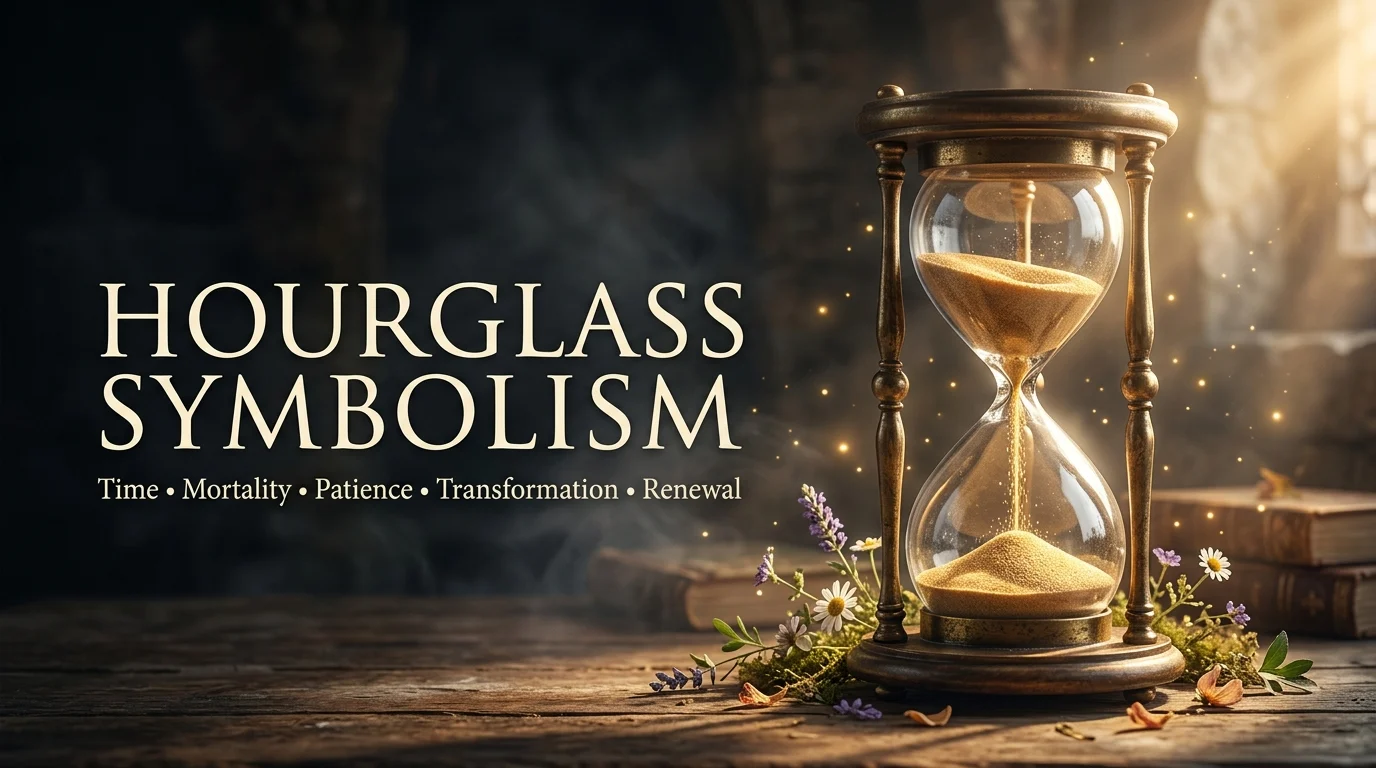
Hourglass symbolism represents the passage of time, the temporary nature of life, patience, mortality, and the importance of living in the present. With its flowing sand and two connected chambers, the hourglass reminds us that every moment is precious and that change is an unavoidable part of life.
An hourglass is more than a simple instrument for measuring time. Across history, it has become a powerful symbol of life’s beginning and ending, the wisdom gained through experience, and the opportunities we have before time runs out.
Whether you see an hourglass in a dream, a painting, a spiritual setting, or everyday life, its meaning often encourages you to reflect on how you spend your time and what truly matters.
Hourglass Symbolism Meaning (Clear Definition)
The symbolic meaning of an hourglass is the passage of time and the certainty of change. Its falling sand represents moments moving forward, while its two chambers symbolize different stages of existence, such as beginnings and endings, youth and age, or life and death.
The hourglass commonly symbolizes:
- Time: Every moment passes and cannot be recovered.
- Mortality: Human life is temporary, making each day meaningful.
- Patience: Important things often require time and persistence.
- Transformation: Life moves through different stages and experiences.
- Balance: The two chambers suggest the relationship between beginnings and endings.
- Urgency: The falling sand reminds us that opportunities may not last forever.
- Wisdom: Recognizing the limits of time can help us make thoughtful decisions.
At its heart, the hourglass symbolizes the relationship between time, change, and human experience.
What Does Hourglass Symbolism Represent?
The hourglass represents several connected ideas, from the unavoidable passage of time to the possibility of personal growth. Its meaning can change depending on its setting, appearance, and cultural context.
|
Symbolic meaning
|
Interpretation
|
| — | — |
|
Time
|
Life moves forward one moment at a time.
|
|
Mortality
|
Every human life has a natural limit.
|
|
Patience
|
Growth and understanding take time.
|
|
Transformation
|
Every ending can lead to a new beginning.
|
|
Balance
|
Different stages of life are connected.
|
|
Opportunity
|
The present moment deserves attention.
|
|
Destiny
|
Some aspects of life unfold beyond our control.
|
1. The Passage of Time
The most recognizable meaning of the hourglass is the passage of time. As sand falls from the upper chamber to the lower one, it illustrates how moments continually move from the future into the past.
This symbolism encourages people to become more aware of their daily choices. Time is constantly moving, even when life feels ordinary or repetitive.
2. Mortality and the Temporary Nature of Life
An hourglass is often associated with mortality because its sand eventually runs out. It reminds us that life is finite and that no one can preserve every moment indefinitely.
Rather than representing only sadness or fear, this meaning can encourage gratitude, meaningful relationships, and a deeper appreciation of everyday experiences.
3. Patience and Perseverance
The steady movement of sand also represents patience. Each grain falls at its own pace, suggesting that meaningful achievements and personal development cannot always be rushed.
The hourglass can serve as a reminder to trust the process, remain consistent, and allow important changes to unfold naturally.
4. Transformation and New Beginnings
An hourglass has two chambers connected by a narrow passage. When all the sand moves into the lower chamber, the glass can be turned over and the process begins again.
This makes it a symbol of transformation, renewal, and life’s repeating cycles. An ending does not necessarily mean that everything is finished; it may simply mark the beginning of another chapter.
5. Balance Between Past and Future
The two chambers can represent the relationship between the past and the future, with the narrow center representing the present.
The hourglass invites us to recognize our experiences without becoming trapped in yesterday or overly anxious about tomorrow.
Spiritual Meaning of Hourglass Symbolism
Spiritually, the hourglass can represent divine timing, personal awakening, the impermanence of worldly experiences, and the importance of being present.
Its steady movement can encourage reflection on how people respond to uncertainty, change, and the limits of their control.
1. Divine Timing
Some spiritual interpretations associate the hourglass with divine timing. The steady falling sand can represent the belief that life unfolds through stages, even when the purpose of an experience is not immediately clear.
For people who hold this belief, the hourglass can be a reminder to practice patience while remaining open to opportunities.
2. Living in the Present Moment
The narrow center of an hourglass offers a useful spiritual metaphor for the present.
The past has already moved through, while the future has not yet arrived. The only moment we can directly experience and influence is now.
This interpretation encourages mindfulness, gratitude, and attention to ordinary experiences.
3. Spiritual Transformation
The hourglass can symbolize a transition from one state of awareness to another.
Its upper and lower chambers may be interpreted as different phases of spiritual development, while the falling sand represents the experiences that connect them.
In this sense, difficult periods, personal discoveries, and major life changes can become opportunities for reflection and growth.
4. Impermanence and Letting Go
Many spiritual traditions emphasize that circumstances, emotions, possessions, and even relationships can change.
The hourglass offers a visual reminder of impermanence. It can encourage people to appreciate what they have without assuming that everything will remain the same.
Letting go, in this interpretation, means accepting change while continuing to act with care and intention.
Biblical / Religious Meaning of Hourglass Symbolism
The hourglass is not a central or explicitly established symbol in the Bible. However, its themes of limited human life, wisdom, patience, and the passage of time can be compared with several biblical teachings.
1. Human Life Is Temporary
Psalm 90:12 asks for wisdom in recognizing the limited number of our days.
This idea closely relates to hourglass symbolism. Both encourage people to acknowledge life’s brevity and use their time thoughtfully.
The hourglass can therefore serve as a visual reminder of the value of wisdom and purposeful living.
2. God’s Timing and Patience
Ecclesiastes 3:1 describes how there is a season for different activities and experiences.
This teaching can be connected to the hourglass because its movement suggests that life unfolds through different periods. The symbolism may encourage patience and acceptance when circumstances cannot be changed immediately.
3. The Importance of Wisdom
In Christian interpretations, the hourglass can represent the need to make meaningful choices during one’s lifetime.
Its falling sand may remind believers that earthly opportunities are limited and that faith, kindness, compassion, and spiritual priorities deserve attention.
These are symbolic associations rather than a specific biblical definition of the hourglass.
Hourglass Symbolism in History and Culture
The hourglass has a long history as a practical timekeeping device and a visual representation of passing time. Its simple construction made it particularly useful as a symbol in historical art, religious imagery, and objects associated with daily life.
1. The Hourglass as a Timekeeping Device
Hourglasses became useful tools for measuring intervals of time before modern clocks were widely available.
They were used in settings where a relatively consistent duration was important, including maritime activities and some household or institutional routines.
Their practical function helped establish their symbolic connection with time, deadlines, and the temporary nature of human activity.
2. Medieval and Renaissance Symbolism
In European medieval and Renaissance art, the hourglass became associated with mortality and the transience of earthly life.
It appeared in imagery that encouraged viewers to reflect on death, moral responsibility, and the difference between temporary worldly possessions and lasting spiritual concerns.
The hourglass could also accompany personifications of time and representations of human aging.
3. The Hourglass and Father Time
In traditional European imagery, Father Time is sometimes depicted carrying an hourglass.
This figure personifies time as a force that continually moves forward, affecting all living things regardless of wealth, status, or power.
The hourglass reinforces the idea that no person can escape the passage of time.
4. Maritime and Everyday Culture
Hourglasses have also been associated with navigation, work, and daily routines.
On ships, particular types of sand timers were used to measure intervals important to maritime activities. In everyday contexts, they could represent discipline, order, and the careful management of limited time.
Their continued appearance in modern designs preserves these practical and symbolic associations.
Hourglass Symbolism in Literature and Art
In literature and visual art, the hourglass often communicates ideas that would otherwise require lengthy explanations. Its falling sand provides a recognizable image of time passing, while its shape suggests the connection between different stages of existence.
1. Mortality in Classical and Traditional Art
The hourglass is a familiar object in vanitas imagery, a tradition of still-life painting that emphasizes the temporary nature of worldly achievements and possessions.
Artists placed hourglasses alongside objects such as skulls, extinguished candles, flowers, and books.
Together, these objects encouraged viewers to consider mortality, knowledge, beauty, and the limits of material success.
2. Time and Regret in Literature
Writers can use the hourglass as a metaphor for opportunities that gradually disappear.
A character watching sand fall might be confronting an approaching deadline, regretting a past decision, or recognizing that an important relationship is changing.
The symbol can create tension because the reader understands that time continues to move even when a character hesitates.
3. Transformation and Rebirth in Visual Art
Artists may also use the hourglass to communicate renewal rather than simply loss.
An hourglass being turned upside down can represent a fresh start, a reversal of circumstances, or a willingness to approach life differently.
In contemporary illustrations, it may appear alongside flowers, butterflies, stars, or natural landscapes to emphasize growth and the cyclical character of existence.
Dream Meaning of Hourglass Symbolism
Dreaming of an hourglass may reflect your thoughts about time, responsibilities, life changes, or the pressure to make a decision. The interpretation depends on the dream’s details and the emotions you experienced.
Dream symbols do not have universally established meanings, so consider these possibilities as prompts for personal reflection rather than predictions.
1. Seeing an Hourglass in a Dream
Seeing an hourglass may reflect an awareness that something in your life is changing or approaching an important stage.
You might be thinking about an upcoming deadline, a personal goal, or a decision that requires attention.
Consider whether the dream made you feel calm, curious, anxious, or rushed.
2. Watching Sand Fall
Watching sand fall may symbolize your awareness of time passing.
If you felt peaceful, the dream might reflect acceptance and patience. If you felt worried, it might mirror pressure about responsibilities or opportunities.
3. An Empty Hourglass
An empty hourglass may represent a sense of completion, exhaustion, or concern that an opportunity has passed.
It may also symbolize the end of a particular stage and the need to decide what comes next.
The surrounding dream details can help distinguish between these interpretations.
4. Turning an Hourglass Upside Down
Turning an hourglass over may symbolize a fresh start, a changed perspective, or the decision to begin again.
It can be a useful image for reflecting on habits, relationships, or goals that you want to approach differently.
5. A Broken Hourglass
A broken hourglass may represent disrupted plans, anxiety about uncertainty, or a feeling that you have lost control of a situation.
It can also suggest a desire to break free from rigid expectations about how quickly something should happen.
Modern Meaning of Hourglass Symbolism
Today, the hourglass remains a recognizable symbol of time, urgency, patience, and intentional living. Its appearance in digital interfaces, jewelry, tattoos, decorations, and personal accessories gives it new meanings while preserving its traditional associations.
1. Hourglass Symbolism in Tattoos
An hourglass tattoo can express a personal relationship with time and the experiences that shape a person’s life.
Common interpretations include:
- Mortality: Remembering that life is limited.
- Resilience: Continuing forward through difficult periods.
- Transformation: Recognizing personal growth and change.
- Mindfulness: Appreciating the present.
- Remembrance: Honoring a person, relationship, or meaningful period of life.
An hourglass tattoo paired with flowers may emphasize growth and renewal, while one paired with a skull may emphasize mortality and the temporary nature of life.
2. Hourglass Symbolism in Jewelry
Hourglass pendants, rings, and other accessories can represent a personal reminder to value time.
For some people, they symbolize a meaningful life transition. For others, they express patience, remembrance, or the desire to make more deliberate choices.
The meaning often comes from the wearer’s personal experiences rather than a fixed cultural definition.
3. Hourglass Symbolism in Digital Life
The hourglass is widely recognizable as a visual metaphor for waiting.
In digital interfaces, an hourglass or similar loading symbol can indicate that a process is underway and that the user needs to wait.
This modern usage reinforces its associations with patience, anticipation, and the temporary suspension of activity.
4. The Hourglass as a Reminder to Live Intentionally
In a world filled with deadlines, notifications, and competing demands, the hourglass can encourage people to reflect on how they allocate their attention.
It can serve as a reminder that spending time meaningfully matters as much as managing it efficiently.
Rather than encouraging constant urgency, the symbol can invite a balance between ambition, rest, relationships, and personal fulfillment.
What Does an Hourglass Symbolize in Love?
In love, the hourglass can symbolize commitment, shared experiences, patience, and the changing nature of relationships.
Its flowing sand may represent the time two people spend together, while its connected chambers can suggest the different stages of a relationship.
An hourglass can also remind partners that relationships require attention. Meaningful connections grow through everyday actions, communication, and mutual care.
When associated with remembrance, it may represent a relationship that continues to hold significance even after circumstances have changed.
What Does an Upside-Down Hourglass Symbolize?
An upside-down hourglass commonly symbolizes a fresh start, a change in perspective, or the beginning of another cycle.
Turning the hourglass over reverses the movement of the sand, making it a natural metaphor for renewal and new opportunities.
Depending on the context, it can also represent the idea that life moves through repeating stages, with each new beginning shaped by previous experiences.
FAQs About Hourglass Symbolism
1. What is the main meaning of hourglass symbolism?
Hourglass symbolism primarily represents the passage of time, mortality, patience, and change. It reminds us that life is temporary and that the present moment deserves attention.
2. What does an hourglass symbolize spiritually?
Spiritually, an hourglass can symbolize divine timing, impermanence, mindfulness, and transformation. Its meaning often depends on a person’s beliefs and the circumstances in which the symbol appears.
3. Is an hourglass a symbol of good luck?
An hourglass is not universally recognized as a good-luck symbol. However, some people associate it with patience, renewal, and the possibility of making meaningful changes.
4. What does an hourglass symbolize in a tattoo?
An hourglass tattoo often represents the value of time, mortality, personal transformation, and resilience. Additional imagery can give the tattoo a more specific personal meaning.
5. What does it mean to dream about an hourglass?
Dreaming about an hourglass may reflect your awareness of time, upcoming decisions, or personal transitions. Your emotions and the details of the dream can help you explore what it means to you.
Conclusion
Hourglass symbolism reminds us that time is always moving, life continually changes, and every stage has its own significance. From mortality and patience to transformation and renewal, the hourglass offers a meaningful way to reflect on life’s limits and possibilities.
Its deepest message is not simply that time runs out, but that the moments we have can be lived with greater purpose, gratitude, and awareness.

I am Simon Michael, an author passionate about exploring symbols, their meanings, and cultural significance. I enjoy making symbolism simple, engaging, and meaningful for curious readers everywhere.