Map Symbolism Meaning (Clear Definition)
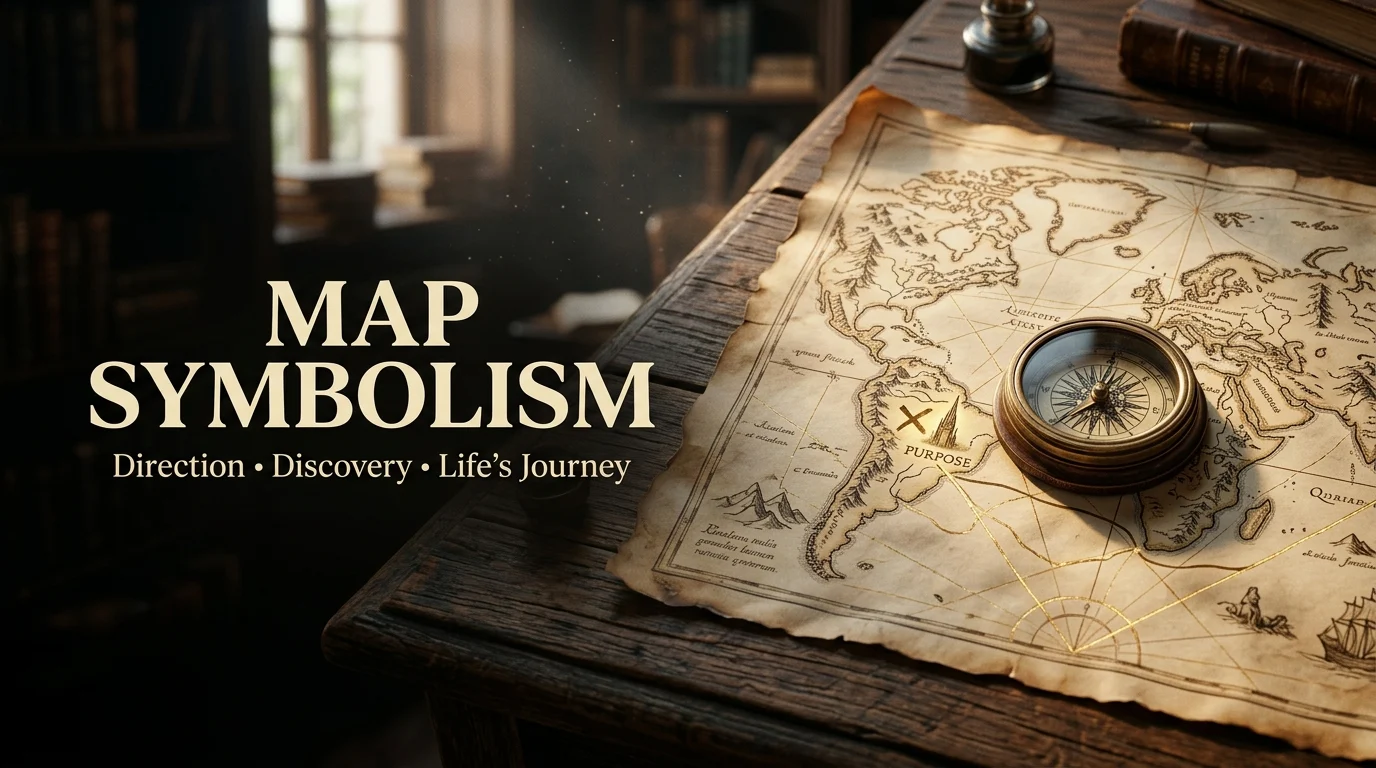
Map symbolism represents direction, guidance, exploration, discovery, and the search for purpose. A map is more than a tool for finding places; it can symbolize the journey through life, the choices we make, and the desire to understand where we belong.
In everyday life, maps help us navigate unfamiliar surroundings. Symbolically, they reflect our need for clarity when facing uncertainty, change, or important decisions. They can also represent the knowledge, experience, and wisdom that help us move forward.
At its heart, map symbolism is about finding your way, discovering new possibilities, and understanding your place in the world.
What Does Map Symbolism Represent?
Maps carry several meaningful interpretations, depending on their appearance, purpose, and cultural context.
|
Symbolic meaning
|
Interpretation
|
| — | — |
|
Direction
|
Knowing where you want to go
|
|
Guidance
|
Finding support and advice
|
|
Exploration
|
Discovering unfamiliar opportunities
|
|
Life journey
|
Moving through different experiences
|
|
Knowledge
|
Understanding the world around you
|
|
Freedom
|
Having choices and exploring possibilities
|
|
Purpose
|
Finding meaning and personal direction
|
1. Direction and Guidance
One of the most common meanings of a map is direction. It symbolizes the desire to make informed decisions and find a clear path through life’s uncertainties.
A map can represent a mentor, personal values, education, or experience that helps someone choose their next step.
2. Exploration and Discovery
Maps are closely associated with adventure and discovering unfamiliar places. Symbolically, they represent curiosity, courage, and the willingness to step outside your comfort zone.
An old map, in particular, may suggest forgotten opportunities, hidden knowledge, or a desire to reconnect with the past.
3. Life’s Journey
A map can symbolize the different stages of life, including challenges, achievements, unexpected changes, and new beginnings.
Just as a traveler may change direction when a road is blocked, people often adjust their plans as they learn and grow.
4. Knowledge and Understanding
Maps transform complicated geographical information into something understandable. Symbolically, they represent wisdom, planning, learning, and the ability to see the bigger picture.
A map may also suggest that you are trying to organize your thoughts or understand a complicated situation.
5. Freedom and Possibility
A map can represent the freedom to choose your own destination. It suggests that life offers multiple routes, and your decisions influence which experiences you encounter.
An open map may symbolize independence, opportunity, and excitement about the future.
Spiritual Meaning of Map Symbolism
Spiritually, map symbolism can represent the search for inner direction, personal transformation, and a deeper understanding of your purpose.
A map may serve as a metaphor for the spiritual journey: a process of learning, reflection, uncertainty, and discovering what matters most.
Finding Your Spiritual Path
A map can symbolize the desire to understand your beliefs and values. It may represent the questions you ask when searching for peace, meaning, or a stronger connection with your inner self.
Rather than suggesting that every answer is already known, a spiritual map can remind you that understanding often develops gradually.
Trusting the Journey
Not every journey follows a straight line. A map can symbolize patience and trust when your progress feels slow or your destination remains unclear.
Its meaning may encourage you to accept that uncertainty is sometimes part of personal growth.
Discovering Inner Wisdom
A map can also represent intuition and self-awareness. Reading a map requires interpreting information and choosing a direction; similarly, spiritual reflection involves considering your experiences and making thoughtful decisions.
A map with an unclear route might symbolize a period of questioning, while a clear route might represent a growing sense of purpose.
Biblical / Religious Meaning of Map Symbolism
Maps are not a central recurring symbol in the Bible in the way that roads, journeys, wilderness, and paths are. However, maps can be interpreted through these related biblical themes.
God’s Guidance
In Christian interpretation, a map can represent the desire for divine guidance. Biblical imagery frequently uses paths and ways to describe a person’s relationship with God.
For example, Psalm 119:105 describes God’s word as a lamp for the feet and a light for the path. A map can serve as a modern metaphor for seeking guidance through faith.
The Journey of Faith
Many biblical narratives involve journeys, including Abraham’s travels and the Israelites’ journey through the wilderness.
A map may symbolically represent faith during periods of transition, when the destination is important but the route is not fully understood.
Wisdom and Discernment
A map can also represent the importance of seeking wisdom before making decisions. In a religious context, it may suggest prayer, reflection, and considering moral responsibilities when choosing a direction.
These are symbolic interpretations rather than a fixed biblical meaning assigned to maps.
Map Symbolism in History and Culture
Maps have played important roles in navigation, trade, exploration, politics, education, and the understanding of the natural world. Their symbolism has developed alongside these practical uses.
Ancient Maps and the Search for Understanding

Early maps often reflected both geographical knowledge and the worldview of the people who created them.
Some ancient maps emphasized cities, rivers, trade routes, or sacred places. Others represented the world according to religious, political, or philosophical ideas.
Symbolically, these maps can represent humanity’s longstanding desire to understand its surroundings and place in the universe.
Maps and Exploration

During periods of maritime exploration, maps became associated with discovery, navigation, trade, and encounters between cultures.
An old nautical map can symbolize adventure, ambition, uncertainty, and the courage to travel beyond familiar boundaries.
However, historical maps can also represent territorial claims, colonial expansion, and political power. Their meaning depends partly on who created them and whose perspective they reflect.
Maps as Cultural Identity
Maps can represent the connection between people and their homeland. They may carry meanings associated with ancestry, belonging, national identity, and collective memory.
For displaced communities, maps may also symbolize separation, migration, and the longing to return to familiar places.
Map Symbolism in Literature and Art
In literature and visual art, maps often function as symbols of adventure, imagination, identity, and the search for meaning.
Maps as Symbols of Adventure
In adventure stories, a map may introduce a mystery or provide the starting point for an exciting journey.
A marked location, hidden island, or unexplored territory can symbolize the possibility of discovering something extraordinary.
Maps in these stories often represent the difference between the familiar world and the unknown.
Maps as Symbols of Personal Growth
In reflective literature, maps can symbolize the complicated process of becoming yourself.
A character searching for a destination may actually be searching for belonging, identity, freedom, or a sense of purpose.
An incomplete map can represent uncertainty, while a map that changes throughout a story may reflect a character’s evolving understanding.
Maps in Visual Art

Artists may use maps to explore the relationship between geography, memory, history, and identity.
A map can be shown as a beautiful object, a record of a journey, or a representation of boundaries and human ambitions.
Contemporary artworks may also distort or fragment maps to question how people understand territory, ownership, and belonging.
Dream Meaning of Map Symbolism
Dreaming about a map may reflect your thoughts about direction, decisions, uncertainty, or future plans. Its possible meaning depends on what happens in the dream and how you feel.
Dream interpretations are subjective, not reliable predictions or universal explanations.
|
Map dream
|
Possible symbolic interpretation
|
| — | — |
|
Reading a map
|
Seeking clarity or guidance
|
|
Losing a map
|
Feeling uncertain about a decision
|
|
Finding an old map
|
Revisiting memories or past ambitions
|
|
Following a map
|
Working toward a particular goal
|
|
Drawing a map
|
Planning your future
|
|
Seeing an unfamiliar map
|
Considering new possibilities
|
Dreaming of Reading a Map
Reading a map in a dream may reflect your desire to understand a situation or decide what to do next.
It may be especially meaningful if you are currently facing an important choice.
Dreaming of Losing a Map
Losing a map may symbolize uncertainty or frustration about your direction.
It could reflect a feeling that your plans are incomplete or that you need more information before moving forward.
Dreaming of Finding a Map
Finding a map may represent discovering a new idea, recognizing an opportunity, or reconsidering an ambition.
If the map leads somewhere meaningful in the dream, consider what that destination represents to you personally.
Modern Meaning of Map Symbolism
In modern life, maps have expanded beyond paper and navigation. Digital maps, virtual worlds, and data visualizations have given them additional symbolic meanings.
Digital Maps and Connection
Digital maps can symbolize accessibility, connection, and the ability to navigate a complex world.
They help people find places, coordinate journeys, and understand their surroundings. Symbolically, they can represent how technology makes information easier to access.
Maps and Personal Goals
A map can also be a metaphor for planning your future. People use vision boards, roadmaps, and personal development plans to organize ambitions into achievable steps.
A personal map might include career goals, relationships, learning, travel, and milestones that matter to you.
Maps and Self-Discovery
Modern map symbolism is also closely connected to understanding your own identity.
A personal map might represent where you have been, what you have learned, what matters to you, and where you hope to go.
It can remind you that your life is not simply a destination to reach, but an experience shaped by your choices.
What Does an Old Map Symbolize?
An old map commonly symbolizes history, forgotten knowledge, nostalgia, adventure, and the desire to uncover something hidden. It can also represent inherited beliefs or lessons from previous generations.
What Does a Map Symbolize in Love?
In relationships, a map can symbolize shared direction, emotional understanding, and planning a future together. It may also represent the importance of respecting each person’s individual journey while building a common path.
What Does a Map Symbolize in Personal Growth?
A map can symbolize self-discovery, progress, and the ability to make intentional choices. It represents the idea that personal growth involves exploring possibilities, learning from setbacks, and adjusting your direction.
Is Map Symbolism Positive or Negative?
Map symbolism is generally associated with guidance, exploration, knowledge, and opportunity, but it can also represent confusion, restrictions, boundaries, or the fear of getting lost. Its meaning depends on the context and the person’s interpretation.
Conclusion
Map symbolism represents direction, exploration, knowledge, freedom, and the journey toward a meaningful life. Whether it appears in history, spirituality, literature, dreams, or modern culture, a map reminds us that finding our way involves both thoughtful planning and the courage to explore. Sometimes, the most meaningful part of the journey is discovering who we become along the way.

I am Simon Michael, an author passionate about exploring symbols, their meanings, and cultural significance. I enjoy making symbolism simple, engaging, and meaningful for curious readers everywhere.