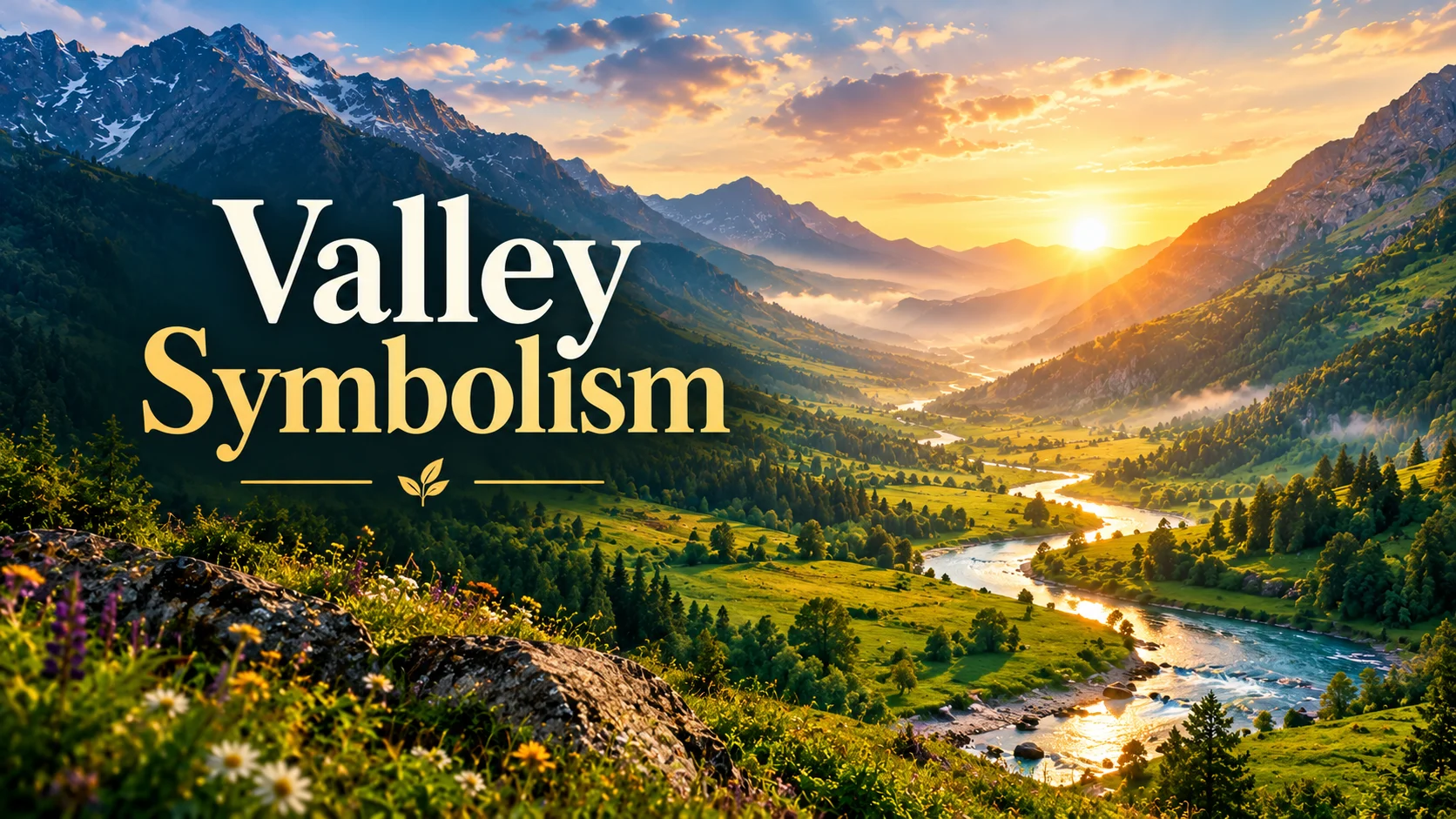
Valley symbolism represents humility, peace, reflection, personal growth, and the journey through life’s challenges. A valley lies between mountains, creating a powerful image of shelter, renewal, and the quiet spaces where transformation begins. While mountains often symbolize ambition and achievement, valleys remind us that life also requires patience, rest, and inner strength.
The meaning of a valley can change depending on its appearance, cultural context, and personal associations. A green valley filled with flowers may suggest abundance and hope, while a dark or misty valley may represent uncertainty, emotional struggles, or a journey into the unknown.
Understanding valley symbolism helps us explore how landscapes reflect human emotions, spiritual beliefs, and the different seasons of life.
Valley Symbolism Meaning (Clear Definition)
Valley symbolism refers to the symbolic meanings associated with valleys, including humility, protection, emotional depth, transition, and renewal. Because valleys exist between higher elevations, they often represent the quieter periods of life when people reflect, recover, and prepare for new beginnings.
A valley can symbolize both difficulty and comfort. It may represent a low point in someone’s journey, but it can also be a peaceful refuge where growth becomes possible.
In symbolic interpretation, a valley often reminds us that being in a low place does not mean we have failed. Sometimes, it is where we find clarity, develop resilience, and discover what truly matters.
Key Symbolic Meanings of a Valley
| Symbolic meaning | What it represents |
|---|---|
| Humility | Accepting life’s natural ups and downs |
| Peace | Finding calm away from pressure and noise |
| Protection | Feeling sheltered and supported |
| Personal growth | Learning through difficult experiences |
| Renewal | Recovering and beginning again |
| Emotional depth | Exploring hidden feelings and thoughts |
| Transition | Moving from one stage of life to another |
| Hope | Trusting that difficult periods will pass |
The central message of valley symbolism is that every stage of life has value, including the moments when progress feels slow or uncertain.
What Does Valley Symbolism Represent?
A valley can represent several aspects of the human experience. Its meaning often depends on the surrounding landscape, the emotions it inspires, and the journey taking place within it.
1. Humility and Acceptance
A valley sits below the surrounding mountains, making it a natural symbol of humility. It encourages us to accept that life is not always about reaching the highest point.
Humility does not mean thinking less of yourself. It means understanding your limitations, appreciating what you have, and remaining open to learning.
2. Peace and Tranquility
Quiet valleys, especially those surrounded by green hills and flowing streams, often symbolize peace. Their sheltered landscapes create an image of a place where people can escape everyday pressures and reconnect with themselves.
A peaceful valley may represent the need to slow down, breathe, and make room for a more balanced life.
3. Struggle and Difficult Times
The expression “going through a valley” can describe a period of sadness, uncertainty, or hardship.
In this sense, valley symbolism acknowledges that life includes difficult experiences. These periods may challenge our confidence, but they can also teach patience, courage, and compassion.
A valley is not necessarily a permanent destination. It can be one stage of a much longer journey.
4. Protection and Shelter
Many valleys provide shelter from strong winds and create environments where plants, animals, and communities can flourish.
Symbolically, this makes a valley an image of safety, belonging, and emotional support. It may represent a relationship, family, home, or community that offers comfort during challenging times.
5. Fertility and Abundance
Valleys often contain fertile soil, rivers, and vegetation. Historically, these features have supported agriculture and human settlement.
As a result, a fertile valley may symbolize prosperity, nourishment, creativity, and the potential for life to flourish.
6. Transition and New Beginnings
A valley can serve as a passage between mountain ranges or different landscapes. This makes it a useful symbol of transition.
In personal life, it may represent the period between leaving an old situation and discovering a new direction. Although the future may remain uncertain, the journey through the valley can prepare us for change.
Spiritual Meaning of Valley Symbolism
Spiritually, valley symbolism often represents inner transformation, surrender, patience, and the discovery of wisdom through life’s quieter or more difficult moments.
A valley can invite you to look inward instead of constantly searching for outward achievements. It reminds you that spiritual development may happen during periods of uncertainty, solitude, or reflection.
A Valley as a Place of Inner Growth
When life becomes difficult, it is natural to wonder why certain experiences are happening. Symbolically, a valley can represent the space where these questions lead to deeper self-understanding.
It may encourage you to examine your values, release unhealthy patterns, and recognize the lessons hidden within your experiences.
This interpretation does not mean that suffering is necessary or that every hardship has a predetermined purpose. Rather, it suggests that people can sometimes discover meaning and strength while navigating difficult circumstances.
Trusting the Journey
Mountains and valleys form part of the same landscape. Spiritually, this can represent the changing nature of human life.
There are seasons of success and seasons of uncertainty. Neither defines your entire journey.
Valley symbolism encourages patience when progress feels slow and reminds you that you do not need to have every answer immediately.
The Valley as a Sacred Refuge
A quiet valley can also symbolize a sacred space where the mind becomes still and the heart finds rest.
For some people, this meaning connects with prayer, meditation, time in nature, or moments of solitude. The valley becomes a reminder that spiritual connection can be found in stillness as well as in dramatic experiences.
What Does a Valley Mean Spiritually?
A valley may carry the following spiritual associations:
- Inner peace: Finding calm despite external difficulties.
- Surrender: Accepting what cannot immediately be changed.
- Patience: Allowing personal growth to unfold naturally.
- Transformation: Developing wisdom through experience.
- Renewal: Making space for a fresh beginning.
- Faith and trust: Continuing forward without knowing every outcome.
Ultimately, the spiritual meaning of a valley is closely connected to the idea that quiet seasons can be meaningful, even when they do not feel rewarding at first.
Biblical / Religious Meaning of Valley Symbolism
In the Bible, valleys often represent danger, hardship, refuge, fertility, and God’s presence during difficult circumstances. Their meanings depend on the specific passage, so a valley is not always a symbol of suffering or spiritual weakness.
The Valley of the Shadow of Death
One of the best-known biblical references appears in Psalm 23:4, which describes walking through the valley of the shadow of death without fear because God is present.
In this passage, the valley represents a frightening or dangerous journey. The central message, however, is not despair. It is the reassurance that the person walking through the valley is not alone.
This passage has made the valley a powerful symbol of courage, divine comfort, and trust during hardship.
The Valley as a Place of Restoration
The Bible also uses valley imagery in contexts of restoration and renewed hope.
In Ezekiel 37, the prophet sees a valley filled with dry bones. In the vision, the bones come to life, symbolizing the restoration of Israel and the possibility of renewal after devastation.
This image gives the valley another dimension: what appears lifeless or hopeless may become a place associated with restoration and new life.
Valleys of Blessing and Abundance
Biblical valleys can also be fertile and life-sustaining places.
Psalm 65:13 describes valleys covered with grain, presenting an image of abundance and the fruitfulness of the land. Such imagery connects valleys with provision, nourishment, and gratitude.
Religious Interpretations Beyond Christianity
In broader religious and spiritual traditions, valleys may be interpreted as places of retreat, contemplation, or encounters with the sacred. However, the exact meaning varies by tradition and text.
Across many interpretations, the valley offers an important reminder: a low or difficult season does not necessarily mean abandonment, failure, or the absence of hope.
Valley Symbolism in History and Culture
Throughout history, valleys have played essential roles in human settlement, agriculture, trade, and cultural development. Their physical importance has also shaped their symbolic meanings.
Valleys as the Cradles of Civilization
Some of the world’s earliest civilizations developed around fertile river valleys. The Nile Valley in Egypt and the valleys associated with the Tigris and Euphrates rivers in Mesopotamia supported farming, transportation, and the growth of cities.
These environments helped connect valley landscapes with fertility, prosperity, stability, and the continuity of human life.
A valley was not merely a low place between mountains. It could be a source of food, community, and opportunity.
Valleys as Places of Refuge
Mountain valleys have sometimes provided shelter from harsh weather, conflict, or outside interference.
This association has strengthened their symbolic connection with security, privacy, and belonging. A hidden valley in a story or legend may serve as a protected place where a person can recover or begin a new life.
Valleys in Eastern Philosophical Traditions
In the Tao Te Ching, associated with Laozi and Taoist philosophy, valley imagery is used to explore receptivity, humility, and the generative power of what appears low or empty.
The valley can suggest a way of living that does not rely on domination or constant competition. Instead, it emphasizes openness, flexibility, and harmony with the natural flow of life.
This interpretation offers a striking contrast to the idea that greater height always means greater importance.
Valleys as Symbols of Community
Valleys have often connected settlements through rivers, roads, and agricultural land. In many regions, they became centers of shared traditions and collective identity.
Their symbolism can therefore include home, ancestry, cooperation, and the relationship between people and their environment.
Across cultures, the valley’s meaning reflects both its physical qualities and the human stories attached to it.
Valley Symbolism in Literature and Art
In literature and visual art, valleys often provide more than a setting. They help express a character’s emotional condition, the atmosphere of a story, or the possibility of transformation.
Valleys as Emotional Landscapes
Writers may use a valley to represent a character’s inner world.
A peaceful green valley can reflect contentment, innocence, or a longing for simplicity. A dark valley filled with fog may suggest confusion, grief, isolation, or fear of the unknown.
These associations are not universal rules. An author may deliberately use a beautiful valley to conceal danger or present a bleak landscape as a place of truth and freedom.
The Valley as a Journey
In adventure stories, valleys frequently appear between mountains, forests, or distant destinations. A character who enters a valley may be entering a new phase of life.
The landscape can mark a pause in the journey, a test of courage, or a place where the character discovers something important.
The valley becomes a symbol of the experiences that shape someone before they reach their next destination.
Valleys in Romantic and Nature Art
Romantic landscape paintings often emphasize the emotional power of nature. Valleys, mountains, rivers, and mist can evoke wonder, vulnerability, solitude, and the smallness of human beings in relation to the natural world.
Artists may use light breaking through clouds to suggest hope or place a solitary figure in a vast valley to explore contemplation and the search for meaning.
Common Artistic Interpretations
Valleys in literature and art may symbolize:
- A refuge from a chaotic world.
- A difficult stage in a personal journey.
- A connection between humanity and nature.
- The contrast between ambition and contentment.
- A hidden place where truth or transformation emerges.
- A landscape of memory, belonging, or longing.
Through these images, the valley becomes a flexible symbol that can communicate both emotional vulnerability and quiet strength.
Dream Meaning of Valley Symbolism
Dreaming about a valley may reflect your emotional state, your current challenges, or your desire for peace and direction. Dreams do not have one scientifically established symbolic meaning, so the most useful interpretation depends on your personal experiences and the feelings you had during the dream.
Dreaming of a Green Valley
A green, fertile valley may suggest hope, emotional balance, growth, or a desire for a more peaceful life.
If the dream feels comforting, consider if you are entering a period when you want greater stability or connection with nature.
Dreaming of a Dark or Misty Valley
A dark valley may reflect uncertainty, anxiety, or a situation whose outcome remains unclear.
Rather than treating the dream as a prediction, consider if something in your waking life feels confusing or difficult to navigate.
Dreaming of Walking Through a Valley
Walking through a valley may represent a process rather than a destination. You might be working through a personal challenge, adapting to change, or gradually finding your direction.
Pay attention to if you felt calm, frightened, hopeful, or exhausted while walking.
Dreaming of a Valley Surrounded by Mountains
A valley surrounded by towering mountains may represent both protection and limitation.
Depending on your emotions, the mountains might feel reassuring, or they might suggest obstacles that seem difficult to overcome.
Dreaming of a River in a Valley
A river flowing through a valley may symbolize emotional movement, change, or the natural progression of life.
Clear water might feel reassuring, while turbulent water could reflect stress or unresolved feelings. These are possible personal associations rather than fixed interpretations.
Modern Meaning of Valley Symbolism
Today, valley symbolism remains relevant because it reflects the emotional ups and downs of everyday life. People use valley imagery to describe periods of uncertainty, recovery, reflection, and gradual progress.
The Valley as a Metaphor for Difficult Times
In everyday language, a valley can represent a low point in a person’s life.
Someone experiencing a career setback, relationship difficulty, or period of uncertainty might describe the experience as being in a valley.
The image acknowledges the difficulty without suggesting that the current situation will last forever.
Personal Growth and Resilience
Modern interpretations often connect valleys with resilience. Moving through a difficult period can require flexibility, patience, and the willingness to seek support.
The valley symbolizes the work that happens away from public recognition, when progress is gradual and personal growth may be difficult to measure.
Mental Rest and Emotional Balance
In a culture that often celebrates achievement and constant productivity, the valley offers a different message.
It represents the importance of rest, reflection, and knowing when to slow down. Not every season needs to be defined by reaching a new goal.
Environmental Meaning
Valleys also remind us of the importance of healthy ecosystems. Many support forests, wetlands, rivers, farmland, and diverse wildlife.
Their modern symbolism can therefore include environmental stewardship, interconnectedness, and respect for the natural systems that sustain communities.
How to Apply Valley Symbolism to Everyday Life
You can use the valley as a personal reminder in several practical ways:
- During a setback: Remember that one difficult period does not define your entire life.
- When feeling overwhelmed: Give yourself permission to rest before making major decisions.
- During a transition: Accept that uncertainty can be part of moving toward something new.
- When seeking direction: Reflect on your values instead of comparing your progress with others.
- When feeling disconnected: Spend time in nature or reconnect with people who make you feel supported.
The modern meaning of a valley is not simply about being low. It is about recognizing the value of every stage of the journey.
Frequently Asked Questions About Valley Symbolism
1. What does a valley symbolize spiritually?
A valley often symbolizes humility, inner peace, spiritual growth, and renewal. It can represent a time of reflection when a person develops patience and discovers a deeper sense of meaning.
2. Is a valley a symbol of sadness or hope?
A valley can symbolize either sadness or hope, depending on its context. A dark valley may suggest hardship, while a green and fertile valley may represent peace, abundance, and new possibilities.
3. What does a valley symbolize in the Bible?
In the Bible, valleys can represent danger, hardship, divine comfort, fertility, and restoration. The valley in Psalm 23:4 emphasizes God’s presence and reassurance during frightening or difficult times.
4. What does it mean to dream about a valley?
Dreaming about a valley may reflect a personal transition, emotional uncertainty, a desire for peace, or the process of overcoming a challenge. Your feelings during the dream and your current life circumstances can help you explore its personal significance.
5. What is the main message of valley symbolism?
The main message of valley symbolism is that quiet seasons and difficult experiences can still hold value. A valley reminds us to practice humility, allow ourselves to rest, and continue moving forward with patience and hope.
Conclusion: The Deeper Meaning of Valley Symbolism
Valley symbolism reminds us that life is made up of both high points and low points, and each can offer something valuable. Valleys represent humility, protection, reflection, spiritual comfort, and the possibility of renewal. if viewed through nature, religion, literature, or personal experience, a valley invites us to slow down and recognize the strength that can develop during quieter seasons. Sometimes, the place that seems lowest is also where we find room to heal, grow, and begin again.

I am Simon Michael, an author passionate about exploring symbols, their meanings, and cultural significance. I enjoy making symbolism simple, engaging, and meaningful for curious readers everywhere.


