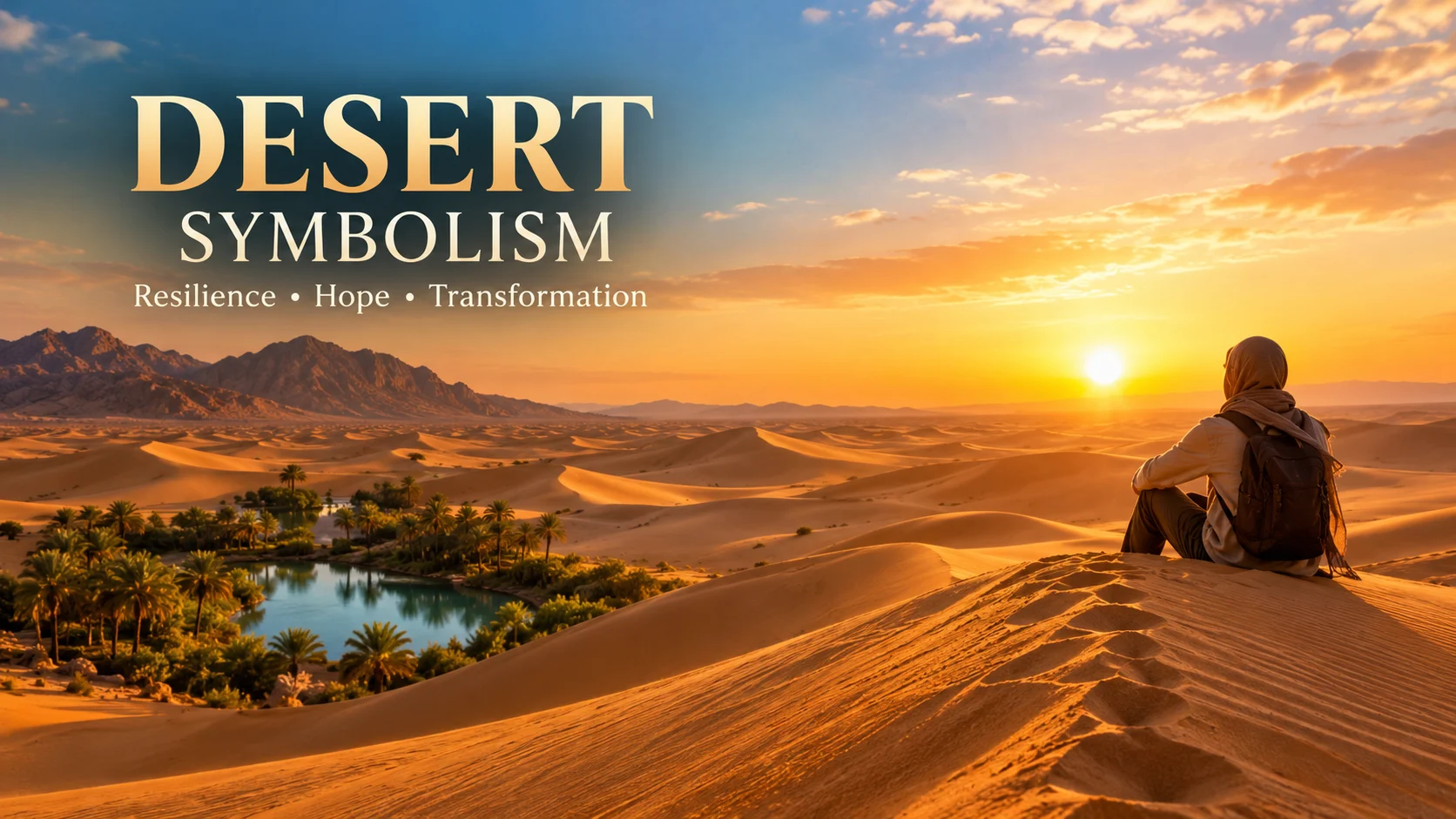
Desert symbolism represents solitude, survival, spiritual awakening, patience, resilience, and personal transformation. A vast desert landscape can symbolize both the challenges of life and the inner strength needed to overcome them. Its endless sands, scorching sun, and quiet horizons remind us that growth often happens in places where comfort and certainty disappear.
Throughout history, deserts have inspired spiritual journeys, ancient myths, religious stories, poetry, and works of art. They can represent emptiness and hardship, but they can also symbolize freedom, clarity, peace, and new beginnings.
Understanding desert symbolism helps us explore what this powerful landscape means in dreams, spirituality, literature, and everyday life. if you see a desert as a place of struggle or a peaceful escape, its deeper meaning often depends on the experience and emotions connected to it.
Desert Symbolism Meaning (Clear Definition)
Desert symbolism refers to the symbolic meanings associated with deserts, including solitude, endurance, spiritual discovery, isolation, freedom, and renewal. Because deserts are often harsh, quiet, and seemingly empty, they can represent moments when people must look inward and discover their true strength.
A desert may symbolize a difficult period when resources feel limited or the path forward seems uncertain. At the same time, its wide-open spaces can suggest independence, possibility, and freedom from distractions.
The desert’s meaning is not always negative. Although it can represent loneliness or emotional emptiness, it can also symbolize peace, simplicity, wisdom, and the opportunity to begin again.
In simple terms, the desert symbolizes the journey through life’s challenges toward greater strength, understanding, and inner peace.
What Does Desert Symbolism Represent?
Desert symbolism can represent several important themes depending on the landscape, cultural background, and personal interpretation.

1. Resilience and Survival
Deserts require living things to adapt to limited water, extreme temperatures, and difficult conditions. Symbolically, they represent the ability to survive hardships and keep moving forward when life becomes challenging.

2. Solitude and Self-Discovery
The silence of the desert can represent time spent alone, away from outside expectations. It reminds us that solitude can create opportunities for reflection, self-understanding, and personal growth.

3. Hope and Renewal
An oasis surrounded by dry land symbolizes relief, unexpected blessings, and renewed hope. It suggests that even during difficult seasons, comfort and opportunity may still be possible.

4. Freedom and Possibility
The vast desert horizon can symbolize independence, open choices, and freedom from limitations. It invites us to imagine new directions without the distractions of everyday life.

5. Patience and the Passage of Time
Desert landscapes change slowly through wind, weather, and shifting sand. They can symbolize patience, acceptance, and the understanding that meaningful changes do not always happen quickly.
Key Symbolic Meanings of the Desert
| Desert symbol | Common symbolic meaning |
|---|---|
| Endless sand dunes | Change, uncertainty, life’s journey |
| Scorching sun | Trials, truth, intense emotions |
| Desert oasis | Hope, relief, renewal |
| Empty landscape | Solitude, simplicity, introspection |
| Desert storm | Conflict, confusion, sudden change |
| Distant horizon | Possibility, ambition, freedom |
| Night sky over the desert | Mystery, wisdom, spiritual reflection |
| Desert plants | Resilience, adaptation, survival |
These meanings are interpretive rather than universal. A desert may feel frightening to one person and peaceful or liberating to another.
Spiritual Meaning of Desert Symbolism
The spiritual meaning of desert symbolism is often connected to inner transformation, faith, reflection, and the search for deeper truth.
Because deserts offer few distractions, they are frequently imagined as places where people confront their fears, question their beliefs, and discover what matters most.
1. Spiritual Awakening
A desert can represent a period when familiar beliefs or routines no longer provide clear answers. This experience may encourage someone to examine their values and develop a deeper understanding of themselves.
The desert becomes a metaphor for awakening: a journey into uncertainty that can lead to greater clarity.
2. Inner Strength and Endurance
The harshness of the desert reminds us that strength is not always loud or visible. Sometimes, strength means continuing patiently, adapting to circumstances, and maintaining hope when progress feels slow.
Spiritually, this symbolism encourages perseverance without pretending that hardship is easy.
3. Letting Go of Distractions
The simplicity of an empty desert can symbolize the need to release unnecessary worries, external pressures, or material attachments.
Its stillness invites a person to focus on essential questions: What do I value? What gives my life meaning? What should I leave behind?
4. Faith During Uncertainty
A desert journey often involves moving forward without knowing exactly what lies ahead. In spiritual interpretations, this can represent trusting a larger purpose even when immediate results are difficult to see.
For some people, it symbolizes faith in God. For others, it represents confidence, patience, or trust in the process of personal growth.
5. Transformation Through Difficult Seasons
The phrase desert season is sometimes used to describe a period of emotional or spiritual dryness, when inspiration seems distant and life feels especially challenging.
This metaphor suggests that difficult experiences may create opportunities for reflection and change. It does not mean every hardship has a hidden purpose, but it can encourage people to seek meaning and support while navigating uncertainty.
Biblical / Religious Meaning of Desert Symbolism
In the Bible, the desert or wilderness is a significant setting associated with testing, dependence on God, spiritual preparation, deliverance, and renewal.
Its meaning depends on the particular story. The wilderness can be a place of danger and deprivation, but it can also become a setting for divine guidance and important encounters.
1. The Israelites’ Journey Through the Wilderness
In the Book of Exodus, the Israelites travel through the wilderness after leaving slavery in Egypt. Their journey involves hardship, uncertainty, and dependence on God’s provision.
The desert therefore symbolizes a transition between an old life and a new one. It can represent the challenges of freedom, the development of faith, and the patience required during a long journey.
2. Moses and the Burning Bush
In Exodus 3, Moses encounters God through the burning bush while tending sheep near Horeb. This encounter takes place in a wilderness setting and leads to his calling to help free the Israelites.
In this story, the wilderness can symbolize a place of revelation, preparation, and unexpected purpose.
3. Jesus in the Wilderness
According to Matthew 4:1–11 and Luke 4:1–13, Jesus spends forty days in the wilderness fasting and facing temptation.
This account connects the desert with spiritual testing, discipline, and faithfulness. It also illustrates the challenge of remaining committed to one’s purpose under pressure.
4. A Place of Solitude and Prayer
Biblical wilderness settings sometimes provide opportunities for prayer and communion with God. Jesus also withdraws to solitary places to pray, as described in passages such as Luke 5:16.
For many Christians, desert symbolism therefore represents stepping away from distractions to seek guidance and strengthen one’s relationship with God.
5. Desert Imagery in Other Religious Traditions
Desert landscapes also hold significance beyond Christianity.
- Islam: The desert is central to the historical and geographical setting of early Islam and the life of the Prophet Muhammad. It can evoke endurance, humility, and reliance on God, although its symbolic meaning varies by context.
- Judaism: Wilderness narratives are central to Jewish identity, particularly the Exodus and the Israelites’ covenant journey.
- Sufi traditions: Some spiritual teachings use imagery of emptiness, longing, and the stripping away of ego to describe the search for closeness to God. These ideas should not be reduced to desert imagery alone.
Across these traditions, the desert can become a powerful metaphor for spiritual searching, although its meaning differs between texts, communities, and individual beliefs.
Desert Symbolism in History and Culture
Deserts have shaped human civilizations, trade routes, religious traditions, and cultural imagination for thousands of years. Their meanings reflect both the challenges of living in arid environments and the knowledge developed by the people who call these places home.
1. Survival and Adaptation in Ancient Civilizations
Ancient societies developed sophisticated ways to live in desert and semi-arid environments. Water management, navigation, seasonal knowledge, and trade were essential to survival.
In this context, desert symbolism can represent resourcefulness, cooperation, practical wisdom, and respect for the natural world.
2. The Desert as a Place of Testing
Across different stories and traditions, deserts often appear as settings where travelers face physical hardship and difficult decisions.
This has helped establish the desert as a metaphor for personal trials. Crossing the desert may represent completing a difficult stage of life, while losing one’s way can symbolize uncertainty or a lack of direction.
3. Nomadic Cultures and Freedom
For many nomadic and pastoral communities, arid landscapes are not simply empty or hostile places. They are living environments shaped by knowledge, movement, relationships, and cultural traditions.
Desert symbolism may therefore express mobility, independence, belonging, and the ability to adapt. These meanings vary considerably among communities and should not be treated as identical across all desert cultures.
4. Ancient Egypt and the Desert
In ancient Egyptian culture, the desert had complex associations. Arid lands could represent danger and sterility, while the fertile Nile Valley supported agriculture and settled life.
The Egyptian god Seth was associated with deserts, storms, and disorder in some religious contexts, although his character and roles were more complex than these associations alone.
This contrast between fertile land and surrounding desert helped shape ideas about order, danger, and the boundaries of civilization.
5. The Desert in Modern Exploration
Deserts have also become symbols of exploration, adventure, and the limits of human endurance. Modern journeys across deserts often emphasize preparation, navigation, respect for nature, and the psychological experience of vast open spaces.
At the same time, real deserts are diverse ecosystems, not lifeless wastelands. Their beauty and complexity remind us that survival depends on understanding an environment rather than simply conquering it.
Desert Symbolism in Literature and Art
In literature and art, deserts provide powerful imagery for expressing emotional states, philosophical questions, and journeys of transformation.
Their scale, silence, and striking visual contrasts make them especially useful for representing experiences that are difficult to describe directly.
1. The Desert as Emotional Emptiness
Writers may use a barren landscape to reflect loneliness, grief, disconnection, or a character’s feeling that life has lost its meaning.
The absence of familiar landmarks can mirror an inner struggle, making the external setting an extension of the character’s emotional world.
2. The Desert as a Journey of Discovery
In adventure stories and philosophical literature, crossing a desert can symbolize the search for wisdom, identity, or purpose.
A traveler may begin with confidence but gradually learn humility, patience, and self-reliance. The physical journey becomes a metaphor for inner change.
3. The Desert as Mystery and the Sublime
Artists often depict enormous dunes, distant mountains, and expansive skies to inspire awe. The desert can make human figures appear small in comparison with the natural world.
This visual contrast can suggest humility, wonder, freedom, or the limits of human understanding.
4. The Desert as a Symbol of Hope
A small plant growing from dry soil or an oasis appearing beyond the dunes can represent hope amid adversity.
Such images communicate that life can persist under difficult conditions. They may also suggest that beauty and possibility can exist where they are least expected.
5. The Desert in Famous Literary Works
Several well-known works use desert landscapes to explore different themes:
- The Little Prince by Antoine de Saint-Exupéry uses the Sahara as an important setting for encounters involving friendship, love, and the meaning of life.
- Dune by Frank Herbert presents the desert planet Arrakis as an environment that shapes survival, politics, ecology, and power.
- The Alchemist by Paulo Coelho uses the desert as part of Santiago’s journey toward self-discovery, spiritual insight, and the pursuit of his personal legend.
These works demonstrate that desert symbolism can communicate both personal transformation and larger questions about society, nature, and human purpose.
Dream Meaning of Desert Symbolism
Dreaming about a desert may reflect feelings of isolation, uncertainty, exhaustion, freedom, or the desire for a fresh start. However, dreams do not have fixed or scientifically established symbolic meanings, so the most useful interpretation depends on your personal circumstances and emotions.
Here are some common ways people interpret desert dreams.
| Desert dream | Possible interpretation |
|---|---|
| Walking alone through a desert | Independence, loneliness, or self-discovery |
| Getting lost in the desert | Uncertainty about a decision or life direction |
| Finding an oasis | Relief, hope, or a welcome opportunity |
| Crossing the desert successfully | Perseverance through a difficult period |
| Seeing a desert storm | Feeling overwhelmed by conflict or change |
| Watching the sunrise over dunes | Optimism, renewal, or a new beginning |
| Resting peacefully in the desert | Desire for quiet, simplicity, or personal space |
| Seeing a dry, lifeless landscape | Feeling depleted or disconnected, depending on personal context |
What Does It Mean to Walk Through a Desert in a Dream?
Walking through a desert may reflect a journey in which you feel responsible for finding your own direction. If you feel confident in the dream, it might reflect independence or determination; if you feel frightened, it could mirror uncertainty or stress.
What Does a Desert Oasis Mean in a Dream?
An oasis may symbolize comfort, hope, or the possibility of relief after a challenging period. It can also reflect a desire for emotional nourishment, supportive relationships, or renewed motivation.
Is Dreaming About a Desert a Good Sign?
A desert dream is not inherently good or bad. Its emotional atmosphere, the events within it, and your waking-life experiences are more useful clues than any universal prediction about the future.
Modern Meaning of Desert Symbolism
Today, desert symbolism remains relevant in discussions of mental well-being, personal growth, creativity, and environmental awareness.
The desert can represent both a challenging experience and an opportunity to reconsider how we live.
1. Personal Growth and Resilience
In everyday language, a person may describe a difficult period as crossing a desert. The phrase suggests that progress can feel slow and rewards may seem distant.
Its positive message is that persistence, flexibility, and realistic expectations can help people move through uncertain times.
2. Mental Clarity and Minimalism
The desert’s simple visual landscape has become a source of inspiration for minimalist design, photography, architecture, and personal reflection.
Its uncluttered appearance can symbolize a desire to simplify life, reduce distractions, and focus on what truly matters.
3. Emotional Isolation and Burnout
The desert can also represent emotional exhaustion or disconnection. A person who feels unsupported may describe their experience as a barren landscape where energy and inspiration have disappeared.
This symbolism can help people articulate difficult feelings, but it should not replace practical support, meaningful relationships, or professional help when needed.
4. Freedom and Independence
A vast desert horizon can evoke a sense of possibility. In modern storytelling and visual design, deserts frequently represent escape from expectations, exploration, and the courage to choose a different path.
The image encourages independence while reminding us that freedom also requires preparation and responsibility.
5. Environmental Awareness
Desert symbolism has an important modern ecological dimension. Desert ecosystems support specially adapted plants, animals, and human communities, despite limited rainfall.
As climate change, water scarcity, and land degradation receive greater attention, desert imagery can encourage respect for fragile ecosystems and responsible use of natural resources.
Desertification, in particular, refers to land degradation in drylands; it does not simply mean that every desert is expanding. This distinction helps us appreciate the desert as a complex environment rather than merely a symbol of emptiness.
Frequently Asked Questions About Desert Symbolism
1. What is the main meaning of desert symbolism?
The main meaning of desert symbolism is resilience, solitude, endurance, and spiritual or personal transformation. Depending on the context, it can also represent freedom, emotional emptiness, hope, and renewal.
2. What does a desert symbolize spiritually?
Spiritually, a desert often symbolizes reflection, faith, inner strength, and the search for deeper truth. It may represent a challenging season that encourages a person to reconsider their beliefs and priorities.
3. What does a desert symbolize in the Bible?
In the Bible, the desert or wilderness often represents testing, preparation, dependence on God, and spiritual encounters. Stories involving Moses, the Israelites, and Jesus show how the wilderness can be a place of both hardship and revelation.
4. What does a desert symbolize in dreams?
A desert in a dream may reflect loneliness, uncertainty, freedom, or a period of personal change. Finding an oasis may suggest hope or relief, while feeling lost may reflect concerns about direction in waking life.
5. Is desert symbolism positive or negative?
Desert symbolism can be positive or negative depending on the context. It may represent isolation, hardship, and uncertainty, but it can also symbolize perseverance, peace, freedom, and the possibility of a new beginning.
Conclusion: The Deeper Meaning of Desert Symbolism
Desert symbolism reminds us that emptiness does not always mean nothingness, and hardship does not always mean defeat. The desert can represent solitude, endurance, spiritual discovery, and the quiet strength needed to navigate uncertain seasons.
From ancient religious stories to modern literature and personal reflection, the desert offers a powerful image of life’s challenges and possibilities. Its deepest lesson may be that even when the path seems empty, there is still room for growth, hope, and transformation.

I am Simon Michael, an author passionate about exploring symbols, their meanings, and cultural significance. I enjoy making symbolism simple, engaging, and meaningful for curious readers everywhere.


