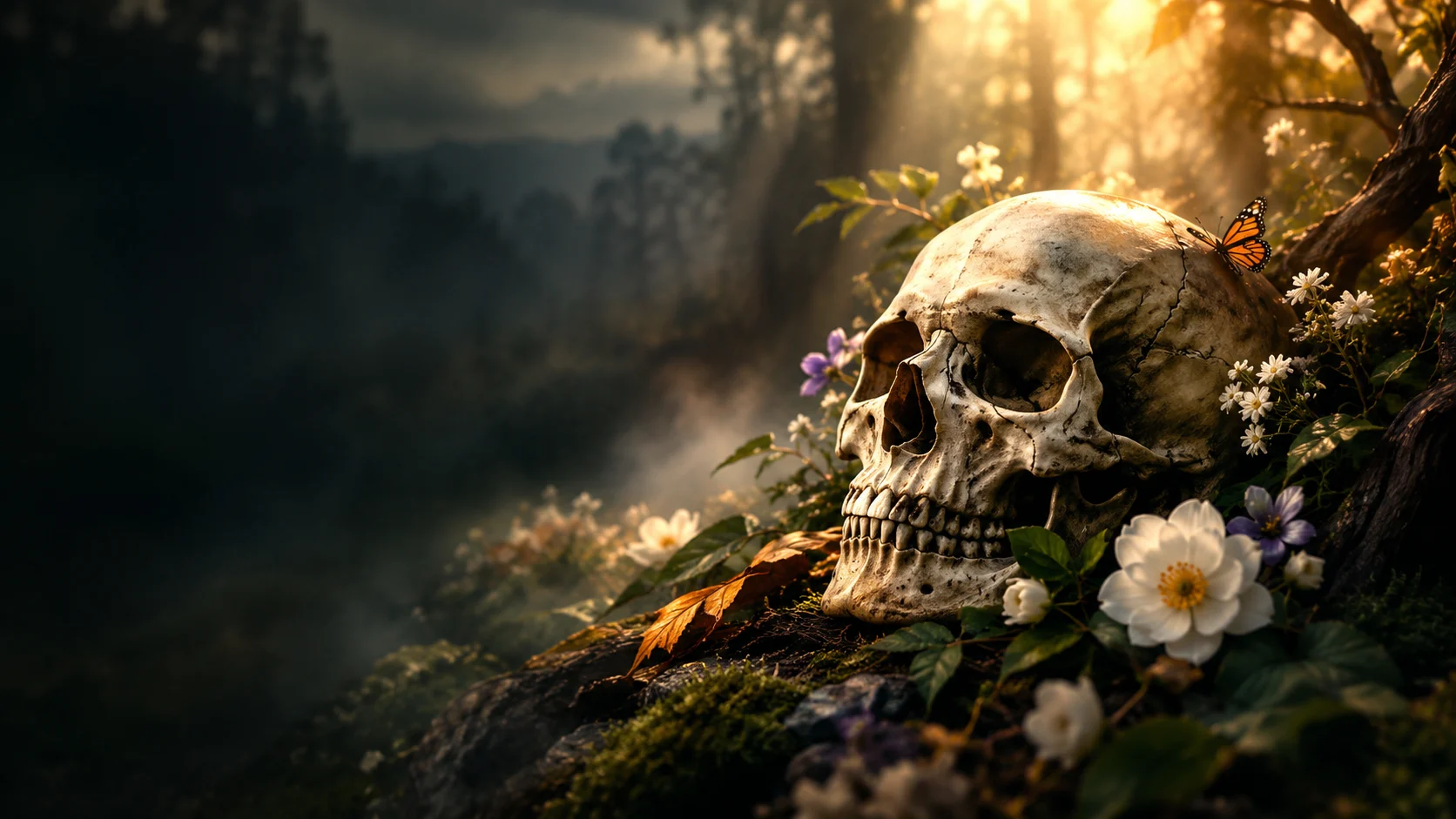
Skull symbolism has fascinated people for centuries because the skull can represent both the end of life and the deeper meaning of existence. While it is often associated with death, its symbolism goes far beyond mortality. A skull may represent transformation, impermanence, wisdom, danger, protection, rebirth, and the acceptance of life’s natural cycles.
The meaning of a skull depends heavily on its context. In spiritual traditions, artwork, dreams, jewelry, tattoos, literature, and popular culture, it can communicate very different ideas.
Skull Symbolism Meaning (Clear Definition)
Skull symbolism refers to the meanings and ideas associated with the human skull as a visual or cultural symbol.
At its simplest, a skull represents mortality and the temporary nature of physical life. However, it can also symbolize transformation, courage, remembrance, rebellion, protection, and spiritual awakening.
A concise definition is:
Skull symbolism represents mortality, impermanence, transformation, wisdom, danger, and the reminder to value life.
The skull is powerful because it strips away external identity. Regardless of wealth, status, age, or appearance, the human skeleton reminds us of our shared mortality.
Common Skull Symbolism Meanings
| Symbolic Meaning | What It Can Represent |
|---|---|
| Death | The end of physical life |
| Mortality | Awareness that life is temporary |
| Transformation | Change from one state to another |
| Rebirth | A new beginning after an ending |
| Wisdom | Lessons gained through life’s experiences |
| Danger | Warning, risk, or caution |
| Protection | Strength against threats or negative forces |
| Rebellion | Independence and rejection of convention |
| Remembrance | Honoring people or lives that have passed |
What Does Skull Symbolism Represent?
Skull symbolism can represent several ideas at once. Its interpretation often depends on the surrounding imagery and the person’s beliefs.
1. Mortality and Impermanence
The most universal meaning of the skull is mortality. It reminds us that physical life is finite and that nothing remains unchanged forever.
This interpretation can encourage people to appreciate the present rather than take time for granted.
2. Transformation
A skull can symbolize a major transition. Something may be ending, but an ending can create space for something new.
For this reason, skull imagery sometimes appears alongside themes of personal growth, change, healing, and renewal.
3. Wisdom
The skull can also represent wisdom gained through hardship. Its connection with mortality can encourage deeper reflection about what truly matters.
In this sense, skull symbolism is not necessarily dark. It can represent the lessons that come from understanding life’s limitations.
4. Danger and Warning
A skull with crossed bones or other warning imagery commonly communicates danger. This meaning appears in signs, labels, games, and popular visual culture.
5. Rebellion and Individuality
In modern culture, skull imagery can express independence, nonconformity, strength, or a refusal to follow traditional expectations.
This is especially common in fashion, tattoos, music, and motorcycle culture.
Spiritual Meaning of Skull Symbolism
Spiritually, the skull often represents impermanence, inner transformation, detachment, and awareness of life’s deeper meaning.
Rather than simply symbolizing physical death, it may encourage reflection on the transition between different stages of existence.
Some spiritual interpretations include:
- Awareness: Remembering that life is temporary.
- Transformation: Letting go of an old identity or phase.
- Detachment: Releasing excessive attachment to material things.
- Wisdom: Learning from difficult experiences.
- Rebirth: Beginning again after a major ending.
- Inner reflection: Looking beyond physical appearance.
- Acceptance: Recognizing natural cycles of life and change.
In some spiritual practices, contemplation of mortality is used as a way of developing gratitude and greater awareness of the present moment.
Biblical / Religious Meaning of Skull Symbolism
The skull has religious associations in several traditions, although its meaning is not identical everywhere.
In Christianity, the skull is sometimes associated with mortality, repentance, death, and contemplation of human impermanence. The phrase memento mori, meaning “remember that you must die,” became an important theme in Christian devotional art and later European culture.
The skull is also traditionally associated with Golgotha, the place of Jesus’ crucifixion, whose name is connected with the idea of a “place of the skull.”
In Eastern Christian art, particularly some depictions connected with monastic spirituality, skull imagery can encourage reflection on death and the temporary nature of worldly life.
Importantly, Christianity does not have one universal interpretation of skull imagery. Its meaning depends on the tradition, artwork, historical period, and context.
Skull Symbolism in History and Culture


Skull imagery has appeared across many cultures and historical periods.
Ancient and Medieval Traditions
Human remains have long been used as reminders of mortality. In European religious settings, skulls could appear in devotional objects and artwork designed to encourage reflection on death and spiritual life.
Memento Mori
The Latin phrase memento mori means “remember that you must die.” Skull imagery became one of its most recognizable visual forms.
The purpose was not simply to frighten people. It could serve as a reminder to live thoughtfully, recognize life’s temporary nature, and consider what has lasting value.
Vanitas Art
During the European Baroque period, skulls frequently appeared in vanitas paintings. Artists combined them with objects such as candles, clocks, books, flowers, and valuable possessions.
These compositions emphasized the temporary nature of wealth, beauty, knowledge, and physical life.
Mexican Día de los Muertos
In Mexican culture, calaveras, or decorative skulls, are strongly associated with Día de los Muertos. They can represent remembrance and celebration of deceased loved ones.
Unlike interpretations that treat skulls exclusively as frightening symbols, these traditions can connect skull imagery with memory, family, celebration, and the continuing relationship between the living and the dead.
Skull and Crossbones
The skull and crossbones became a widely recognized warning symbol associated with poison, danger, and hazardous substances.
Its meaning is therefore strongly practical in safety contexts rather than purely spiritual or artistic.
Skull Symbolism in Literature and Art
Artists and writers have used skulls to explore some of life’s biggest questions.
In literature, the skull can represent mortality, existential reflection, grief, vanity, or the passage of time. One of the most famous examples is Shakespeare’s Hamlet, where the skull of Yorick becomes a powerful image of mortality and the temporary nature of human existence.
In visual art, skulls frequently appear in vanitas paintings, still lifes, religious works, gothic art, contemporary paintings, tattoos, and graphic design.
The surrounding objects dramatically influence the interpretation. A skull beside flowers may suggest mortality and beauty, while a skull surrounded by weapons may communicate danger or conflict.
Dream Meaning of Skull Symbolism
Dreams involving skulls can have many possible interpretations and should not automatically be treated as predictions.
A skull in a dream may symbolize:
- An ending: Something in your life may feel finished or ready to change.
- Fear of loss: The image may reflect concerns about mortality or separation.
- Transformation: You may be moving through a significant personal transition.
- Hidden wisdom: The skull may represent lessons from past experiences.
- Reflection: You may be thinking deeply about time, priorities, or meaning.
- Warning: In some contexts, it may reflect awareness of risk or danger.
The emotional atmosphere of the dream matters. A peaceful skull may carry a very different meaning from one associated with fear, violence, or distress.
Modern Meaning of Skull Symbolism
Today, skull symbolism appears in fashion, tattoos, jewelry, music, gaming, film, advertising, sports imagery, and social media.
Its modern meanings can include:
Strength: A skull can represent toughness and resilience.
Individuality: Some people use skull designs to express a distinctive personal identity.
Rebellion: Skull imagery can communicate nonconformity or resistance to convention.
Mortality awareness: Others use it as a modern form of memento mori.
Remembrance: A skull tattoo or artwork may honor someone who has died or represent an important life experience.
Transformation: Skull designs can symbolize leaving an old version of oneself behind.
Because skull imagery has become so widespread, its meaning cannot be determined from the image alone. Personal experience and cultural context are essential.
Skull Symbolism in Tattoos
Skull tattoos can carry deeply personal meanings.
For one person, a skull may symbolize overcoming hardship. For another, it may represent remembrance, freedom, mortality, strength, or a particular cultural tradition.
Common combinations can add additional meaning:
- Skull and roses: Beauty, love, mortality, and the contrast between life and death.
- Skull and snake: Transformation, danger, renewal, or hidden knowledge.
- Skull and butterfly: Change, transformation, and rebirth.
- Skull and clock: The passage of time and impermanence.
- Skull and flowers: Life, death, beauty, and natural cycles.
- Skull and wings: Freedom, remembrance, spirituality, or transcendence.
Skull Symbolism and the Meaning of Life
Perhaps the most meaningful interpretation of the skull is its ability to make people think about how they use their limited time.
The symbol can remind us that life is temporary, relationships matter, and change is unavoidable. Instead of representing only an ending, the skull can therefore become a symbol of living with greater awareness.
Its message can be simple: because life does not last forever, the present moment has value.
Frequently Asked Questions About Skull Symbolism
What is the main meaning of skull symbolism?
The main meaning of skull symbolism is mortality and the temporary nature of life. Depending on context, it can also represent transformation, wisdom, danger, protection, remembrance, or rebellion.
What does a skull symbolize spiritually?
Spiritually, a skull can symbolize impermanence, transformation, detachment, reflection, and acceptance of life’s natural cycles. It may encourage deeper awareness of what truly matters.
Is skull symbolism always negative?
No. Although skulls are strongly associated with death, they can also represent wisdom, remembrance, personal transformation, courage, celebration, and new beginnings.
What does a skull mean in a dream?
A skull in a dream may reflect themes such as endings, change, fear of loss, mortality, or personal reflection. Its meaning depends on the dream’s emotional tone and personal context.
What does a skull tattoo symbolize?
A skull tattoo may symbolize mortality, strength, remembrance, rebellion, transformation, or overcoming hardship. The surrounding imagery and the wearer’s personal meaning often determine its interpretation.
Conclusion
Skull symbolism is ultimately about more than death. It can represent mortality, transformation, wisdom, remembrance, danger, rebellion, and the natural cycle of endings and beginnings.
Whether appearing in ancient art, spiritual traditions, dreams, tattoos, or modern culture, the skull invites us to reflect on a timeless truth: life is temporary, and that very impermanence can make it more meaningful.

I am Simon Michael, an author passionate about exploring symbols, their meanings, and cultural significance. I enjoy making symbolism simple, engaging, and meaningful for curious readers everywhere.