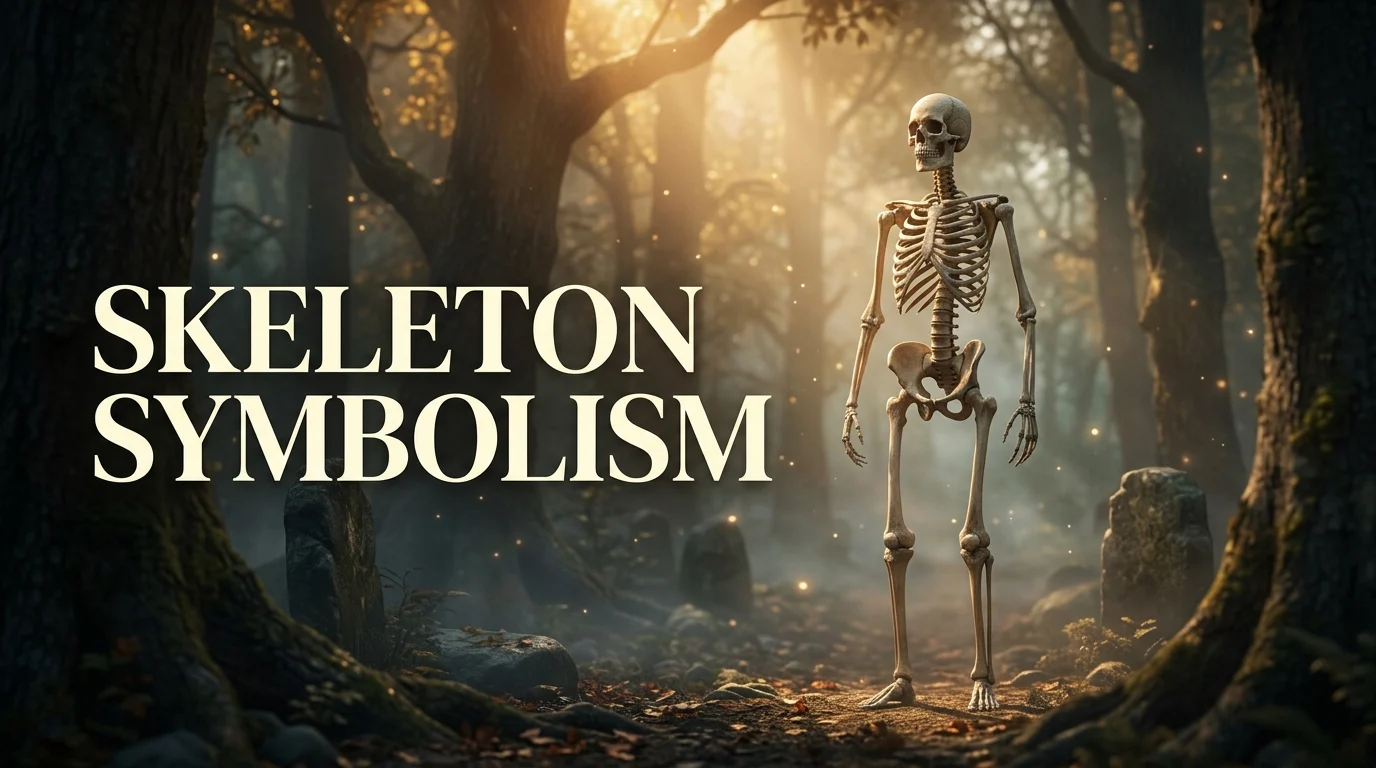
Skeletons are among the most powerful symbols in human culture. They can represent mortality, transformation, hidden truth, resilience, endings, rebirth, and the passage of time. The meaning of skeleton symbolism often depends on context: a skeleton in a dream may suggest something different from a skeleton appearing in religious art, literature, or modern fashion.
At its deepest level, a skeleton reminds us of what remains when everything superficial is removed. It can symbolize both the reality of death and the strength that continues beneath the surface.
Skeleton Symbolism Meaning (Clear Definition)
Skeleton symbolism refers to the meanings associated with bones and skeletons, commonly representing mortality, death, hidden truths, transformation, endurance, and the essential structure of life.
Skeletons have a naturally mysterious quality because they reveal what normally remains hidden beneath the body. For this reason, they often symbolize things that are concealed, forgotten, or waiting to be understood.
Common meanings include:
- Mortality: A reminder that life is temporary.
- Death and endings: The closing of one stage or chapter.
- Transformation: Change from one state of existence to another.
- Hidden truth: Something beneath the surface being revealed.
- Strength: The bones represent the internal structure that supports us.
- Resilience: Skeletons can survive long after other parts of the body disappear.
- Memory: Bones can represent the remains of people, places, or past experiences.
The symbolism is not always negative. In many contexts, a skeleton can encourage reflection, acceptance, personal growth, and appreciation for life.
What Does Skeleton Symbolism Represent?
Skeleton symbolism can carry several layers of meaning.
1. Mortality and the Temporary Nature of Life
The most universal interpretation is mortality. A skeleton reminds us that every physical life eventually changes and ends.
Rather than being purely frightening, this symbolism can encourage people to value the present moment and recognize the limited nature of time.
2. Hidden Truths and Secrets
Because skeletons are normally concealed beneath the skin, they can symbolize what is hidden.
The phrase “skeletons in the closet”, for example, connects skeleton imagery with secrets, shame, unresolved history, or information someone wants to keep hidden.
3. Strength and Inner Structure
Bones provide the framework that supports the human body. Symbolically, this makes the skeleton a representation of inner strength, stability, and structure.
A skeleton can therefore suggest that real strength exists beneath the visible surface.
4. Transformation and Change
Skeleton imagery can also represent profound transformation. Something has ended, but its fundamental structure remains.
This can make skeleton symbolism meaningful during major life transitions, when an old identity, relationship, belief, or chapter is changing.
5. Endings and New Beginnings
Death symbolism does not necessarily mean literal death. Symbolically, death can represent the ending of an old phase.
A skeleton may therefore appear as a reminder to release what no longer belongs in your life and make room for something new.
6. Ancestry and Remembrance
Bones can represent ancestors and the people who came before us. In this sense, skeleton symbolism can connect with heritage, memory, family history, and remembrance.
| Skeleton Symbol | Common Meaning |
|---|---|
| Skull and bones | Mortality, warning, death |
| Skeleton figure | Transformation, mortality, mystery |
| Exposed bones | Hidden truth, vulnerability |
| Ancient skeleton | History, ancestry, forgotten memories |
| Skeleton emerging from earth | Renewal, passage of time |
| Dancing skeleton | Celebration of life, acceptance of mortality |
| Broken bones | Vulnerability, struggle, loss |
| Strong skeletal structure | Resilience, stability, inner strength |
Spiritual Meaning of Skeleton Symbolism
Spiritually, skeleton symbolism can encourage people to look beyond the physical world and consider deeper questions about existence.
A skeleton may symbolize spiritual transformation, particularly when an individual is leaving an old identity behind.
It can represent the stripping away of unnecessary attachments. When the outer layers disappear, only the essential structure remains.
For some spiritual traditions and personal interpretations, skeleton imagery can therefore suggest:
- Spiritual awakening
- Transformation
- Release and surrender
- Acceptance of mortality
- Inner strength
- Ancestral connection
- Renewal after an ending
- Deeper self-awareness
A skeleton can also serve as a reminder that physical appearances are temporary. What matters most may be the inner qualities a person develops throughout life.
Biblical / Religious Meaning of Skeleton Symbolism
Skeleton and bone imagery appears in several religious and biblical contexts, although its meaning varies depending on the passage.
In the Bible, dry bones are especially significant in the vision of Ezekiel. In Ezekiel 37, the prophet sees a valley filled with dry bones, which God restores to life. The imagery is commonly interpreted in relation to restoration, renewal, and hope.
Bones can therefore carry meanings beyond death. They may represent something that appears lifeless or hopeless but can be restored.
Religious traditions outside Christianity have also used bones, skeletons, death imagery, and human remains to encourage reflection on mortality, impermanence, spiritual discipline, or the temporary nature of physical existence.
Because religious interpretations differ across traditions, the surrounding cultural and textual context matters.
Skeleton Symbolism in History and Culture
Skeleton imagery has appeared throughout human history in burial practices, religious art, folklore, festivals, monuments, and public symbolism.
In medieval European art, skeletons were frequently used in memento mori imagery. The Latin phrase means “remember that you must die,” and such artwork encouraged viewers to remember mortality rather than becoming consumed by wealth, status, or worldly pleasures.
The Dance of Death, or Danse Macabre, became another important artistic tradition. Skeletons were depicted alongside people from different social classes, emphasizing that death ultimately affects everyone.
Skeleton imagery also became important in Mexican Día de los Muertos traditions. Calaveras, or decorated skulls, can appear as part of celebrations that honor and remember deceased loved ones. These traditions demonstrate that skull and skeleton imagery does not universally mean fear or darkness.
In modern culture, skeletons can represent everything from Halloween and mystery to rebellion, music, fashion, humor, and remembrance.
Skeleton Symbolism in Literature and Art
Artists and writers have long used skeletons to explore major human themes.
In literature, skeletons can symbolize:
- Mortality
- Secrets from the past
- Fear of death
- The consequences of actions
- Forgotten history
- Transformation
- The fragility of human existence
In visual art, a skeleton can immediately create a sense of mystery because it exposes what is usually hidden.
Still-life paintings containing skulls and other objects often use vanitas symbolism, reminding viewers that worldly possessions, beauty, and achievements are temporary.
Contemporary artists may reinterpret skeletons in completely different ways, using them to explore identity, environmental concerns, social issues, humor, or personal transformation.
Dream Meaning of Skeleton Symbolism
Dreaming about a skeleton can have many possible interpretations, and the meaning depends heavily on the dreamer’s emotions and circumstances.
A skeleton appearing in a dream may symbolize:
- Fear of change
- Acceptance of mortality
- Something from the past returning to attention
- A hidden truth becoming visible
- The ending of a relationship or life chapter
- Emotional vulnerability
- Personal transformation
Dreaming of a Skeleton Chasing You
This may symbolize something you are avoiding, such as an unresolved issue, difficult memory, or major change.
Seeing Your Own Skeleton
A dream involving your own skeleton may encourage reflection on identity, vulnerability, mortality, or what lies beneath your outward appearance.
Seeing a Calm or Peaceful Skeleton
A peaceful skeleton may represent acceptance, closure, or becoming comfortable with a major transition.
Seeing Many Skeletons
Multiple skeletons may symbolize accumulated memories, unresolved experiences, history, or a strong awareness of mortality.
Dream symbolism is highly personal, so the emotions you experienced in the dream are often as important as the skeleton itself.
Modern Meaning of Skeleton Symbolism
Today, skeleton imagery has expanded far beyond traditional associations with death.
It frequently appears in:
- Fashion and graphic design
- Tattoos
- Music and album artwork
- Halloween decorations
- Jewelry
- Street art
- Movies and television
- Video games
- Social media aesthetics
A modern skeleton design may communicate individuality, rebellion, mystery, humor, mortality, or personal transformation.
For some people, wearing or displaying a skeleton represents acceptance of life’s impermanence. For others, it is simply an artistic symbol associated with a particular aesthetic.
The meaning depends on the design, surrounding imagery, cultural context, and personal interpretation.
What Does a Skeleton Symbolize Spiritually?
Spiritually, a skeleton can symbolize transformation, mortality, inner strength, ancestral memory, and the release of an old phase of life.
Is Skeleton Symbolism Always Negative?
No. Skeleton symbolism can represent death and endings, but it can also express resilience, renewal, acceptance, wisdom, remembrance, and the beauty of life.
What Does Seeing a Skeleton Mean?
Seeing a skeleton may symbolize hidden truths, mortality, change, unresolved memories, or the need to recognize something beneath the surface.
What Does a Skeleton Mean in a Dream?
A skeleton in a dream can represent an ending, fear, transformation, vulnerability, or something from the past that needs attention. The dreamer’s emotions and personal circumstances provide important context.
Why Are Skeletons Symbols of Strength?
Bones form the internal framework of the body. Symbolically, a skeleton can therefore represent the structure, stability, and inner strength that support a person beneath their outward appearance.
Conclusion
Skeleton symbolism reaches far beyond simple associations with death. It can represent mortality, hidden truth, transformation, resilience, ancestry, endings, and renewal.
Whether found in ancient art, religious imagery, dreams, literature, or modern design, the skeleton often asks us to look beneath the surface. Its deepest lesson may be that endings are part of life—and understanding impermanence can make the life we have feel even more meaningful.

I am Luna Grace, an author passionate about exploring the meanings, history, and symbolism behind everyday signs. I enjoy sharing thoughtful insights that help readers understand symbols and their deeper significance.