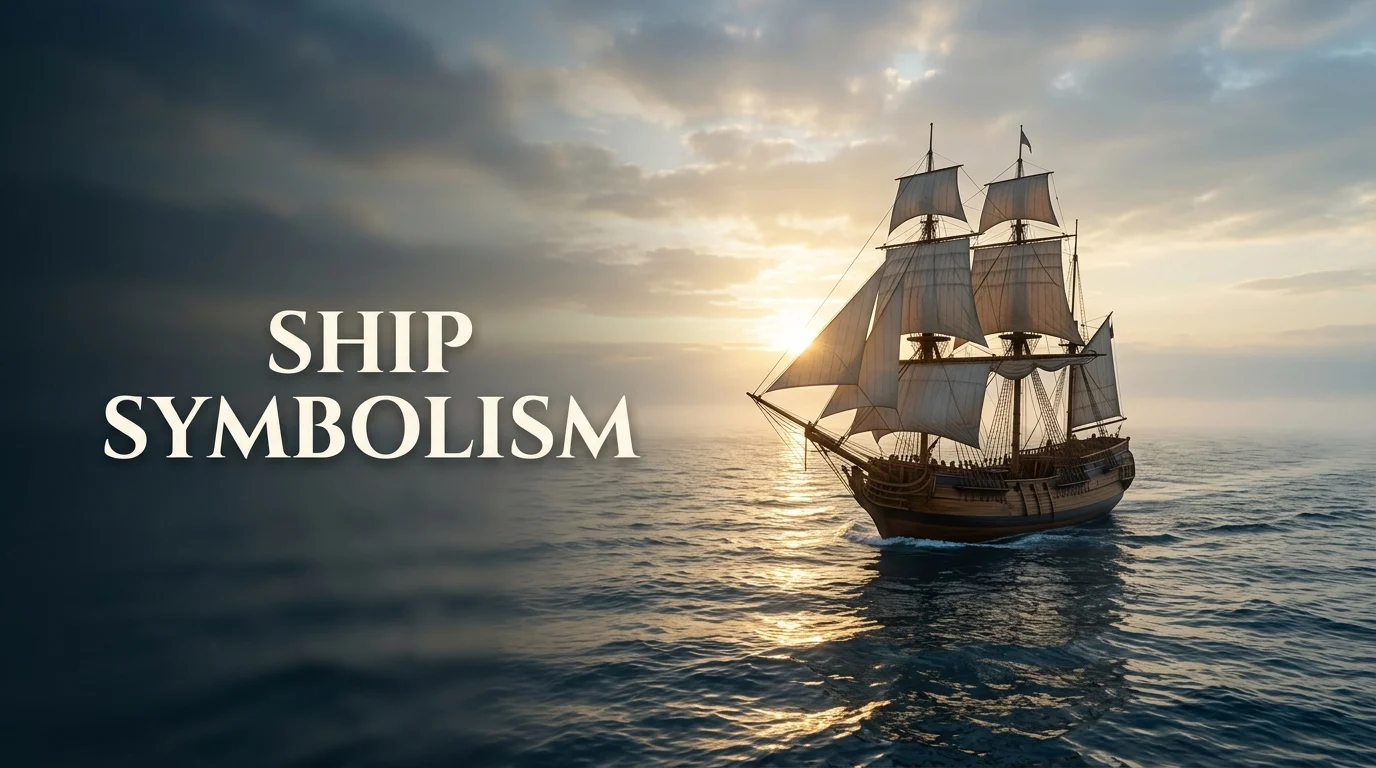
Ship symbolism is often connected with journeys, exploration, freedom, transition, ambition, and the courage to move through uncertain waters. Across history and cultures, ships have represented more than transportation—they have become powerful symbols of life’s journey, emotional discovery, spiritual growth, and the pursuit of new horizons.
A ship carries people from one place to another, making it a natural symbol of change, movement, adventure, independence, and transformation. Its meaning can also depend on the condition of the ship, the surrounding water, and the direction in which it is traveling.
Ship Symbolism Meaning (Clear Definition)
Ship symbolism represents the journey through life, exploration, transition, freedom, and the ability to navigate challenges.
A ship moves across a vast and unpredictable sea, much like a person moving through the uncertain stages of life. Because of this, ships can symbolize both physical journeys and inner journeys.
Common meanings associated with a ship include:
- Journey and adventure
- Freedom and independence
- Exploration and discovery
- Life transitions
- Emotional navigation
- Hope and new beginnings
- Strength and resilience
- Spiritual growth
A ship sailing toward a distant horizon may symbolize optimism and a desire to discover what lies ahead, while a damaged or sinking ship can represent difficulties, uncertainty, or the need for change.
What Does Ship Symbolism Represent?
Ship symbolism can have several layers of meaning depending on the context.
Journey and Life Path
A ship is constantly moving from one destination to another. This makes it a strong representation of the journey of life and the different stages people experience along the way.
Exploration and Discovery
Ships historically allowed people to cross oceans and reach unknown lands. Symbolically, they can represent curiosity, adventure, learning, and the desire to discover something beyond the familiar.
Freedom and Independence
A ship leaving the harbor can represent breaking away from limitations. It may symbolize independence, personal freedom, and the courage to choose a new direction.
Transition and Change
Crossing water often suggests moving from one state of life to another. Ship symbolism can therefore represent important transitions such as starting a new chapter, changing careers, moving somewhere new, or pursuing a different dream.
Resilience and Strength
The ocean can be unpredictable, yet ships are designed to withstand waves and storms. For this reason, a ship can symbolize endurance, adaptability, and the ability to keep moving despite challenges.
Spiritual Meaning of Ship Symbolism
Spiritually, ship symbolism is often associated with inner journeys, faith, transformation, guidance, and the search for meaning.
The ocean may represent the unknown, while the ship represents the individual traveling through it. In this interpretation, the ship becomes a vessel carrying a person through uncertainty toward greater understanding.
A ship can symbolize:
- Spiritual journey
- Faith during uncertainty
- Personal transformation
- Guidance and direction
- Emotional healing
- Trust in the journey
- Movement toward a higher purpose
A ship guided by a lighthouse can be especially meaningful. The lighthouse may represent wisdom, divine guidance, hope, or a source of direction during difficult times.
Biblical / Religious Meaning of Ship Symbolism
Ships have important associations within biblical and religious traditions, particularly in stories involving water, journeys, danger, faith, and divine protection.
One of the best-known biblical examples is Noah’s Ark, where a vessel represents preservation, obedience, protection, and survival through a catastrophic flood.
The New Testament also contains several important stories involving boats and the sea. The disciples were fishermen, and boats frequently appear in accounts involving Jesus and his followers. These stories can connect boats and ships with faith, calling, uncertainty, and trust.
In a broader religious interpretation, a ship may symbolize:
- Protection during hardship
- Faith through uncertainty
- A spiritual journey
- Divine guidance
- Deliverance and survival
- A passage from one stage to another
The exact interpretation depends on the religious tradition and the particular story or symbol being considered.
Ship Symbolism in History and Culture
Ships have played a central role in human civilization for thousands of years. They enabled trade, migration, exploration, warfare, fishing, communication, and cultural exchange.
Because of this history, ships developed rich symbolic meanings across cultures.
Ancient maritime civilizations often associated ships with gods, voyages, commerce, and the passage between worlds. In some traditions, boats were also connected with journeys into the afterlife.
During the Age of Exploration, ships became symbols of discovery and ambition. They represented humanity’s desire to cross boundaries and reach unfamiliar places.
Ships can also symbolize homecoming. After a long voyage, returning to a harbor may represent safety, belonging, reunion, and the completion of an important journey.
Symbolic Meanings of Different Ships
| Ship Image | Possible Symbolic Meaning |
|---|---|
| Sailing ship | Adventure, freedom, exploration |
| Large ship | Strength, ambition, major life journey |
| Small boat | Personal journey, independence, vulnerability |
| Ship at sea | Uncertainty, discovery, emotional journey |
| Ship in harbor | Safety, rest, belonging, completion |
| Ship leaving harbor | New beginnings, freedom, change |
| Ship in a storm | Struggle, resilience, emotional challenges |
| Sinking ship | Loss, failure, endings, major transformation |
| Ship with sails raised | Motivation, progress, opportunity |
| Ship near a lighthouse | Guidance, hope, protection |
Ship Symbolism in Literature and Art
Ships have been powerful images in literature and visual art because they naturally communicate movement, mystery, adventure, and uncertainty.
Writers often use ships as settings for journeys that transform their characters. A voyage can become a metaphor for growing up, confronting fear, searching for identity, or discovering a new truth.
In poetry, the sea and ship may represent the relationship between the individual and the unknown. A distant ship can suggest longing, separation, freedom, or hope.
Artists also use ships to create emotional contrasts. A small vessel surrounded by a vast ocean can emphasize human vulnerability, while a ship approaching a bright horizon can communicate hope and possibility.
In symbolic storytelling, the ship is rarely just a ship. It often represents the person traveling through life’s changing circumstances.
Dream Meaning of Ship Symbolism
Dreaming about a ship can reflect themes of life direction, emotional movement, change, relationships, or personal growth.
The meaning depends heavily on what happens in the dream.
Dreaming of Sailing on a Calm Sea
A ship moving peacefully across calm water may symbolize emotional balance, confidence, and a sense that life is moving in a positive direction.
Dreaming of a Ship in a Storm
A stormy voyage can represent stress, uncertainty, conflict, or challenges that require patience and resilience.
Dreaming of a Ship Leaving
Watching a ship leave may symbolize separation, opportunity, change, or the feeling that an important phase of life is passing.
Dreaming of a Sinking Ship
A sinking ship can symbolize feelings of loss, disappointment, fear, or a situation that no longer feels sustainable. It may also represent the ending of an old chapter before transformation begins.
Dreaming of a Ship Reaching Land
A ship successfully reaching its destination may symbolize achievement, completion, relief, or reaching an important personal goal.
Dream interpretation is personal rather than universal, so the emotions you experienced in the dream are often as important as the ship itself.
Modern Meaning of Ship Symbolism
Today, ships continue to represent adventure, travel, freedom, ambition, connection, and personal transformation.
Modern culture often uses ships to represent the idea of leaving one’s comfort zone and pursuing something new.
A ship can also symbolize emotional independence. Just as a vessel must navigate changing conditions, people must often make decisions without knowing exactly what lies ahead.
In tattoos, jewelry, logos, artwork, and personal designs, ship imagery may represent a love of travel, a connection to the sea, perseverance, family heritage, or an important life journey.
For many people, the ship carries a simple but powerful message:
You may not control the sea, but you can choose how you navigate it.
Frequently Asked Questions About Ship Symbolism
What is the main meaning of ship symbolism?
Ship symbolism commonly represents life’s journey, exploration, freedom, transition, resilience, and movement toward a new destination.
What does a ship symbolize spiritually?
Spiritually, a ship can symbolize an inner journey, faith, guidance, transformation, and navigating uncertainty while searching for greater meaning.
What does a ship symbolize in dreams?
A ship in dreams may represent your current life direction, emotional state, relationships, or a significant transition. Calm seas and storms can change the interpretation considerably.
What does a ship symbolize in Christianity?
Ships and boats appear in several biblical stories and can be associated with faith, protection, journeys, obedience, uncertainty, and divine guidance. Noah’s Ark is one of the most prominent examples.
What does a ship leaving the harbor symbolize?
A ship leaving the harbor commonly symbolizes new beginnings, independence, adventure, change, and the courage to move beyond familiar surroundings.
Conclusion
Ship symbolism reminds us that life is a journey filled with calm waters, changing tides, unexpected storms, and new horizons. Whether viewed spiritually, culturally, artistically, or personally, the ship represents the courage to move forward even when the destination is not completely known.
Like a vessel crossing a vast ocean, we each navigate our own path—carrying our experiences with us while continuing toward what lies beyond the horizon.

I am Simon Michael, an author passionate about exploring symbols, their meanings, and cultural significance. I enjoy making symbolism simple, engaging, and meaningful for curious readers everywhere.