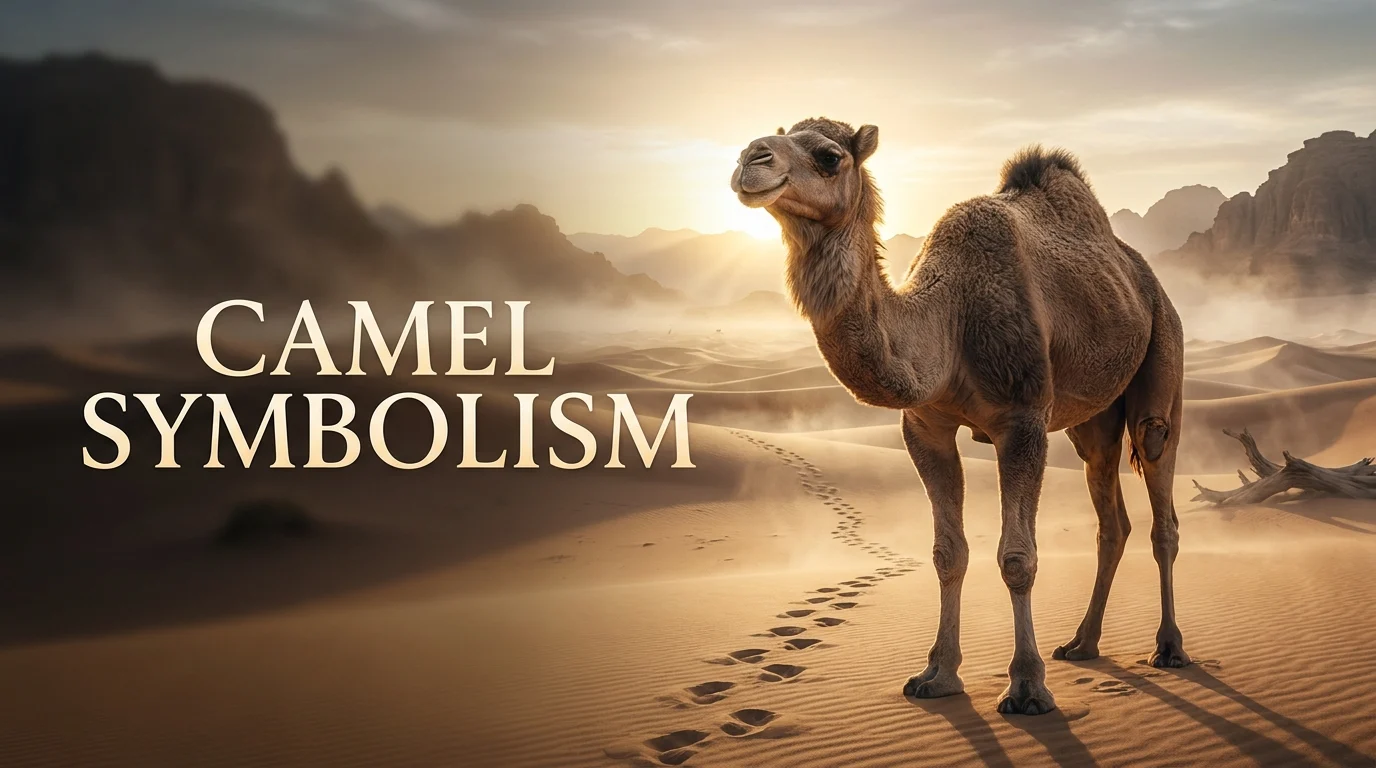
Camel symbolism represents endurance, patience, resilience, survival, and the ability to overcome difficult challenges. Known for traveling across vast deserts and enduring harsh conditions, the camel symbolizes inner strength, self-reliance, and the wisdom to keep moving forward when life becomes difficult.
The camel also represents resourcefulness, adaptability, and the importance of conserving your energy for the journey ahead. Its presence in dreams, spiritual traditions, and cultural stories often encourages people to trust their abilities, remain patient, and prepare for the future.
Whether you encounter a camel in a dream, see one during a journey, or feel drawn to its symbolism, this remarkable animal offers a powerful reminder: you can travel through difficult seasons without losing sight of your destination.
Camel Symbolism Meaning (Clear Definition)
The meaning of camel symbolism is the representation of strength, endurance, patience, perseverance, and survival through challenging circumstances. It reflects the ability to carry responsibilities, adapt to changing environments, and continue moving forward with determination.
Camels are especially associated with desert landscapes, where water and food may be scarce and journeys can be long. Their remarkable adaptations make them powerful symbols of resilience and practical wisdom.
Here are the primary meanings associated with camel symbolism:
- Endurance: Remaining strong during long and difficult periods.
- Patience: Understanding that meaningful progress often takes time.
- Resilience: Recovering from setbacks and adapting to adversity.
- Self-reliance: Learning to trust your abilities and resources.
- Wisdom: Using energy, time, and resources carefully.
- Abundance: Recognizing wealth, provision, and the value of resources.
- Safe journeys: Representing preparation, guidance, and perseverance during transitions.
At its heart, camel symbolism teaches that success does not always come from moving quickly. Sometimes, the greatest achievement is continuing steadily when the road ahead feels uncertain.
What Does Camel Symbolism Represent?
Camel symbolism represents several interconnected qualities that can help people understand their personal challenges, relationships, and ambitions.
1. Strength and Endurance
The camel is famous for its ability to travel through demanding environments. Symbolically, this represents the strength to withstand pressure without giving up on important goals.
If you are facing a difficult period, the camel can serve as a reminder that strength is not always dramatic. Sometimes, it means getting up each day, fulfilling your responsibilities, and taking one more step.
2. Patience and Perseverance
A long desert journey cannot always be rushed. The camel represents the importance of respecting the time required to reach a destination.
This meaning is especially relevant when working toward a career goal, building a relationship, learning a skill, or recovering from disappointment.
The camel encourages you to focus on consistent progress rather than immediate results.
3. Adaptability and Survival
Camels have physical adaptations that help them survive in arid environments. Their symbolism therefore connects with flexibility, practical thinking, and the ability to respond to changing circumstances.
A camel may represent a period when you must adjust your plans, develop new skills, or find creative solutions with limited resources.
4. Responsibility and Burden
Because camels have traditionally carried people and goods across long distances, they can symbolize responsibility and the burdens people carry.
This interpretation has two sides. Carrying a meaningful responsibility can demonstrate commitment and maturity, but carrying too much for too long can lead to exhaustion.
Camel symbolism encourages you to recognize your responsibilities while also understanding your personal limits.
5. Resourcefulness and Abundance
Camels are closely associated with the careful use of resources in environments where supplies may be limited.
Symbolically, this represents saving for the future, managing money wisely, protecting your energy, and appreciating what you already have.
The camel’s association with wealth and abundance also reflects its historical importance in trade and transportation.
6. Independence and Self-Trust
The camel’s ability to endure difficult terrain makes it a symbol of self-reliance.
It encourages you to develop confidence in your judgment, prepare for obstacles, and trust yourself when other people cannot make the journey for you.
However, independence does not mean refusing help. True resilience includes knowing when cooperation and support are necessary.
Quick Guide to Camel Symbolism
| Symbolic quality | Meaning |
|---|---|
| Endurance | Staying strong through hardship |
| Patience | Allowing progress to unfold naturally |
| Resilience | Recovering and adapting after setbacks |
| Abundance | Appreciating resources and opportunities |
| Responsibility | Carrying duties with care |
| Wisdom | Preparing for future challenges |
| Journey | Moving toward a meaningful destination |
| Self-reliance | Trusting your abilities and judgment |
Spiritual Meaning of Camel Symbolism
Spiritually, camel symbolism is often interpreted as a message of patience, perseverance, humility, and trust during life’s difficult journeys.
Although spiritual meanings vary between individuals and traditions, the camel’s ability to cross challenging landscapes makes it a natural metaphor for personal growth.
The Camel as a Symbol of Spiritual Endurance
A spiritual journey rarely follows a perfectly smooth path. There may be moments of uncertainty, disappointment, or loneliness.
The camel represents the inner strength needed to continue searching for meaning even when answers do not come immediately.
Its symbolism reminds you that difficult experiences can become opportunities to develop wisdom, compassion, and emotional maturity.
Trusting the Journey
The desert is often used as a spiritual metaphor for uncertainty, solitude, and transformation. Within this imagery, the camel represents the ability to keep moving without knowing every detail of what lies ahead.
Seeing a camel may inspire you to trust your preparation, remain open to learning, and approach the future with a balanced mind.
This is a reflective interpretation rather than a guaranteed supernatural message.
Conserving Your Energy
The camel’s association with resourcefulness offers an important spiritual lesson: not every challenge deserves all your energy.
You can protect your peace, establish boundaries, and choose carefully where you invest your time.
Sometimes, spiritual growth means doing less, becoming more intentional, and recognizing that rest is part of progress.
The Camel and Personal Transformation
A difficult journey can change the person who undertakes it.
Camel symbolism can represent the transformation that comes from enduring hardship without allowing hardship to define your entire identity.
It encourages you to carry the lessons of your past while remaining open to new beginnings.
Biblical / Religious Meaning of Camel Symbolism
Camels have significant roles in the Bible and in several religious and cultural traditions, particularly those connected with the ancient Near East.
Their meanings depend on the passage, historical setting, and religious interpretation rather than on one universal symbolic definition.
Camel Symbolism in the Bible
In biblical narratives, camels are associated with travel, wealth, trade, and the movement of people across long distances.
For example, Abraham’s household is described as possessing camels in Genesis 24, during the account of Abraham’s servant traveling to find a wife for Isaac. The camels help establish the setting of a journey involving hospitality, family, and divine guidance.
Camels also appear in stories involving the wealth and travels of biblical figures, reflecting their practical importance in the ancient world.
The Camel and Humility
One of the most recognized biblical references appears in Matthew 19:24, where Jesus uses the image of a camel passing through the eye of a needle to illustrate the difficulty of a rich person entering the kingdom of heaven.
The central lesson is commonly understood as a warning against allowing wealth to become an obstacle to spiritual commitment.
In this context, the camel is part of a teaching about material attachment, humility, and the priorities of faith.
Camel Symbolism in Islam
Camels have an important place in Islamic history and the cultural life of Arabia. They supported transportation, trade, and travel across desert regions.
The Quran also refers to camels in passages that invite reflection on the natural world. Surah Al-Ghashiyah 88:17 asks people to consider how camels were created.
This passage encourages contemplation of creation and the signs of divine power.
Camels are also associated with patience, provision, and desert life in broader Islamic cultural traditions. These associations should be distinguished from specific religious teachings.
A Shared Religious Lesson
Across these contexts, the camel can prompt reflection on several themes:
- Using material resources responsibly.
- Practicing humility rather than pride.
- Appreciating the natural world.
- Preparing carefully for life’s journeys.
- Recognizing the importance of faith, patience, and perseverance.
The exact interpretation depends on the religious tradition and the context in which the camel appears.
Camel Symbolism in History and Culture
Camels have influenced human civilization for thousands of years. Their symbolic meanings developed partly from their essential role in transportation, commerce, survival, and cultural exchange.
The Camel and Ancient Trade
In many parts of North Africa, the Middle East, and Central Asia, camels helped people transport goods across difficult terrain.
They played important roles in long-distance trade networks, including trans-Saharan commerce and routes connecting communities across arid regions.
Because camels could carry heavy loads over extended journeys, they became associated with wealth, trade, opportunity, and economic survival.
Their presence in a caravan also represented cooperation. Traders, guides, and travelers depended on shared knowledge and preparation to reach their destinations.
The Camel as a Symbol of the Desert
The camel is strongly connected with desert landscapes and the communities that have adapted to them.
In this setting, it represents practical wisdom, survival, and respect for the natural environment.
Its image can evoke independence, freedom of movement, and the ability to find a path through challenging terrain.
However, the camel should not be treated as a symbol of every desert culture in the same way. Its significance differs across regions and communities.
Camels in Bedouin Culture
Camels have historically held considerable practical and cultural importance among many Bedouin communities.
They have served as transportation, sources of milk, and valuable livestock. In some settings, they have also represented status, hospitality, and livelihood.
Their importance reflects a relationship built on knowledge of the environment and the ability to manage limited resources.
The Camel as a Symbol of Wealth
In societies where camels were valuable economic assets, owning them could reflect prosperity and social standing.
This historical association helps explain why camels sometimes symbolize abundance, security, and material success.
At the same time, the camel’s ability to support life in difficult conditions gives it a deeper meaning: wealth is not only about possessions but also about having the resources needed to endure uncertainty.
Camel Symbolism in Literature and Art
In literature and visual art, camels often represent journeys, endurance, cultural identity, and the mysteries of distant landscapes.
Their appearance can help communicate both the physical difficulty of travel and the emotional experience of searching for something meaningful.
The Camel as a Journey Symbol
A camel crossing a desert can represent a character’s movement from one stage of life to another.
The landscape may symbolize uncertainty, while the camel represents the strength and preparation needed to move through it.
Writers may use this imagery to explore ambition, loneliness, personal discovery, or the pursuit of a distant goal.
The Camel as a Symbol of Patience
A camel moving steadily across a vast landscape can create a sense of quiet determination.
In storytelling, this image may contrast with characters who want immediate results or who struggle to tolerate uncertainty.
The camel can therefore symbolize the value of steady effort over impulsive action.
The Camel in Paintings and Photography
Artists frequently use camels to establish the atmosphere of desert scenes, historical trade routes, and journeys through arid environments.
A camel silhouetted against a sunset may suggest solitude, freedom, or the beauty of a long journey. A caravan may symbolize cooperation, commerce, and cultural exchange.
In modern photography, camels can also represent travel, exploration, tradition, and the relationship between people and their environment.
The meaning depends on the composition, cultural setting, and surrounding imagery.
Dream Meaning of Camel Symbolism
Dreaming about a camel may reflect patience, responsibilities, endurance, or a challenging journey in your waking life. Dream interpretations are subjective, so the most useful meaning depends on your emotions, experiences, and the details of the dream.
Here are some common interpretations of camel dreams.
Dreaming of a Camel Walking
A camel walking steadily may symbolize gradual progress toward a goal.
If you are working through a demanding period, the dream might reflect your determination to keep going, even when results are slow.
Dreaming of Riding a Camel
Riding a camel may represent control over your direction, confidence in your plans, or movement through an important life transition.
If the ride feels peaceful, it may reflect a sense of trust in your journey. If it feels frightening or unstable, it could mirror uncertainty about a decision.
Dreaming of a Camel Carrying Heavy Loads
A heavily loaded camel may reflect the responsibilities you carry in your personal or professional life.
Consider whether you feel capable of managing your commitments or whether you have taken on more than you can reasonably handle.
The dream may encourage you to reconsider your priorities and ask for support when necessary.
Dreaming of a Baby Camel
A baby camel may symbolize new responsibilities, developing confidence, or the early stages of a long-term goal.
It can also represent something valuable that requires patience and consistent care before it becomes strong.
Dreaming of a White Camel
A white camel may be interpreted as a symbol of peace, hope, clarity, or a fresh start.
These meanings are personal and culturally dependent; a white camel does not have one universally established dream interpretation.
Dreaming of a Camel in the Desert
A camel traveling through the desert may reflect a period of uncertainty or personal growth.
If you feel calm in the dream, it may suggest confidence in your ability to adapt. If you feel lost, it may reflect concerns about your direction or available resources.
Instead of treating a dream as a prediction, use it as an opportunity to reflect on what is happening in your life.
Modern Meaning of Camel Symbolism
Today, camel symbolism remains relevant because its central themes relate to challenges people experience in everyday life.
The camel can serve as a metaphor for persistence, responsible planning, emotional resilience, and the importance of moving at a sustainable pace.
Camel Symbolism in Personal Growth
Personal growth often involves periods when progress feels invisible.
Learning a new skill, recovering from a setback, or building confidence requires consistent effort over time.
The camel represents the ability to continue despite slow progress. It encourages you to focus on what you can do today rather than becoming discouraged by how far you still have to go.
Camel Symbolism in Work and Career
In a professional setting, the camel can symbolize reliability, discipline, and the ability to manage long-term responsibilities.
It encourages careful planning, realistic expectations, and persistence when projects become demanding.
However, its symbolism is not an invitation to work without rest. Sustainable success depends on balancing determination with recovery and realistic boundaries.
Camel Symbolism in Relationships
In relationships, the camel may represent loyalty, patience, and the willingness to work through difficult periods.
Healthy relationships require time, understanding, and mutual effort.
The camel’s symbolism can also remind you that commitment should not mean carrying every responsibility alone. Lasting relationships need cooperation and support from both people.
Camel Symbolism in Financial Planning
The camel’s historical connection with survival and valuable resources makes it a useful symbol for financial responsibility.
It may inspire you to save consistently, prepare for unexpected expenses, and distinguish between immediate wants and long-term needs.
The broader lesson is simple: preparation can provide greater stability when circumstances change.
Camel Symbolism as a Personal Reminder
You can use the camel as a reminder to ask yourself a few practical questions:
- Am I being patient with my progress?
- Am I using my time and energy wisely?
- Which responsibilities genuinely belong to me?
- Have I prepared for the challenges ahead?
- Am I moving toward my goals at a sustainable pace?
These questions turn camel symbolism into a practical guide for everyday decisions.
Frequently Asked Questions About Camel Symbolism
1. What does a camel symbolize spiritually?
A camel often symbolizes spiritual endurance, patience, humility, and perseverance through difficult periods. It can serve as a reminder to conserve your energy, trust your preparation, and continue your personal journey with purpose.
2. Is a camel a symbol of good luck?
In some personal and cultural interpretations, a camel may represent good fortune, prosperity, safe travel, and the resources needed to overcome challenges. However, it is not universally recognized as a good-luck symbol, and its meaning depends on the context.
3. What does it mean when you see a camel in a dream?
A camel in a dream may represent patience, responsibilities, resilience, or a long-term goal. The camel’s behavior and your feelings during the dream can help you explore which interpretation best reflects your current circumstances.
4. What does a camel symbolize in the Bible?
In the Bible, camels commonly appear in stories involving wealth, travel, trade, and daily life. The camel also features in Jesus’ teaching about the difficulty of a rich person entering the kingdom of heaven, emphasizing the spiritual dangers of attachment to wealth.
5. What does a camel symbolize in love and relationships?
In relationships, a camel can symbolize patience, loyalty, commitment, and perseverance through challenges. It may also remind you that healthy love requires shared responsibility rather than one person carrying every burden.
Conclusion: The Lasting Wisdom of Camel Symbolism
Camel symbolism teaches us that strength is not always about speed, power, or immediate success. Sometimes, strength means remaining patient, managing your resources wisely, and continuing forward when circumstances become difficult.
From its historical role in desert travel to its spiritual associations with perseverance and humility, the camel represents the ability to endure challenges without losing sight of a meaningful destination.
Let the camel remind you that every journey has its own pace. Prepare wisely, protect your energy, and trust that steady progress can take you farther than you imagine.

I am Luna Grace, an author passionate about exploring the meanings, history, and symbolism behind everyday signs. I enjoy sharing thoughtful insights that help readers understand symbols and their deeper significance.


