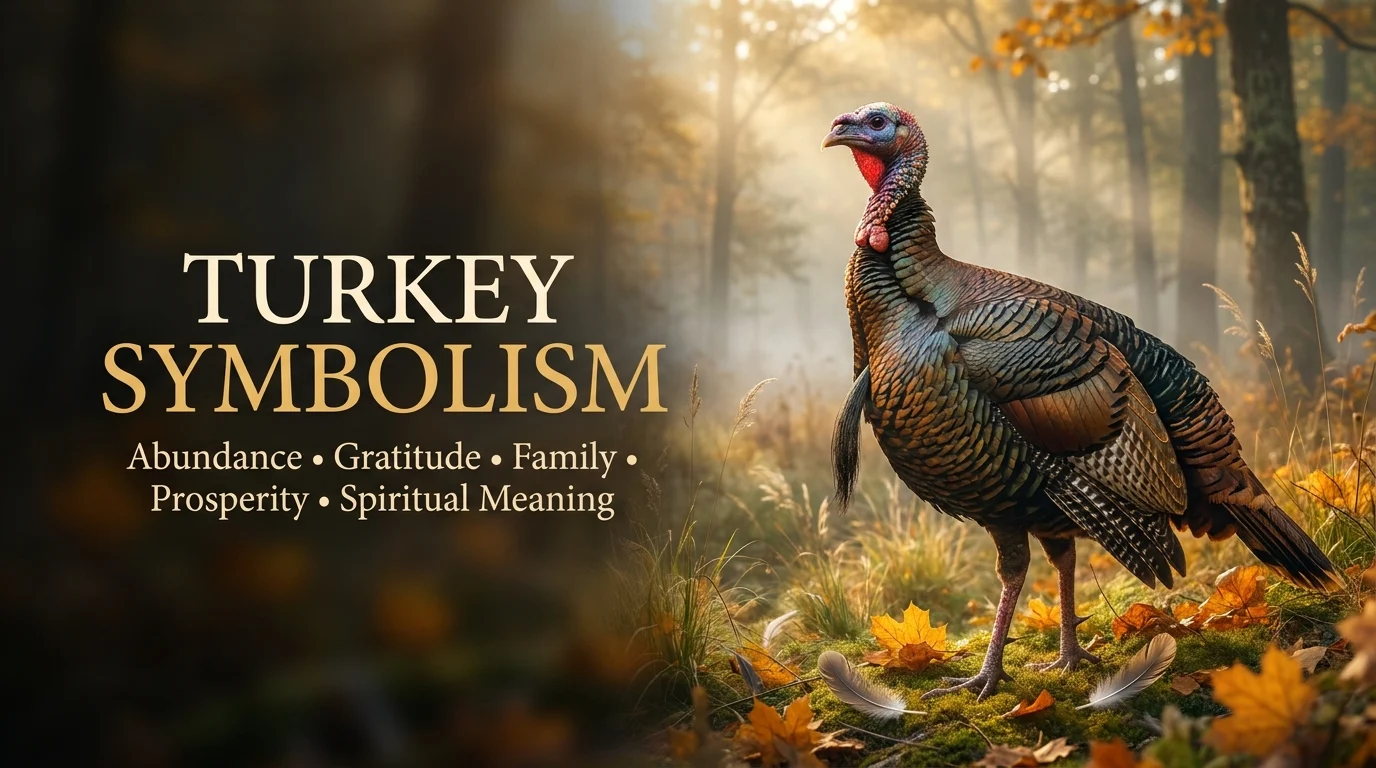
Turkey symbolism is often associated with abundance, gratitude, generosity, family, community, and connection to the natural world. This familiar bird carries meaningful associations in different cultures, especially where it represents sharing, nourishment, and the blessings of life.
Seeing a turkey in nature, dreaming about one, or feeling drawn to its presence can inspire reflection on your relationships, personal growth, and appreciation for what you already have. Although symbolic meanings vary across traditions, the turkey often reminds us that true abundance includes more than material wealth.
Turkey Symbolism Meaning (Clear Definition)
The meaning of turkey symbolism centers on gratitude, prosperity, togetherness, generosity, and grounded living. It encourages people to recognize their blessings, support their communities, and appreciate the resources available to them.
Turkeys are social birds that spend time in groups, search for food, and adapt to their surroundings. These natural behaviors help explain why people associate them with cooperation, nourishment, and connection.
Here are the most common symbolic meanings of a turkey:
- Abundance: Having enough resources and recognizing life’s blessings.
- Gratitude: Appreciating what you have rather than focusing only on what is missing.
- Family and community: Building meaningful relationships and supporting others.
- Generosity: Sharing food, time, knowledge, and opportunities.
- Groundedness: Staying connected to nature and practical responsibilities.
- Adaptability: Responding to changing circumstances with awareness.
- Celebration: Gathering with loved ones and honoring important moments.
The turkey’s message is not simply about receiving more. It is also about appreciating what you have and using your blessings in thoughtful ways.
What Does Turkey Symbolism Represent?
Turkey symbolism represents several important themes that connect everyday life with deeper personal values.
1. Abundance and Prosperity
Turkeys are strongly associated with abundance because of their connection to food, harvest celebrations, and plentiful gatherings.
Symbolically, a turkey may encourage you to recognize opportunities that are already available to you. Abundance does not always mean having more money or possessions. It can also mean enjoying good relationships, meaningful work, good health, and a sense of belonging.
2. Gratitude and Appreciation
One of the most familiar meanings of the turkey is gratitude.
In many households, turkey is associated with Thanksgiving, a celebration centered on appreciation, sharing, and togetherness. This cultural connection makes the bird a reminder to pause and acknowledge the people and experiences that enrich your life.
Turkey symbolism encourages you to practice gratitude even when life feels uncertain.
3. Family and Community
Turkeys are social animals that often travel and forage in groups. Their behavior makes them natural symbols of community, cooperation, and belonging.
Seeing a turkey may inspire you to reconnect with family members, spend more time with friends, or strengthen the relationships that make you feel supported.
It can also remind you that independence is valuable, but accepting help and offering support are equally important.
4. Generosity and Sharing
The turkey’s association with shared meals gives it a powerful connection to generosity.
Its symbolism encourages you to share what you can, whether that means offering practical help, listening to someone who needs support, or celebrating another person’s success.
Generosity does not require great wealth. Sometimes, a little kindness can make a meaningful difference.
5. Groundedness and Connection to Nature
Although turkeys can fly short distances, they spend much of their time on the ground searching for food and moving through their environment.
This behavior supports associations with practicality, stability, and a connection to the earth.
Turkey symbolism can remind you to stay grounded when pursuing ambitious goals. Big dreams are valuable, but steady effort and realistic decisions help turn them into reality.
6. Confidence and Self-Expression
A turkey’s distinctive appearance, colorful head, and elaborate courtship displays make it an interesting symbol of visibility and self-expression.
In a personal or reflective interpretation, the turkey may represent the courage to express your individuality without constantly comparing yourself with others.
It can encourage you to recognize your strengths and feel comfortable being yourself.
7. Adaptability and Resourcefulness
Wild turkeys forage for different kinds of food and adjust their behavior to changing environments.
Symbolically, they can represent resourcefulness and the ability to work with what is available.
This meaning is especially relevant when you are facing a transition, learning a new skill, or finding a practical solution to a difficult problem.
Spiritual Meaning of Turkey Symbolism
The spiritual meaning of turkey symbolism often centers on gratitude, generosity, balance, and respect for the interconnectedness of life.
Although spiritual interpretations differ among individuals and traditions, the turkey can serve as a meaningful reminder to live with greater awareness and appreciation.
Turkey as a Symbol of Spiritual Abundance
Spiritual abundance involves recognizing that life’s richness cannot be measured by possessions alone.
A turkey may symbolize the importance of appreciating your relationships, personal experiences, inner strengths, and opportunities for growth.
Its message is simple: notice the blessings that are already present in your life.
Turkey as a Reminder to Practice Gratitude
When a turkey repeatedly catches your attention, you might use the experience as an opportunity to reflect on gratitude.
Consider what is going well, who has supported you, and which everyday comforts you sometimes overlook.
This interpretation does not mean the bird is necessarily delivering a supernatural message. Rather, its appearance can become a personal reminder to approach life with appreciation.
Turkey and the Energy of Generosity
Turkey symbolism also connects to giving and receiving.
Healthy generosity involves sharing your resources while respecting your own needs. You can help others without neglecting yourself, and you can accept assistance without feeling that you have failed.
The turkey can represent this balance between personal well-being and responsibility toward others.
Turkey as a Symbol of Grounded Spirituality
Spiritual growth does not always require dramatic experiences or extraordinary events.
Sometimes, it begins with ordinary actions: caring for your family, protecting nature, preparing a meal, or helping someone through a difficult day.
The turkey’s grounded symbolism encourages you to bring your values into everyday life.
What Does It Mean Spiritually to See a Turkey?
Seeing a turkey may inspire you to reflect on three questions:
- What blessings in my life deserve more appreciation?
- How can I strengthen my relationships and community?
- Am I sharing my resources and abilities in a healthy, balanced way?
Your personal circumstances and cultural background can shape the meaning you attach to the encounter.
Biblical / Religious Meaning of Turkey Symbolism
The Bible does not specifically assign a symbolic meaning to the turkey. Turkeys are native to the Americas, and the biblical texts do not establish a turkey-specific spiritual interpretation.
However, several biblical themes can help readers reflect on meanings commonly associated with the bird.
Gratitude and Thanksgiving
Gratitude is an important biblical theme. For example, 1 Thessalonians 5:18 encourages believers to give thanks in all circumstances.
Because turkeys are associated with Thanksgiving in modern culture, they can serve as a personal reminder to appreciate God’s blessings, relationships, and daily provisions.
This is a cultural association rather than a specific biblical teaching about turkeys.
Provision and Abundance
The Bible frequently discusses food, provision, hospitality, and caring for others.
In this broader context, turkey symbolism may remind Christian readers to appreciate their daily provisions and share with people experiencing hardship.
The emphasis is on gratitude and generosity rather than a special meaning assigned to the animal itself.
Community and Fellowship
Shared meals play an important role in many religious traditions.
A turkey served at a family gathering may symbolize fellowship, hospitality, and the value of spending time with loved ones.
For some Christians, this association can encourage a deeper appreciation of community and mutual care.
Turkey Symbolism in Other Religious Traditions
There is no single universal religious interpretation of the turkey. Its meaning depends on the culture, community, and individual assigning significance to it.
When exploring Indigenous traditions or other spiritual practices, it is important to recognize that beliefs differ between peoples and should not be reduced to one general interpretation.
Turkey Symbolism in History and Culture
The turkey has a fascinating cultural history that helps explain its modern symbolic meanings.
Turkey and Thanksgiving
In the United States, the turkey has become one of the most recognizable symbols of Thanksgiving.
The bird is associated with family meals, gratitude, seasonal harvests, and sharing food with loved ones. Its cultural importance developed over time, and the modern Thanksgiving turkey should not be mistaken for proof that a turkey-centered feast occurred at the 1621 gathering in precisely the form celebrated today.
Today, the bird remains an enduring image of holiday traditions and family gatherings.
Turkey in Indigenous American Cultures
Turkeys are native to the Americas and have long held practical and cultural importance for Indigenous peoples.
Historically, different Indigenous communities have used turkeys for food, feathers, and other purposes. Their significance varies by nation and tradition, so there is no single symbolic meaning shared by all Indigenous cultures.
The bird’s place in these histories highlights its connection to the land, food systems, and relationships between people and their environments.
Turkey in European History
Turkeys were introduced to Europe from the Americas after European contact began in the late fifteenth and sixteenth centuries.
Over time, they became part of European farming and festive meals. Their size and suitability for serving groups helped strengthen their association with feasting and special occasions.
This history contributed to the turkey’s modern image as a bird of celebration and plentiful food.
Turkey as a Symbol of Harvest and Nourishment
Because turkeys are often connected with autumn meals and harvest celebrations, they can symbolize the results of patience, labor, and seasonal abundance.
This interpretation encourages people to recognize the effort behind what they enjoy.
A plentiful meal, for example, represents not only food but also the work of farmers, cooks, and everyone involved in bringing it to the table.
Turkey Symbolism in Literature and Art
In literature and art, turkeys can represent more than food or holiday traditions. Their appearance, behavior, and cultural associations allow artists to explore several themes.
Abundance and Celebration
A turkey shown on a table or surrounded by seasonal foods can represent prosperity, hospitality, and shared celebration.
In illustrations of family gatherings, the bird may help communicate warmth, tradition, and belonging.
Humor and Human Behavior
Turkeys are sometimes portrayed humorously because of their distinctive appearance, movements, and vocalizations.
In cartoons and children’s stories, they can represent awkwardness, stubbornness, or comic confusion. These interpretations are creative associations rather than universal symbolic meanings.
Nature and Rural Life
In nature writing and wildlife art, wild turkeys may symbolize the richness of forests, fields, and other habitats.
Their presence can draw attention to biodiversity, ecological relationships, and the importance of protecting natural environments.
Identity and Individuality
An artist may use the turkey’s colorful features and distinctive silhouette to explore individuality and self-expression.
In this context, the bird can suggest that something unusual or overlooked may possess its own beauty and value.
The meaning ultimately depends on how the turkey is portrayed and the message the artist intends to communicate.
Dream Meaning of Turkey Symbolism
Dreams involving turkeys can be interpreted in different ways depending on your emotions, experiences, and the details of the dream.
There is no scientifically established universal meaning for dreaming about a turkey. However, the bird’s cultural associations can provide useful starting points for personal reflection.
Dreaming of a Turkey
Seeing a turkey in a dream may bring to mind abundance, family, gratitude, or upcoming social gatherings.
Consider whether you have recently been thinking about your relationships, financial circumstances, or the things you appreciate most.
Dreaming of a Flock of Turkeys
A flock of turkeys may remind you of community, belonging, or the responsibilities involved in maintaining relationships.
If the flock feels peaceful, you might associate it with connection and security. If it feels overwhelming, the dream may reflect your feelings about social expectations or group responsibilities.
These interpretations are possibilities, not predictions.
Dreaming of a Turkey in Your Home
A turkey inside your home may bring up themes of family, hospitality, nourishment, or personal comfort.
Think about the atmosphere of the dream and your current home life. Your own associations are often more useful than a fixed dream dictionary definition.
Dreaming of a Wild Turkey
A wild turkey may symbolize independence, resourcefulness, or a renewed interest in nature.
The dream could also reflect a desire for more freedom or a reminder to pay attention to your surroundings.
Dreaming of a White Turkey
A white turkey may evoke peace, simplicity, or a fresh beginning because white is often associated with these ideas.
However, this interpretation depends on your personal and cultural associations. A white turkey does not automatically predict a spiritual event or future outcome.
Dreaming of a Dead Turkey
A dead turkey may bring up feelings about loss, disappointment, or a change in circumstances.
Rather than assuming that it predicts something negative, consider whether a relationship, routine, or personal goal has recently changed.
Your emotions during and after the dream can provide important context.
Modern Meaning of Turkey Symbolism
Today, turkey symbolism extends beyond traditional harvest celebrations and family meals. It can also reflect modern values such as sustainability, community support, personal well-being, and appreciation for everyday life.
Turkey as a Symbol of Family Traditions
For many people, preparing or sharing a turkey is an opportunity to reconnect with relatives and friends.
The bird represents the importance of creating memories, preserving meaningful traditions, and making space for people who matter.
Family traditions do not need to be elaborate. Even a simple meal shared with care can strengthen relationships.
Turkey as a Symbol of Sustainability
Wild turkeys are part of natural ecosystems, where they interact with plants, insects, and other animals.
Their presence can inspire reflection on wildlife conservation, habitat protection, and responsible relationships with nature.
In this sense, turkey symbolism can encourage greater awareness of the environment that supports human and animal life.
Turkey as a Reminder to Slow Down
Modern life often encourages people to focus on productivity, achievement, and future goals.
The turkey’s association with gratitude and shared meals offers a different perspective: take time to appreciate the present.
You might express this meaning by eating with family without distractions, spending time outdoors, or acknowledging small achievements.
Turkey as a Symbol of Generosity
In contemporary life, generosity can take many forms, including volunteering, sharing knowledge, helping neighbors, or supporting people who need assistance.
Turkey symbolism reminds us that abundance becomes more meaningful when it contributes to the well-being of others.
Turkey as a Symbol of Authenticity
The turkey’s distinctive appearance can also inspire a modern interpretation centered on individuality.
You do not need to imitate everyone around you to be valuable. Embracing your natural strengths and expressing yourself honestly can be a meaningful form of personal growth.
Turkey Symbolism: Quick Reference Table
The following table summarizes common cultural and personal interpretations of turkey symbolism.
| Symbolic theme | Meaning |
|---|---|
| Abundance | Recognizing resources, opportunities, and blessings |
| Gratitude | Appreciating what you have |
| Family | Strengthening relationships and traditions |
| Community | Cooperation, belonging, and mutual support |
| Generosity | Sharing resources and kindness |
| Groundedness | Staying practical and connected to nature |
| Adaptability | Responding thoughtfully to change |
| Celebration | Honoring important moments together |
| Authenticity | Appreciating your individuality |
| Nourishment | Caring for physical and emotional well-being |
These meanings are interpretive rather than universal rules. The most relevant meaning depends on the context in which the turkey appears and the associations you bring to it.
Frequently Asked Questions About Turkey Symbolism
1. What does a turkey symbolize spiritually?
A turkey can symbolize gratitude, abundance, generosity, community, and connection to nature. Spiritually, it may encourage you to appreciate your blessings and share what you can with others.
2. Is seeing a turkey a sign of good luck?
Some people interpret seeing a turkey as a positive symbol of abundance, prosperity, or good fortune. However, there is no universal belief that encountering a turkey guarantees a particular outcome.
3. What does a turkey symbolize in dreams?
A turkey in a dream may bring up themes of family, gratitude, nourishment, or belonging. Its possible meaning depends on the dream’s details, your emotions, and your personal experiences.
4. What does a turkey symbolize in Native American cultures?
Turkeys have practical and cultural significance in various Indigenous American communities, but their meanings differ across nations and traditions. It is more accurate to explore a specific community’s teachings than to assign one universal spiritual meaning to the bird.
5. What does a turkey symbolize in Christianity?
The turkey has no specific, established symbolic meaning in the Bible. However, its association with Thanksgiving and shared meals may remind Christians of biblical themes such as gratitude, provision, hospitality, and fellowship.
Conclusion: The Deeper Meaning of Turkey Symbolism
Turkey symbolism offers a meaningful reminder to appreciate abundance, nurture relationships, practice generosity, and remain connected to the natural world. Whether you associate the bird with family gatherings, spiritual reflection, dreams, or personal growth, its symbolism points toward a life shaped by gratitude and connection.
Ultimately, the turkey’s most valuable message may be that true abundance is not only about what you possess, but also about what you appreciate and share with others.

I am Simon Michael, an author passionate about exploring symbols, their meanings, and cultural significance. I enjoy making symbolism simple, engaging, and meaningful for curious readers everywhere.


