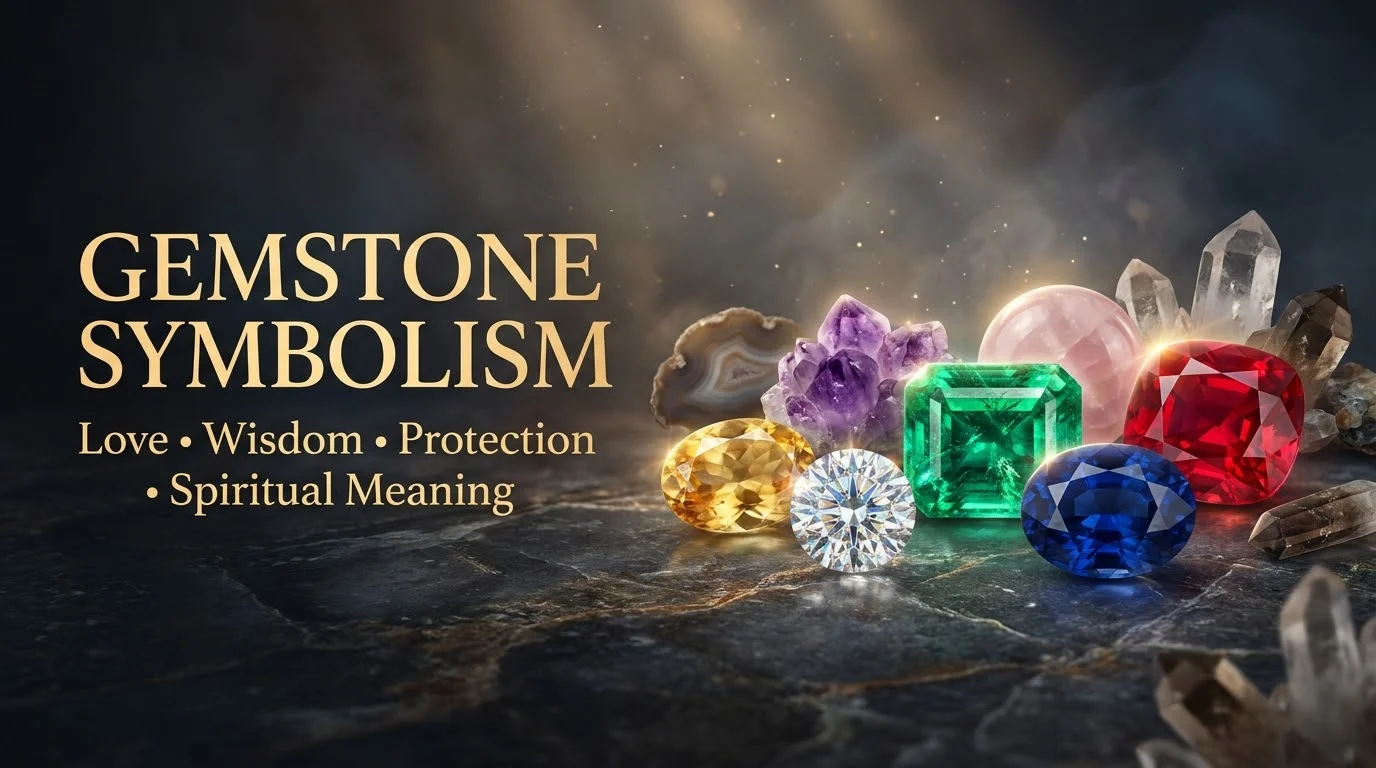
Gemstone symbolism explores the deeper meanings people associate with precious and semiprecious stones, including love, wisdom, protection, strength, prosperity, and spiritual growth. Across centuries, gemstones have inspired myths, religious traditions, royal treasures, and personal jewelry.
From the passionate red ruby to the peaceful blue sapphire, different gemstones have developed unique symbolic associations shaped by their colors, rarity, cultural histories, and traditional beliefs.
if you wear a crystal, collect precious stones, or simply want to understand their hidden meanings, exploring gemstone symbolism can reveal how these beautiful natural treasures connect with human emotions, beliefs, and aspirations.
Gemstone Symbolism Meaning (Clear Definition)
Gemstone symbolism refers to the meanings, values, and spiritual associations that people attach to natural stones. These meanings often reflect a gemstone’s color, appearance, rarity, cultural history, and traditional uses.
For example, emeralds are commonly associated with renewal and prosperity, while diamonds symbolize enduring love, strength, and commitment.
Gemstones can serve as meaningful reminders of personal values, important milestones, and hopes for the future. Although their symbolic meanings vary across cultures, they frequently represent qualities that people admire or wish to cultivate.
In simple terms, gemstone symbolism is the interpretation of precious and semiprecious stones as symbols of emotions, spiritual beliefs, personal qualities, and life’s important experiences.
What Does Gemstone Symbolism Represent?
Gemstones can represent many different ideas, depending on their type, color, cultural background, and personal significance.
Here are some of the most common symbolic meanings associated with gemstones.
- Love and commitment: Diamonds, rubies, and rose-colored stones often represent affection, romance, and lasting relationships.
- Wisdom and knowledge: Sapphires and other blue gemstones are traditionally associated with insight, truth, and thoughtful decisions.
- Protection and courage: Some cultures have regarded gemstones such as turquoise and onyx as protective symbols.
- Wealth and prosperity: Emeralds, jade, and gold-colored stones are frequently connected with abundance, success, and good fortune.
- Peace and emotional balance: Amethyst and aquamarine are commonly associated with calmness, clarity, and tranquility.
- Transformation and renewal: Opal, moonstone, and emerald can symbolize change, fresh beginnings, and personal growth.
- Strength and resilience: Diamonds and garnets often represent endurance, determination, and inner strength.
The following table summarizes popular gemstones and their traditional symbolic associations.
| Gemstone | Common symbolic meaning |
|---|---|
| Diamond | Eternal love, strength, purity |
| Ruby | Passion, courage, vitality |
| Sapphire | Wisdom, loyalty, truth |
| Emerald | Renewal, hope, prosperity |
| Amethyst | Peace, reflection, spiritual awareness |
| Turquoise | Protection, friendship, good fortune |
| Jade | Harmony, longevity, abundance |
| Aquamarine | Serenity, courage, clear communication |
| Opal | Creativity, imagination, transformation |
| Garnet | Commitment, devotion, resilience |
| Moonstone | Intuition, new beginnings, femininity |
| Onyx | Discipline, stability, inner strength |
These interpretations are traditional and cultural associations rather than universal definitions. A gemstone’s meaning may differ depending on the person, community, or tradition.
Spiritual Meaning of Gemstone Symbolism
In spiritual traditions, gemstones are often viewed as reminders of inner wisdom, personal transformation, balance, and connection with something greater than oneself.
Some people use gemstones during meditation, prayer, reflection, or personal rituals. Others wear them as jewelry to represent a particular intention or value.
Gemstones and Spiritual Growth
Different stones are associated with different aspects of spiritual development.
Amethyst is often connected with contemplation, mindfulness, and spiritual awareness. Its purple color has long been associated with mystery, royalty, and higher understanding.
Clear quartz is traditionally associated with clarity, intention, and purification. Some crystal traditions consider it a symbol of focus and renewed perspective.
Moonstone is frequently linked with intuition, cycles, and new beginnings. Its shifting appearance makes it a fitting symbol of change and the rhythms of life.
Lapis lazuli has historical associations with wisdom, truth, and sacred knowledge. Its deep blue color and golden flecks have made it especially significant in art and spiritual objects.
Gemstones and the Chakras
In some Hindu-influenced spiritual practices and modern crystal traditions, specific gemstones are associated with the body’s chakras, which are understood as centers of spiritual or subtle energy.
For example:
- Red stones, such as garnet, are sometimes associated with the root chakra and feelings of stability.
- Green stones, such as emerald, are often linked with the heart chakra and compassion.
- Blue stones, such as sapphire, may be associated with communication and self-expression.
- Purple stones, such as amethyst, are commonly connected with spiritual reflection.
These associations vary between traditions. There is no strong scientific evidence that gemstones balance chakras or produce special healing energies, but people may find personal meaning in using them as tools for reflection.
Gemstones as Symbols of Personal Intention
A gemstone can represent an intention someone wants to carry into daily life.
A person might wear a ruby as a reminder to act courageously, choose an emerald to represent a new chapter, or keep an amethyst nearby as a reminder to slow down and reflect.
The stone becomes meaningful through the intention attached to it rather than any guaranteed supernatural effect.
Biblical / Religious Meaning of Gemstone Symbolism
Gemstones hold important symbolic roles in several religious traditions, including Judaism, Christianity, Hinduism, and Buddhism. Their meanings depend on the relevant scriptures, historical context, and cultural interpretation.
Gemstones in the Bible
In the Bible, gemstones appear in descriptions of sacred objects, priestly garments, heavenly visions, and symbolic structures.
In Exodus 28, precious stones are set into the high priest’s breastpiece. The stones are associated with the twelve teams of Israel, representing the community before God.
In Revelation 21, the foundations of the New Jerusalem are described using precious stones. These images contribute to the passage’s portrayal of heavenly beauty, glory, and divine perfection.
Biblical gemstone symbolism can therefore relate to sacredness, beauty, spiritual significance, and the relationship between God and His people.
The identification of some ancient gemstone names remains uncertain because mineral terminology has changed over time and translations differ.
Gemstones in Hindu Traditions
Gemstones have a longstanding place in Hindu astrology and religious culture. The concept of navaratna, meaning nine gems, associates nine particular stones with nine celestial bodies.
Depending on the tradition, these stones may be worn in jewelry or used in rituals. Some practitioners believe that specific gems support favorable influences, although such effects are not scientifically established.
Gemstones in Buddhist Traditions
Precious jewels appear in Buddhist teachings, stories, and artistic traditions as symbols of wisdom, spiritual value, and enlightenment.
The Three Jewels of Buddhism refer to the Buddha, the Dharma (his teachings), and the Sangha (the community of practitioners). They are not simply three physical gemstones; the jewel metaphor expresses their spiritual importance.
Across religions, gemstones can communicate ideas that are difficult to express through ordinary language, making them enduring symbols of faith, sacred beauty, and spiritual aspiration.
Gemstone Symbolism in History and Culture
Throughout history, gemstones have been valued not only for their beauty but also for their perceived powers, social significance, and symbolic meaning.
Ancient civilizations incorporated stones into jewelry, ceremonial objects, seals, amulets, and royal ornaments.
Ancient Egypt
Ancient Egyptians used gemstones and decorative minerals in jewelry, burial objects, and religious imagery.
Lapis lazuli was especially prized for its intense blue color and associations with royalty and the sacred. Turquoise and carnelian also appeared in ornaments and objects connected with protection, vitality, and status.
These materials reflected the Egyptian appreciation for beauty, divine order, and the afterlife.
Ancient Greece and Rome
In ancient Greek and Roman cultures, gemstones appeared in signet rings, engraved seals, personal ornaments, and amulets.
Some people believed particular stones could protect the wearer or bring good fortune. Gemstones were also associated with social rank, personal identity, and political power.
Engraved gems could display mythological figures, gods, animals, and scenes representing the owner’s interests or beliefs.
Medieval Europe
During the Middle Ages, gemstones appeared in religious objects, royal crowns, ecclesiastical jewelry, and illuminated manuscripts.
Some medieval texts assigned particular virtues or protective properties to different stones. These beliefs reflected the medical, religious, and natural-philosophical ideas of the period.
Sapphires could be associated with heavenly qualities, while rubies were linked with vitality and power in various traditions.
Gemstones in Different Cultures
Gemstone symbolism is not identical worldwide.
In Chinese culture, jade has long been associated with virtue, refinement, harmony, and status. In South Asian traditions, gemstones may be connected with astrology and planetary influences. In Western cultures, diamonds have become especially prominent as symbols of engagement, marriage, and enduring commitment.
These differences demonstrate that gemstones acquire meaning through human history. Their physical beauty provides the foundation, but culture and tradition shape the stories people tell about them.
Gemstone Symbolism in Literature and Art
Gemstones have inspired writers, poets, painters, and craftspeople for centuries. Their colors, brilliance, rarity, and durability make them powerful symbols in creative expression.
Gemstones as Symbols of Wealth and Power
In literature, precious stones often represent wealth, social status, ambition, and authority.
A jeweled crown may symbolize royal power, while a valuable gem can become the object of desire that drives a character’s choices. Stories involving treasured stones sometimes explore greed, temptation, sacrifice, or the moral cost of possessing wealth.
Gemstones as Symbols of Love
Diamonds, rubies, and other precious stones frequently appear in romantic stories and poetry.
A gemstone given as a gift may represent devotion, a promise, or a relationship that someone hopes will endure. Its permanence can contrast with the changing emotions and uncertainties of human life.
Gemstones as Symbols of Mystery
In fantasy literature and mythology, gemstones can possess magical significance within the fictional world.
A glowing crystal might contain ancient knowledge, while a rare jewel could represent a hidden truth or a character’s destiny. These associations make gemstones useful storytelling devices because they combine physical beauty with the suggestion of something extraordinary.
Gemstones in Visual Art
Artists use gemstones and jewel-like colors to create contrast, communicate status, and direct the viewer’s attention.
Deep blue sapphires, vivid green emeralds, and bright red rubies can suggest different moods and associations. Jewelry in portraits may reveal a subject’s wealth, rank, relationships, or cultural identity.
In this way, gemstone symbolism connects material beauty with the deeper themes of human creativity.
Dream Meaning of Gemstone Symbolism
Dreams involving gemstones can be interpreted in different ways, depending on the dreamer’s emotions, personal experiences, and the details of the dream.
There is no single interpretation that applies to everyone. However, gemstones may serve as personal symbols of confidence, affection, ambition, self-worth, or a desire for change.
Common interpretations include:
- Finding a gemstone: May represent discovering a talent, recognizing your value, or noticing a new opportunity.
- Receiving a gemstone as a gift: Could reflect feelings of love, appreciation, trust, or a desire for a closer relationship.
- Losing a precious stone: May relate to concerns about security, self-confidence, or something you value.
- Wearing gemstone jewelry: Could symbolize identity, confidence, personal achievement, or a wish to express yourself.
- Seeing a broken gemstone: Might reflect disappointment, changing priorities, or concerns about a relationship or goal.
- Collecting many gemstones: May represent ambition, curiosity, personal growth, or the desire to preserve meaningful experiences.
The color of the gemstone may also influence your personal interpretation. A red stone might remind you of passion, while a blue stone could bring to mind calmness or communication.
Rather than treating a dream as a prediction, consider how the gemstone made you feel and what it reminds you of in your waking life.
Modern Meaning of Gemstone Symbolism
Today, gemstone symbolism remains popular in jewelry, fashion, gift-giving, personal rituals, and self-expression.
People choose stones not only for their appearance but also for the meanings they associate with them. A piece of gemstone jewelry may commemorate a relationship, celebrate a personal milestone, or express a value that matters to its wearer.
Birthstones and Personal Identity
Birthstones are among the most recognizable examples of modern gemstone symbolism.
Each month is traditionally associated with one or more gemstones. For instance, garnet is commonly linked with January, emerald with May, and sapphire with September.
Birthstone jewelry often represents identity, family connections, birthdays, and treasured memories.
Gemstones as Gifts
Gemstones can communicate feelings that are difficult to express through words.
- Diamonds often represent commitment and lasting love.
- Rubies can express passion and admiration.
- Emeralds may symbolize hope and renewal.
- Amethyst can serve as a thoughtful gift associated with peace and reflection.
- Turquoise may represent friendship, protection, or appreciation.
The meaning of a gift ultimately depends on the giver, the recipient, and the significance they attach to it.
Gemstones and Mindful Living
Some people incorporate gemstones into meditation spaces, journals, or daily routines as reminders of their goals.
For example, a person working toward greater confidence might keep a red gemstone on a desk as a personal symbol of courage. Someone beginning a new chapter might choose green aventurine as a reminder of growth and opportunity.
These practices can encourage reflection and intentional living. However, gemstones should not be considered substitutes for medical treatment, and claims that they directly heal illnesses or guarantee success are not supported by reliable scientific evidence.
Choosing a Gemstone by Meaning
When selecting a gemstone, consider three things: its traditional symbolism, your personal connection to it, and its practical qualities.
If you want a symbol of lasting commitment, a diamond may feel appropriate. If you value renewal, you might prefer an emerald. If you are drawn to calmness and reflection, amethyst or aquamarine may resonate with you.
There is no single correct choice. The most meaningful gemstone is often the one that reminds you of something important in your own life.
Frequently Asked Questions About Gemstone Symbolism
1. What is the most powerful gemstone symbolically?
There is no universally most powerful gemstone because meanings vary across cultures and spiritual traditions. Diamonds are widely associated with strength and enduring love, while rubies symbolize passion and sapphires are connected with wisdom.
2. Which gemstone symbolizes love and relationships?
Diamonds commonly symbolize lasting commitment, rubies represent passion, and rose-colored gemstones are often associated with affection and tenderness. The best choice depends on the message you want the gemstone to convey.
3. Which gemstones symbolize protection?
Turquoise, black onyx, and certain other stones have traditionally been used as protective symbols in different cultures. These associations are rooted in cultural and spiritual beliefs rather than established evidence of supernatural protection.
4. What does it mean spiritually to receive a gemstone?
Receiving a gemstone may symbolize love, appreciation, wisdom, encouragement, or a meaningful new beginning. Its personal significance often depends on the stone, the giver, and the circumstances surrounding the gift.
5. Do gemstones have healing powers?
Some spiritual traditions attribute healing properties to gemstones, but scientific evidence does not establish that crystals or precious stones can cure illnesses or reliably change a person’s energy. They may still have personal, cultural, or meditative value.
Conclusion
Gemstone symbolism reveals how natural stones can represent love, wisdom, courage, protection, prosperity, and transformation. From ancient religious traditions to modern jewelry, gemstones continue to connect physical beauty with deeply held human values. if chosen for a special occasion or personal reflection, a gemstone can serve as a lasting reminder of what matters most.

I am Simon Michael, an author passionate about exploring symbols, their meanings, and cultural significance. I enjoy making symbolism simple, engaging, and meaningful for curious readers everywhere.


